Amikoo AI MCP:
Maintenance & Control agents for your Playwright test automation
You have Playwright setup. You might even have Claude or Gemini to help automate a few dozen tests.
But you're still playing catchup. Automated tests are breaking, code coverage is a mystery, and your Claude-enhanced developers are only getting faster.
Introducing Amikoo AI. Not another no-code/low-code tool, and certainly not another “bring everything to us” test automation platform. The Amikoo AI Maintenance Agent and Control Hub work directly with your dev stack to solve the two biggest remaining challenges in testing:
- Ongoing maintenance & repair of complex tests (Beta available now)
- Ongoing monitoring and analysis of test coverage (Coming soon!)Fix broken Playwright tests 5x faster with Amikoo AI
Amikoo helps QA and engineering teams repair failing tests, monitor coverage, and keep automation reliable without rebuilding their stack.
We are excited to announce the beta release of our Amikoo MCP and Test Repair Agent, available via a free download to a limited number of early signups! Based on 6 years of MuukTest's learnings across hundreds of thousands of automated tests, this agent is designed specifically to keep up with AI-accelerated coding teams - giving QA a fighting chance.
Does it perform? In benchmark testing against Playwright’s MCP and native Healer Agent, Amikoo AI outperforms this tool with a 2x better success rate and 5x faster run time, saving days worth of work over the course of a month.
How does it work? When a test fails, Amikoo: Captures DOM state and screenshots, analyzes the failure context inside VS Code, proposes and applies targeted fixes, and re-runs the test to verify the repair. Unlike generic LLM-based healing, Amikoo works with captured runtime context rather than relying solely on prompt reasoning. Repairs are deterministic, controlled, and executed one test at a time.
How do I use it? Amikoo works on top of existing Playwright test automation natively within your copilot, Cursor, Claude, Gemini, or VSCode environments. Simply sign-up below to download the Amikoo MCP and gain access to the the Amikoo Repair Agent.
5x faster, 2x more thorough than Playwright's native Healer Agent
Amikoo Repair Agent
Playwright Healer Agent
-
Avg. Time per Repair / 100 Repairs
5 min / ~8.3 hours 25 min / ~41.6 hours -
Automated Repair Success Rate
70% 34% -
Avg. Token Usage
↓ 28% Lower token usage Full-context token load -
Avg. Iterations per test
4 7
Amikoo’s maintenance agents operate on an optimized metadata layer refined through years of real-world automation work and the execution and repair of hundreds of thousands of tests. That historical intelligence allows Amikoo to reason about failures more deterministically. Resulting in lower token usage, structured repair flow, and more consistent outcomes at scale.
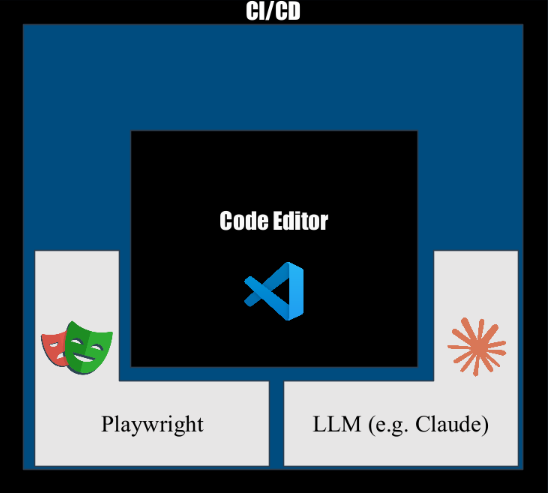
Playwright & LLMs are a strong start for test automation, but leave critical gaps unresolved
With Playwright
- Easily create new test cases
- Control browser to map out test steps
- Log test executions
With an LLM like Claude, you can
- Suggest new test cases to Playwright (with in-depth prompt engineering)
- Enable some NLP test case creation
Gaps & challenges remaining
Maintenance
- Flaky tests that reduce confidence in CI
- Wasted time with high test maintenance and frequent breakage
Visibility & Control
- Unsure what to test, why, and how much
- Poor visibility into what is tested, what is missing, and where risk exists
- Lag between bug reporting and fix
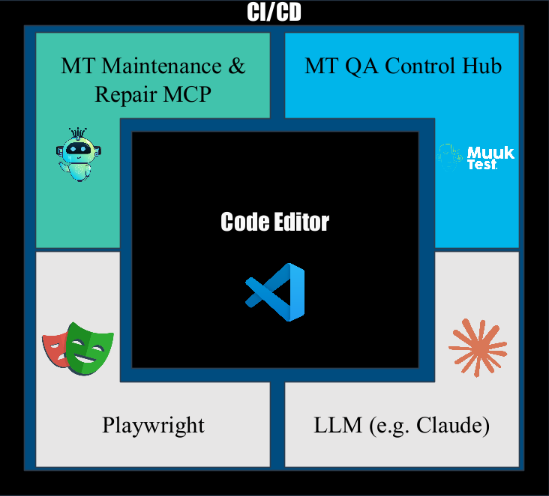
MuukTest’s Maintenance & Repair MCP and QA Control Hub complete existing stacks for lasting coverage
With Playwright
- Easily create new test cases
- Control browser to map out test steps
- Log test executions
With an LLM like Claude, you can
- Suggest new test cases to Playwright (with in-depth prompt engineering)
- Enable some NLP test case creation
With Amikoo
- Detect broken & outdated tests 24/7
- Suggests fixes, repairs, re-writes and new tests as product, usage changes
- Translates these needs to your LLMs without need for prompt engineering
- Define, score, monitor test coverage and highlight areas not covered
- Report bugs & potential fixes in real time
- Managed infrastructure for limitless parallel test runs at scale
How Amikoo Approaches Maintenance Differently
Amikoo MCP was designed to reduce the cognitive burden placed on LLMs during test repair. Instead of relying entirely on prompt engineering and tool selection inside a single model context, Amikoo separates orchestration from execution.
Playwright Healer Agent
Amikoo Repair Agent
Multiple prompts and tools available to the LLM
Single maintenance tool (call_repair_agent)
Tool selection and repair strategy determined dynamically by the LLM
Structured repair flow:
read → invoke → repair → re-run → validate
Full repair reasoning handled within the user’s LLM context
Repair execution handled by hosted maintenance agents
No dedicated maintenance agent layer
LLM responsibility minimized to orchestration

“MuukTest found things that we didn't know were even a problem in the product, which is huge for us. I'd rather MuukTest find something than a customer, even if it's minor”
Wendy Murry, COO


“In the proof of concept, MuukTest delivered exactly what they said they would deliver. This gave me a higher level of confidence in the test coverage and my software.”
Ernie Hudson, Director of Product & Technology


“MuukTest helps move the product along faster. Working on the regression projections ensures our product is more stable with the calculations. I think the value is just peace of mind”
Taylor Perkins, CTO and Co-founder.

Join the early access list!
When you sign up with your work email below, you will get a download link to the Maintenance and Repair MCP toolkit via our amikoo-playwright NPM package.
Our team will send you an access code (typically within 30 minutes, in the form of an NPM key) for free unlimited access to this toolkit.
This email will also include an invite to our Beta Program slack channel, where you can ask the MuukTest team questions and interact with other beta users.
Finally, you will also be enrolled in our early access program for the QA Control Hub, launching in beta early this spring.
Note: the promo code field is optional - registrants without one can still gain free access to the toolkit!