
A coverage percentage tells you very little about an app whose most valuable workflows run ten or more steps deep. The right qa Wolf alternative for that kind of app is a provider that can show, workflow by workflow, which steps are verified, how test data is prepared between steps, and who decides where the real risk sits.
TL;DR
- Measure depth, not count: A suite can look well covered and still never reach the last step of your longest workflow.
- Ask how flows are split: Seeded state lets each segment run on its own, so one early failure does not hide the rest.
- Know where self-healing stops: It fixes locator and timing drift. Changed business logic needs a human decision.
- Define "a test" before comparing prices: qa Wolf charges its platform per test run and quotes its managed service based on the tests you need, while MuukTest prices on tests under management.
About the Author: This guide was written by the MuukTest team. MuukTest is a managed qa service with many years of qa experience, and its Forward Deployed QAs focus on the hard, multi-step paths across web, mobile, and API flows that generic automation tends to skip.
Why Deep Multi-Step User Flows Break Standard Coverage Metrics
Why do deep multi-step user flows break standard coverage metrics? Deep flows break coverage metrics because those metrics count tests, and the risk in a long workflow resides in the steps inside each test. Picture a sign-up workflow that runs through email verification, plan selection, payment, and a teammate invite. It shows up as one line on a dashboard, yet it holds five places where real users get stuck.
A long test behaves like a relay race. If the second runner drops the baton, the race ends and nobody learns anything about the runners who come after. A failure in step two works the same way, because every later step goes unverified until the early break is fixed. One red result hides more than it reveals.
- Masked failures: An early break stops the run, so later steps produce no signal.
- State dependency: Late steps need users, carts, or approvals created earlier. Rebuilding that state through the UI on every run is slow.
- Branches and handoffs: Different user roles take different routes through the workflow. Email links, payment pages, and new tabs pull the workflow outside your app.
Any alternative on your shortlist should be judged against these pressures.
What to Evaluate in a qa Wolf Alternative for Complex Flows
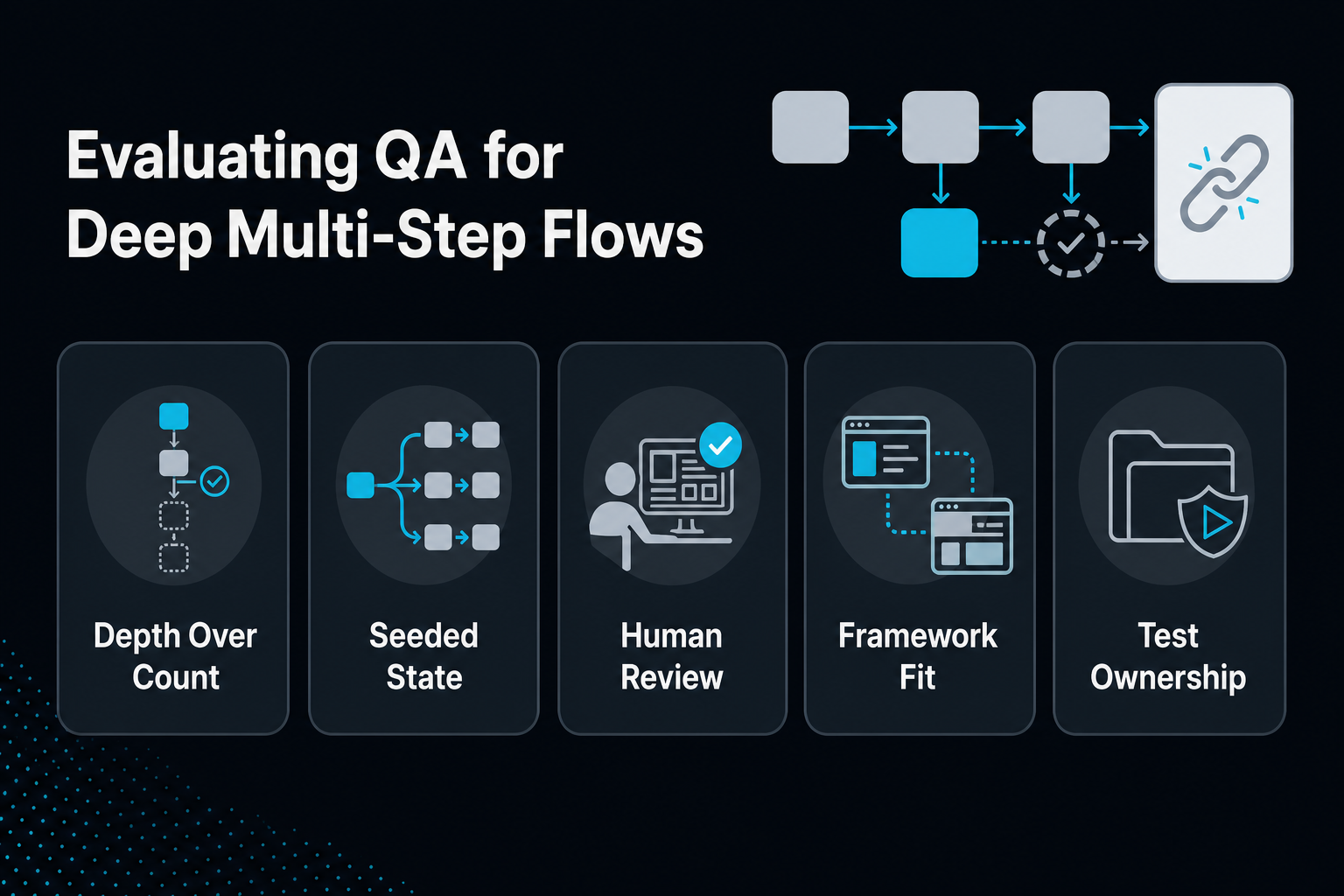
Given those pressures, what should you evaluate? The useful question is how a provider covers your single deepest workflow, not how much coverage it promises overall. Ask each candidate to walk through one real flow from your app and answer these questions:
- Who chooses the paths? Automation can map flows. Ranking which branches carry revenue or support risk is a judgment call.
- How is state seeded? Strong suites create test users and data through APIs or fixtures, so a segment can start partway through a workflow.
- How are mid-flow failures diagnosed? Look for video replays, logs, and a human check that separates real bugs from test issues.
- Does the framework fit the flow? Playwright runs out-of-process and handles multi-tab, multi-origin, and cross-iframe flows natively across Chromium, Firefox, and WebKit. Cypress runs inside the browser, which limits its native handling of multi-tab flows.
Good Playwright test coverage of deep flows depends more on these answers than on any headline percentage. Services like MuukTest give the path-selection question to Forward Deployed QAs, who decide what to cover, which workflows matter, and where the real risk is, and give test generation and repair to Amikoo, MuukLabs' AI tool that maintains standard Playwright TypeScript tests in your own repository, so human judgment stays focused on the decisions that need it.
How Managed qa Services and qa Outsourcing Companies Compare
Once you have criteria, how do providers compare? The next step is sorting them, because searches for qa as a service return several different models under one label. Managed qa services build, run, and maintain the suite for you.
| Provider | Model | Who does the work | Notable capabilities | Pricing basis |
|---|---|---|---|---|
| qa Wolf | Managed end-to-end testing service | AI agents plus human qa engineers | Web, mobile, and desktop; unlimited parallel runs on its own cloud; automated end-to-end coverage capabilities; zero-flake guarantee | Platform charged per test run; Coverage-as-a-Service quoted based on the tests you need |
| Rainforest qa | AI-enabled testing platform and service | Dedicated test managers, plus crowdsourced manual testers | No-code automation, visual testing, self-healing test architecture | Based on test-run volume |
| A1QA | qa consulting firm | Dedicated engineering teams inside your CI/CD | Vendor-neutral automation, microservices testing | Ask the vendor directly |
| MuukTest | Managed qa service | Forward Deployed QAs, with Amikoo generating, repairing, and maintaining tests | Web, mobile (iOS/Android), API, regression, and end-to-end testing; Playwright tests in your repository | Tests under management, scoped to your app |
No single row is right for every team. The best fit depends on how many of your critical workflows are deep, branching, or span more than one platform.
How Self-Healing Test Automation Holds Up on Long User Workflows
A separate question is what happens after launch, because every extra step in a workflow is another place where a UI change can break the test. How does self-healing hold up? Self-healing test automation keeps a test running when the page changes. Human review checks whether the test still verifies the right thing.
Self-healing works like spell-check. Spell-check can fix a misspelled word because the intended word is obvious, but it cannot tell you that a sentence now means something different. A moved button is a typo. A new approval step in the middle of checkout is a change in meaning, and only someone who knows the business can say whether the test or the product is wrong. This distinction affects trust: a suite that quietly heals around a real behavior change will keep passing while customers fail.
When you compare regression testing services, ask what triggers a repair and who approves it. In MuukTest's model, Amikoo handles flaky tests, brittle selectors, and timing issues, and a human qa expert reviews failures so that larger flow changes get a deliberate update.
Comparing qa Wolf Pricing Against Alternatives
Budget comparisons have their own trap for apps with long workflows. How should you compare pricing? qa Wolf charges its self-serve platform per test run and quotes its fully managed Coverage-as-a-Service based on the tests you need. MuukTest also prices on tests under management, so how each provider defines a single test shapes what you pay.
- Ask how a long workflow is counted: One workflow may become one test or several seeded segments.
- Check platform scope: If your deep flows cross web and mobile, confirm that mobile app testing services fall under the same agreement.
- Price the exit: Code you own in your repository lowers the cost of switching providers later.
Keep your deepest workflow in mind when you read qa Wolf reviews or any vendor's case studies. A provider that can show that workflow working end to end gives you better evidence than a headline number.
Frequently Asked Questions
What makes a good qa Wolf alternative for complex user flows?
A good alternative shows your deepest workflow covered step by step, with seeded state and human review of failures.
Is MuukTest an outsourcing company?
No. MuukTest is a managed qa service that owns the outcome of your test suite and extends lean engineering teams.
Does self-healing test automation remove maintenance?
It reduces routine fixes for selectors and timing. When business logic changes, a person still has to decide what the correct behavior is.
Should a long user workflow be one test or several?
Usually several seeded segments, plus one full run as a final check. This structure keeps an early failure from hiding later problems.
Can I keep my tests if I switch providers?
With MuukTest, yes. The tests are standard Playwright TypeScript in your repository. With other providers, ask directly about code ownership and export.
About MuukTest
MuukTest is a managed qa service that builds and maintains automated test suites for lean engineering teams. The company builds frameworks on industry-standard tools like Playwright, Selenium, and Appium, and clients fully own the resulting automation framework. This approach lets teams reach broad test coverage in weeks while avoiding the exit costs that come with proprietary testing platforms. MuukTest works as a managed qa partnership that extends lean engineering teams, covering web, mobile, API, regression, and end-to-end testing without requiring additional hires. Behind the service are expert Forward Deployed QAs, who decide what to cover, which workflows matter, and where the real risk is, working with Amikoo, MuukLabs' AI tool for test generation, repair, maintenance, and defect detection.
If your app's most important workflows run deep, a useful next step is to map them and see how each one would be covered. You can learn more or get in touch with the MuukTest team at https://muuktest.com/.