
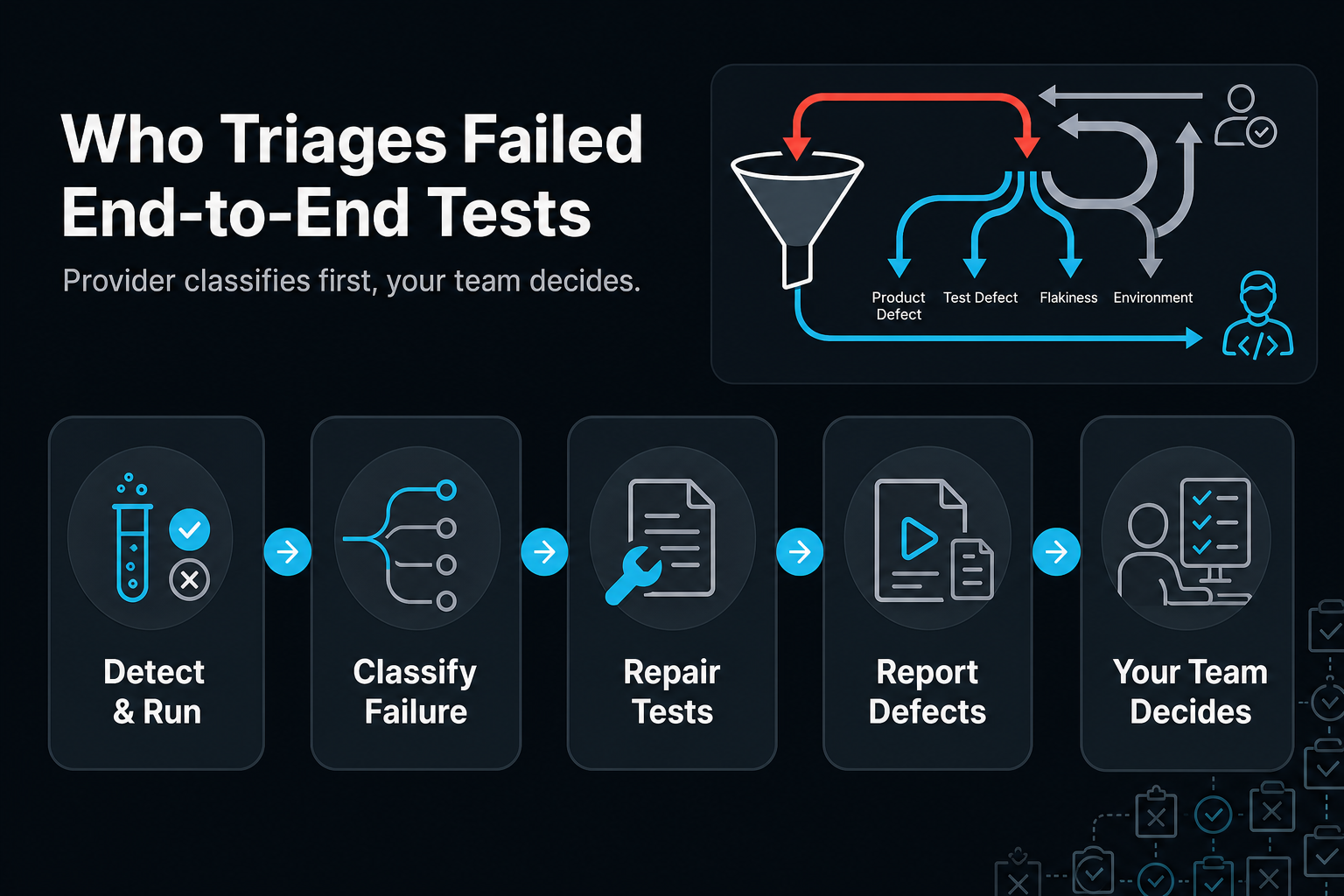
A failed end-to-end test is a question, not a bug report, and answering that question is where most of the cost of automation sits. In a well-run managed testing service, the provider's qa engineers triage every failure first. They classify it as a product defect, a broken test, flakiness, or an environment problem.
They repair anything on the test side and send only confirmed defects to your developers, with replay, logs, and reproduction steps attached. Your team keeps the decisions that need product context: whether a behavior change was intended, how urgent the bug is, and who fixes it.
TL;DR
- Triage is classification: It decides the cause and owner of a failure before anyone writes a fix. In managed qa services, the provider does the first pass.
- Four causes, one queue: Most red E2E tests trace to a product defect, a test defect, flakiness, or environment and data issues. Only product defects belong in your developers' backlog.
- Self-healing has limits: Self-healing absorbs small UI changes. A person still has to judge whether changed behavior is intended.
- Your meeting shrinks: The defect triage meeting stays, but it starts from evidence instead of diagnosis.
Triage is classification, not repair
What does it mean to triage a failed end-to-end test? Triage is the step that turns a red build into a decision about cause and ownership. It matters more for end-to-end tests than for unit tests. An E2E test crosses the UI, APIs, databases, and third-party services, so one failure can start in any of them. Flakiness adds noise on top: flaky tests fail and pass without any change to the code under test, and they are a common pain point in building an E2E suite.
| Cause | Typical signal | Who fixes it |
|---|---|---|
| Product defect | The app behaves wrongly and the failure reproduces by hand | Your developers |
| Test defect | A selector or assertion no longer matches an intended UI change | Test owner (provider) |
| Flakiness | Passes on rerun; timing, async waits, or shared state issues | Test owner (provider) |
| Environment or data | Expired test account, missing seed data, a downstream service down | Whoever owns the environment |
The table hides the hard part. A test defect and a product defect can produce the identical error, and telling them apart requires knowing what the product is supposed to do. This makes triage the step where ownership gets decided.
How ownership splits between provider and team
Building on those four causes, the cleanest split gives the provider everything up to a confirmed defect and gives your team everything after it.
| Step | Provider | Your team |
|---|---|---|
| Detect | Runs the suite on every pull request or build | Sees results |
| Classify | First pass, AI-assisted, human-confirmed | Answers questions about intended behavior |
| Repair tests | Owns it | No action |
| Report defects | Files ticket with evidence | Receives it |
| Prioritize and fix | Recommends severity | Decides and fixes |
| Verify | Reruns affected tests | Confirms closure |
Think of an emergency room. The triage nurse doesn't operate. By sorting patients on cause and urgency, the nurse makes sure the surgeon's limited hours go only to cases that need surgery. Your developers' attention is the scarce resource, and every false alarm that reaches them spends it on nothing.
The model only holds if classifications can be checked. Services like MuukTest attach video replays, logs, and screenshots to each failure and route confirmed defects to Jira, Slack, or Teams.
Self-healing narrows the gap but does not close it
How does qa as a service differ from qa outsourcing on failure ownership? A related but distinct question is whether your arrangement makes anyone responsible for triage at all. qa outsourcing focuses on supplying testing capacity that works under your team's direction. qa as a service, by contrast, focuses on owning an outcome, such as a suite whose red builds can be trusted. Under a capacity arrangement, the contract may leave classification with whoever directs the work. Under an outcome arrangement, unexplained failures are the provider's problem. A tools-only setup sits further out: the tool reports what failed, and interpreting it is still your job.
Self-healing test automation narrows the gap but doesn't close it. It updates locators when a button is renamed or an element moves, removing much of the test-defect noise. It cannot tell whether a missing checkout step is a deliberate redesign or a regression. Forward Deployed QAs work with Amikoo, MuukLabs' AI tool for test repair and maintenance, to decide which workflows matter, where the real risk is, and what each failure means.
The defect triage meeting shrinks
Do you still need a defect triage meeting? Stepping back to your own process, the meeting stays, but its job changes. Without upstream triage, the meeting is spent rerunning tests and arguing about flakiness. With it, the meeting starts from confirmed defects and focuses on priority. A lean flow looks like this:
- Arrive with evidence: Each ticket already carries replay, logs, steps, and a cause classification.
- Confirm intent: Product owners settle any "bug or change?" cases the qa team flags.
- Set severity and owner: Your team ranks urgency against the release plan.
- Close the loop: The provider reruns affected tests after the fix.
Once diagnosis moves upstream, this review can often run asynchronously in your ticket tracker.
What should you ask a managed testing service about triage?
Building on that flow, the contract should name who does each step. These questions surface the answer quickly:
- Who classifies a failure first? Expect a named role, not "the system."
- Does a human review every failure? AI can flag likely causes; a person should confirm before developers are alerted.
- What evidence comes with a defect? Replay, logs, screenshots, and reproduction steps at minimum.
- Who owns the test code? Tests in your repository, in a standard framework, keep fix history with you. MuukTest's are standard Playwright TypeScript in the client's repo.
Frequently Asked Questions
Does a managed testing service fix bugs in my application?
No. The provider fixes test-side failures. Your developers fix application code.
Can AI triage end-to-end failures on its own?
AI can review execution video and logs and suggest whether a failure looks like a test issue or a real bug. Final classification should rest with a qa engineer who knows the product's intended behavior.
Does self-healing hide real bugs?
It shouldn't, if it is limited to minor UI changes and a human reviews the healed tests. Ask whether healed changes are visible to you.
Who decides whether a failure is a bug or an intended change?
Your product owner. The qa team flags ambiguous cases; your team makes the call.
What should a failed-test report include?
A replay video, logs, screenshots, reproduction steps, the environment, and the suspected cause.
About MuukTest
MuukTest is a managed qa service that builds and maintains automated test suites for lean engineering teams. The company builds frameworks on industry-standard tools like Playwright, Selenium, and Appium, and clients fully own the resulting automation framework. This approach lets teams reach broad test coverage in weeks while avoiding the exit costs that come with proprietary testing platforms. MuukTest works as a managed qa partnership that extends lean engineering teams, covering web, mobile, API, regression, and end-to-end testing without requiring additional hires. Behind the service are expert Forward Deployed QAs, who decide what to cover, which workflows matter, and where the real risk is, working with Amikoo, MuukLabs' AI tool for test generation, repair, maintenance, and defect detection.
If you want red builds that reach your developers only when something is actually broken, learn more about how MuukTest handles triage at muuktest.com.


