
To justify managed qa automation to a CFO who expects an SDET headcount request, stop pitching a cheaper person and start pricing an outcome. Put the fully loaded cost and ramp time of an SDET hire next to a fixed fee for maintained regression coverage. Then show who owns the test code if you ever stop paying.
TL;DR
- Price the outcome: CFOs approve headcount because they know how to evaluate it. Give them an equally concrete line item: coverage, maintenance, and failure triage for a known monthly fee.
- Use fully loaded cost: Base salary understates the real cost of an SDET hire. Recruiting, ramp time, tooling, and management time also belong in the number.
- Count delay as cost: The months spent hiring and ramping are months of releases with thin regression coverage.
- Remove lock-in risk: Require client-owned test code in standard frameworks so that leaving does not mean starting over.
About the Author: This article was written by the qa team at MuukTest, a managed qa service with many years of qa experience building and maintaining automated web, mobile, and API test suites for startups and scaleups. Our Forward Deployed QAs decide what to cover, which workflows matter, and where the real risk is, which is where the cost trade-offs below become visible.
Why CFOs expect an SDET headcount request
Finance already knows how to evaluate headcount, so the CFO's expectation is the place to start. A requisition comes with a salary band, a market benchmark, and a line in the plan. A service request has none of that until you build it.
The pressure behind the request is real. Test capacity does not grow just because code output does. Pull requests stack up, regression passes get skipped, and the instinctive fix is to hire an SDET. Your job is to put a second option in front of the CFO with numbers that are just as easy to read.
The fully loaded cost of an SDET
What does an SDET really cost? Fully loaded employee cost is the total annual expense of keeping one person on payroll. It is base salary plus everything the company pays because that role exists. This is the only fair number to set next to a service fee.
| Cost component | What it covers |
|---|---|
| Base salary | Market rate for your location and seniority |
| Payroll taxes and benefits | Employer taxes, health coverage, retirement contributions |
| Recruiting | Agency fees or recruiter time, plus the interview hours your engineers spend |
| Ramp time | Salary paid before the hire owns a stable suite |
| Tooling and infrastructure | CI minutes, browser or device grids, test management licenses |
| Management and backfill | Lead time spent supervising, plus the cost of replacing the hire if they leave |
Ask finance for its own loaded-cost factor instead of quoting a generic multiplier, because rates vary by country and benefits plan. That figure becomes the left column of the comparison below.
Managed qa services vs. an SDET hire
With the cost worksheet built, the next question is what each option actually buys. An SDET hire adds engineering capacity that you direct. Managed qa services deliver a defined result, such as maintained coverage of critical flows, for a scoped fee.
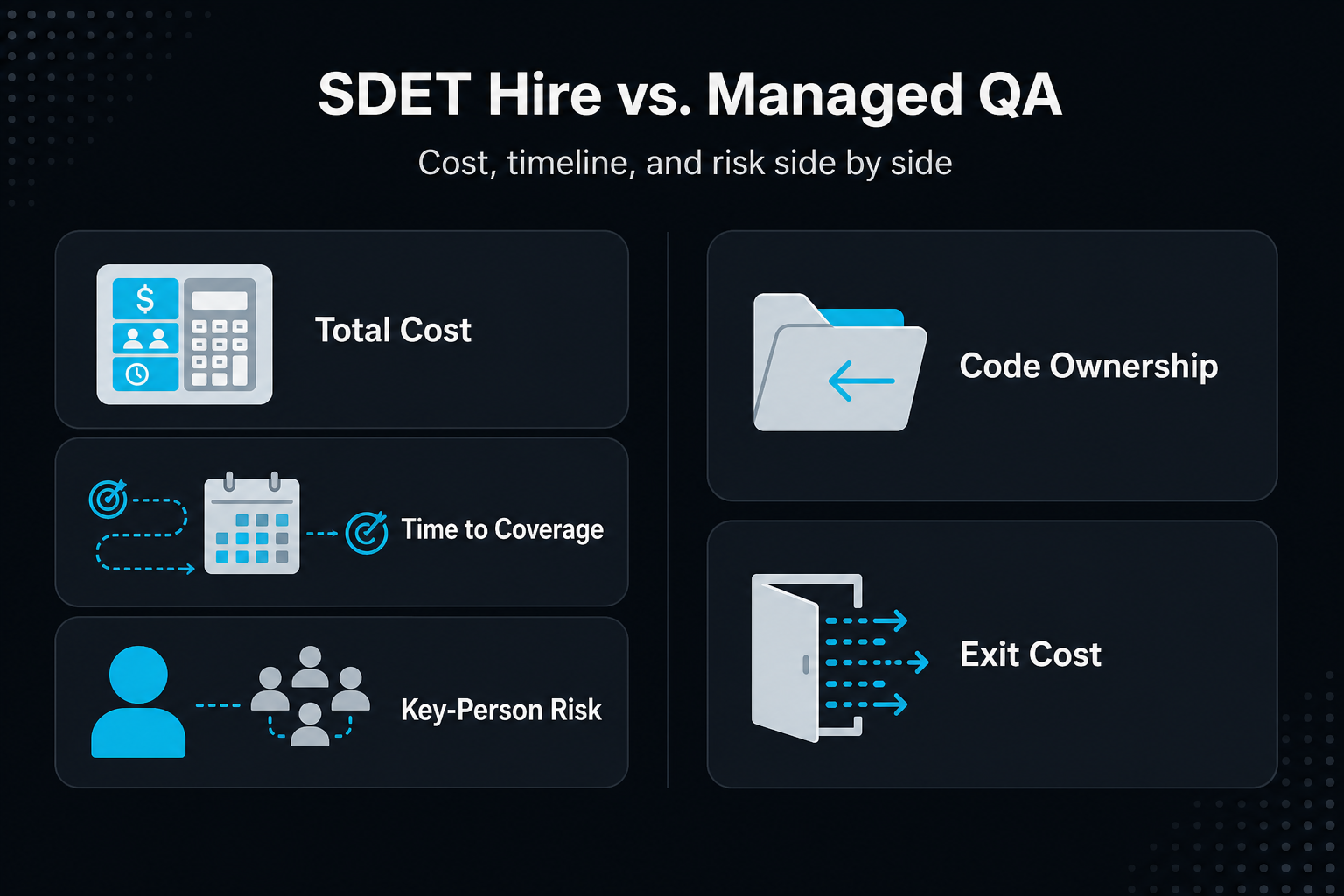
| Factor | SDET hire | Managed qa service |
|---|---|---|
| What you pay for | One person's time and skills | Coverage, maintenance, and failure triage |
| Time to first coverage | After hiring and ramp | Scoped into the engagement, often weeks |
| Maintenance as the app changes | Competes with new test work | Included in the service |
| Key-person risk | High if one person owns the suite | Spread across a team, with tests documented |
| Code ownership | Yours | Yours, if the contract says so |
| Best fit | Long-term in-house test infrastructure | Lean teams that need coverage quickly |
CFOs tend to underrate key-person risk. A suite built by one SDET is like a building where only one person knows where the shutoff valves are. Everything runs fine until that person leaves, and then every leak takes longer to fix. Spreading test knowledge across a documented service reduces that dependency, which lowers risk without adding headcount.
Services like MuukTest make this division of work explicit. Forward Deployed QAs decide what to cover, which workflows matter, and where the real risk is. Amikoo, MuukLabs' AI tool, generates, repairs, and maintains the tests. The tests are standard Playwright TypeScript that live in your repository.
Building a test automation ROI case a CFO will accept
A comparison table will get you a meeting. A test automation ROI calculation is what gets the budget approved. So what does a CFO actually want to see? A 12-month view that counts costs and avoided costs the same way for both options.
- Baseline your current cost of quality: Estimate the engineer hours spent on manual regression before each release. Add the time spent on hotfixes and incident response.
- Price both options over 12 months: Include the SDET months spent hiring and ramping, not only the steady state.
- Treat delay as cost: Every month without regression coverage is a month of releases carrying the same risk of bugs reaching production.
- Add exit cost: Ask what you keep if you stop paying. Client-owned code in standard frameworks keeps that number small.
- Agree on success metrics up front: Track coverage of critical flows, defects caught before production, and suite runtime from the start of the engagement.
Present the result as a range and keep your assumptions visible. The discussion then moves away from "why not a hire?" and toward which assumptions to test first.
CFO objections to qa as a service
Once the numbers hold up, the remaining hurdle is trust. qa as a service asks finance to fund an outcome that does not appear on an org chart. So what objections will a CFO raise? Prepare short answers to the questions that come up most often.
- Are we locked in? Not if the tests are standard framework code that lives in your repository and belongs to you.
- Who is accountable when quality slips? A managed service owns the outcome. A human qa should review each failure before it reaches developers, so your team sees real bugs instead of noise.
- Does this replace our qa team? No. It extends a lean team, and your leads still set priorities and decide when a release is ready.
- Can we try it first? Ask for a proof of concept. MuukTest offers one so you can check fit before you commit a full budget.
With those answers ready, the questions that remain are usually practical ones.
Frequently Asked Questions
What is qa as a service?
qa as a service is a model in which a dedicated team delivers testing outcomes, such as automated regression coverage and failure triage, for a recurring fee. You do not hire or manage the testers yourself.
Are regression testing services cheaper than hiring an SDET?
That depends on scope. Compare the hire's fully loaded cost, including recruiting and ramp time, against the service fee for the same coverage over the same period.
How quickly do managed testing services show results?
Scope drives the timeline. A managed service starts building on day one rather than after a hiring cycle, so coverage of critical flows usually arrives sooner.
Should we ever hire an SDET instead?
Yes. An SDET makes sense when you need someone to own internal test infrastructure or build custom tooling over the long term. Many teams run a managed service alongside their existing engineers.
Do managed qa services fit into existing CI/CD?
Well-run ones do. Tests should trigger on pull requests or deployments and report results into the tools your team already uses, such as Jira or Slack.
About MuukTest
MuukTest is a managed qa service that builds and maintains automated test suites for lean engineering teams. The company builds frameworks on industry-standard tools like Playwright, Selenium, and Appium, and clients fully own the resulting automation framework. This approach lets teams reach broad test coverage in weeks while avoiding the exit costs that come with proprietary testing platforms. MuukTest works as a managed qa partnership that extends lean engineering teams, covering web, mobile, API, regression, and end-to-end testing without requiring additional hires. Behind the service are expert Forward Deployed QAs, who decide what to cover, which workflows matter, and where the real risk is, working with Amikoo, MuukLabs' AI tool for test generation, repair, maintenance, and defect detection.
If you are preparing the case for your next budget review, MuukTest can help you scope coverage and cost against your current plan. Learn more at muuktest.com.