

Feature flags and tenant settings change underneath regression tests more often than the tests themselves break. When a flag flips or a customer's plan tier shifts, a test that does not pin those values as explicit inputs will fail unpredictably, even if every locator is stable. Reliable suites treat flag state and customer configuration as first-class test inputs: pinning flags inside each test, giving every parallel worker its own tenant, and covering a small, risk-ranked set of configurations instead of every combination. That design matters from the first test rather than retrofitted after the suite stops being trustworthy.
TL;DR
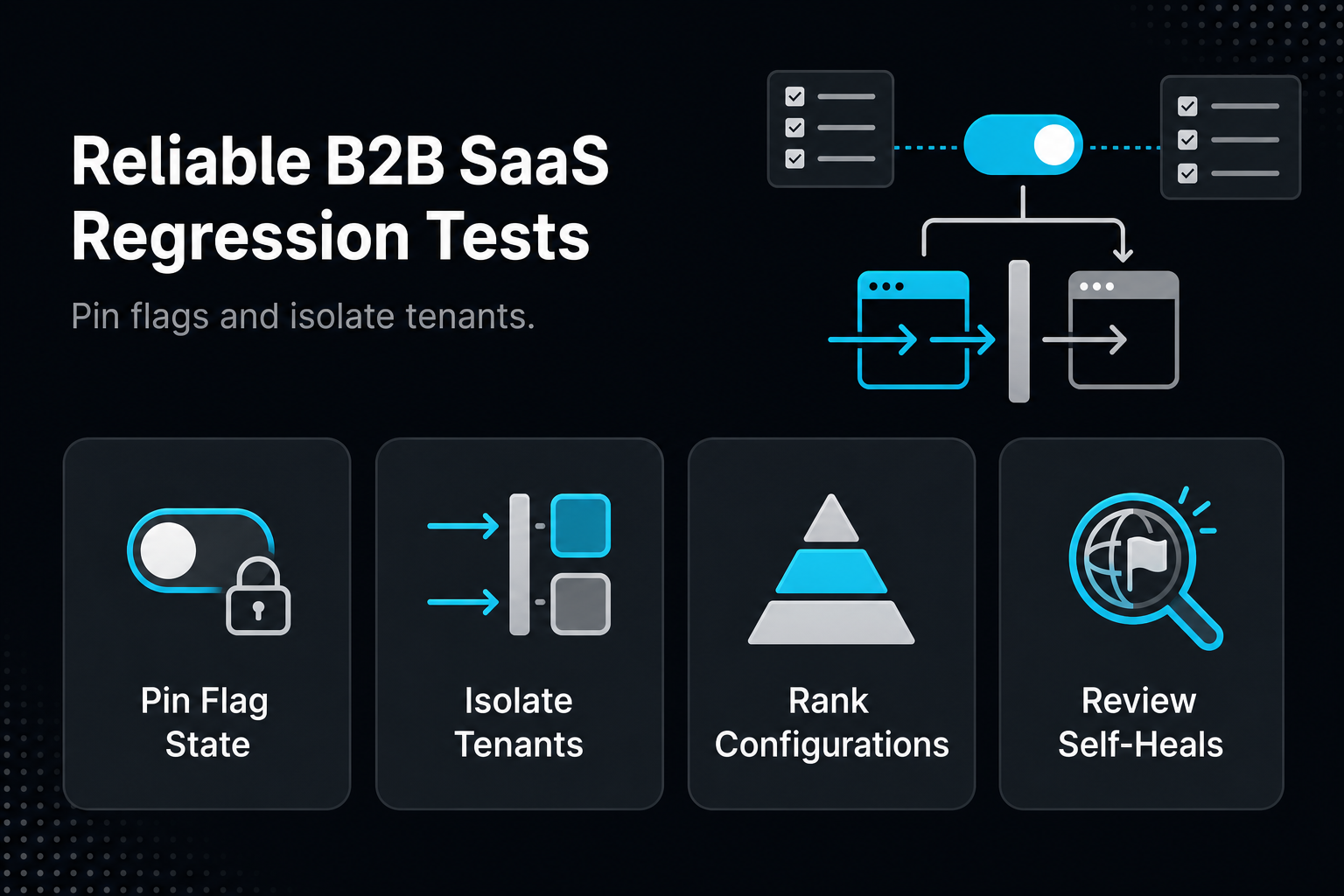
- Flags are inputs: A test that does not set its own flag state is non-deterministic, no matter how stable its locators are.
- Control flags where they are evaluated: Server-side and edge flags bypass browser isolation. Mock them at the SDK or intercept their traffic.
- Isolate tenants per worker: Shared login or config files across parallel workers cause cross-tenant leaks.
- Rank, don't enumerate: Cover defaults, high-risk flags, and real plan tiers, because exhaustive combinations are impossible.
- Review every heal: Self-healing can mistake a leaked flag for a moved button.
Flags are test inputs
The root problem is that a B2B SaaS product is really many products sharing one codebase. Every flag can double the number of code paths, and tenant settings like plan tier, SSO, or custom workflows multiply them again. This combinatorial explosion makes comprehensive coverage nearly impossible. It also makes coverage metrics misleading, because a line counted as "covered" may only have run under one configuration.
- Flags evaluated outside the browser: Many flags resolve in backend services or edge SDKs, so Playwright's browser-context isolation never touches them. Two runs of the same test can see different values and race each other.
- Shared state across workers: Reusing one auth or config file across parallel workers lets one tenant's session or settings bleed into another tenant's test.
- Stale flags: Old toggles keep dead paths alive. Dead code accumulates because removing a flag requires coordination across SDKs, backend services, and dashboards.
Think of an unpinned test as a taste test where someone else restocks the pantry between batches. When the dish changes, you cannot tell whether the recipe broke or the ingredients did. That uncertainty is what erodes trust, because engineers start rerunning failures instead of reading them. The first fix is taking control of the pantry.
Control flags where they are evaluated
Determinism starts by setting flags where they are actually evaluated, not where they happen to be visible. In Playwright regression testing, that usually means two layers of control plus one reality check.
Two layers of flag control plus a reality check
- Pin server-side flags in the SDK: Feature flag tools such as LaunchDarkly offer a test data source for some SDKs that mocks the SDK so flag evaluation is predictable. The environment boots with exactly the values the test declares.
- Intercept client-side flag traffic: For flags fetched in the browser, Playwright's network routing can intercept the flag SDK's requests and return a fixed payload per test.
- Keep one check against real targeting: Local mocks cannot validate production targeting rules or dashboard configuration, so environments can drift. A small staging run against real targeting covers that gap.
| Technique | What it controls well | What it cannot prove |
|---|---|---|
| SDK local test data source | Server-side flag values, offline and repeatable | Real targeting rules and dashboard setup |
| Network interception in Playwright | Client-side flag payloads per test | Flags evaluated on the server or at the edge |
| Staging run with real targeting | Rules resolve as configured | Behavior across every combination |
| Production observability and canaries | Real user impact after release | Correctness before release |
If you are running a test automation tools comparison, ask each option how it pins flag state per test. That question reveals more than any locator feature list. Pinned flags still fail, though, if two tests share a tenant.
Isolate tenants per worker
Building on deterministic flags, the next source of noise is shared tenant state, and it grows with every worker you add. Shared fixtures focus on fast setup, while tenant-scoped fixtures focus on isolation. Parallel test execution only stays trustworthy with the second.
- One tenant per worker: Use worker-scoped fixtures to assign each worker its own tenant, keyed to the worker index.
- Load credentials dynamically: Generate tenant-scoped auth state at runtime instead of committing one storage file everyone reuses.
- Seed configuration explicitly: Set plan tier, permissions, and integrations through an API call during setup, so no test inherits yesterday's settings.
- Use synthetic data: Seeded test tenants also keep real customer PII out of your test runs.
Shared tenants work like hotel guests sharing one key card: whoever used the room last decides what the next guest finds. Give each worker its own room and failures stop depending on run order. Isolation makes each run trustworthy, which leaves the strategic question of which configurations to run.
Rank configurations, don't enumerate them
A related but distinct question is scope, and the real strategy lies in what you leave out. Effective regression management prioritizes critical tests by feature importance, recent changes, and known risk areas, and treats core features differently from customer-specific ones.
- Default configuration: Run full regression against what most tenants actually use.
- Each high-risk flag, on and off: Test one at a time against the workflow it touches.
- Pairs that share a workflow: Combine only flags that touch the same screen or data, since that is where interactions hide.
- Real plan tiers and custom setups: Keep one representative tenant per tier, plus any custom configuration a customer depends on.
- Recently changed areas: Widen coverage temporarily where code just changed.
The matrix also needs an exit. What happens to a flag once it reaches full rollout? Remove it and delete its tests in the same pull request, or your matrix only grows. Feature toggles decouple deployment from release, and current practice pairs risk-based regression suites with production observability, canary releases, and automated rollback. Keeping all of this current as the product changes is where maintenance gets hard.
Can self-healing test automation tell a flag change from a broken test?
Not on its own, and this is the failure mode teams rarely anticipate. Self-healing test automation repairs locators when the UI shifts. If a flag leaks to the wrong tenant and swaps a button, an eager healer may find the new element, update the locator, and pass a test that should have failed.
A locator fix focuses on how the test finds an element, while a regression check focuses on whether that element should exist at all. Assert flag state explicitly at the start of each test so a leak fails loudly, and treat any heal on a flagged screen as a reason for human review. Services like MuukTest split this work deliberately: Forward Deployed QAs decide which flags and tenant configurations carry real risk, Amikoo generates, repairs, and maintains the Playwright TypeScript tests in your repository, and a human qa expert reviews every failure before it reaches developers.
Frequently Asked Questions
Should regression tests run against production flag values?
Mostly no. Pin flags for deterministic regression, add a small staging run against real targeting, and rely on production observability for live validation.
How many flag combinations should we test?
Test defaults, each high-risk flag alone, and pairs that touch the same workflow. Exhaustive coverage stops being achievable once flags multiply.
Does Playwright support per-tenant parallel runs?
Yes. Worker-scoped fixtures and per-worker auth state let each parallel worker use its own tenant.
What should we look for in regression testing services for multi-tenant SaaS?
Ask how the provider pins flag state, isolates tenants per worker, reviews self-healed changes, and whether you own the test code.
Do managed qa services make sense for teams that already have qa?
Yes. Managed qa services extend lean teams by taking on suite building and maintenance, while your team keeps setting priorities.
About MuukTest
MuukTest is a managed qa service that builds and maintains automated test suites for lean engineering teams. The company builds frameworks on industry-standard tools like Playwright, Selenium, and Appium, and clients fully own the resulting automation framework. This approach lets teams reach broad test coverage in weeks while avoiding the exit costs that come with proprietary testing platforms. MuukTest works as a managed qa partnership that extends lean engineering teams, covering web, mobile, API, regression, and end-to-end testing without requiring additional hires. Behind the service are expert Forward Deployed QAs, who decide what to cover, which workflows matter, and where the real risk is, working with Amikoo, MuukLabs' AI tool for test generation, repair, maintenance, and defect detection.
If flag and tenant noise is making your regression suite hard to trust, talk with the MuukTest team at https://muuktest.com/ about building coverage that holds up across the configurations your customers depend on.
About the Author: This guide comes from the qa team at MuukTest.
References
- Playwright documentation on network interception and per-worker test data: https://playwright.dev/docs/network, https://playwright.dev/docs/auth
