

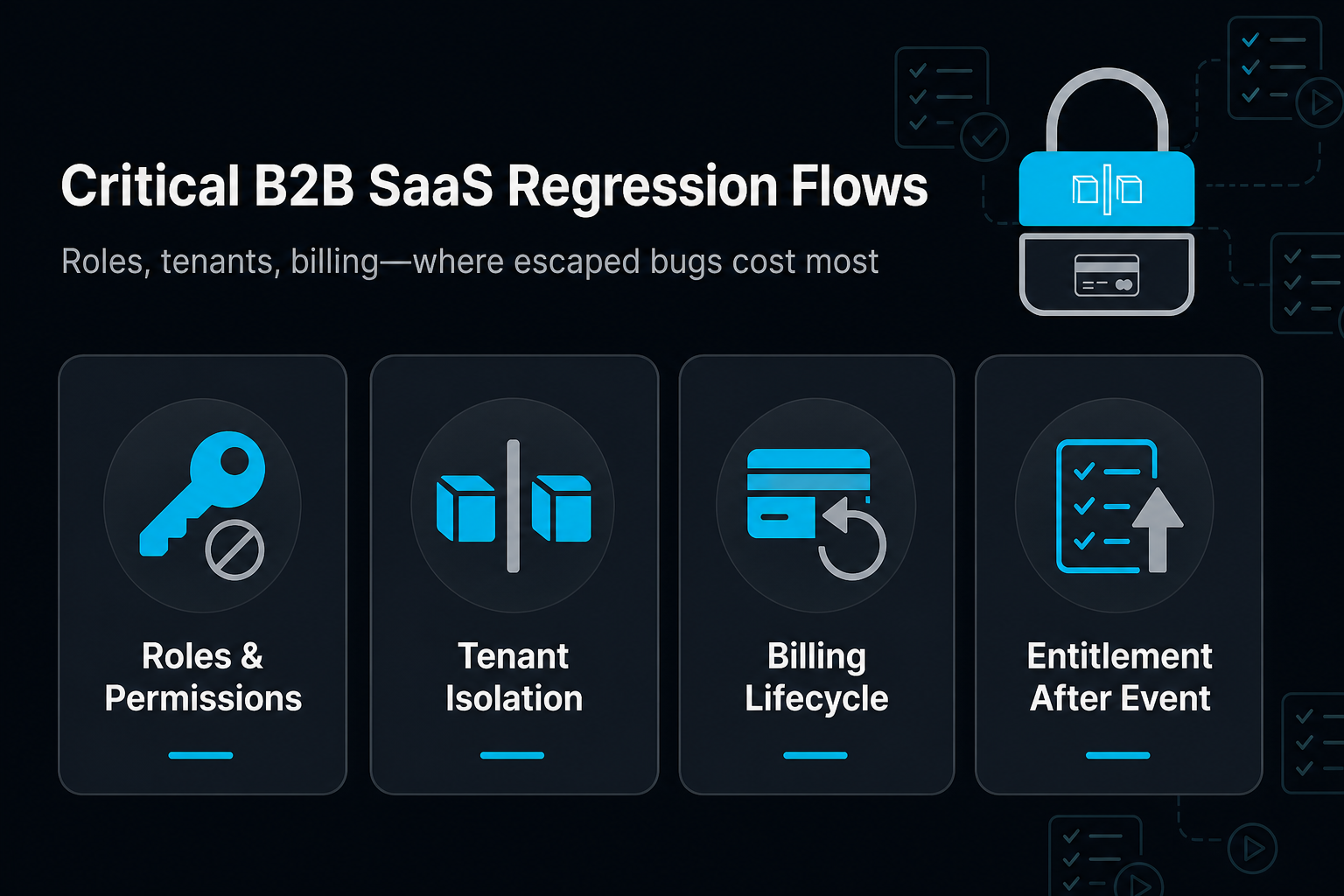
A B2B SaaS regression suite that logs in as one admin, in one account, on one plan, tests the least risky version of your product. The bugs that expose data or produce wrong invoices occur in three flow families: role-based permissions, tenant data isolation, and billing lifecycle events. Each needs positive and negative tests on every release, checked at the API as well as the UI. These three families are where regression coverage matters most because each escaped bug costs the most there.
Below, we cover what each family needs, the common failure modes, and how to keep the coverage stable in CI.
TL;DR
- Roles: Test permissions at the API, rather than only checking which buttons the UI hides.
- Tenants: Prove isolation with negative tests where one tenant's user requests another tenant's data and is refused.
- Billing: Cover plan changes, failed payments, cancellations, and duplicate or out-of-order webhooks.
- Design beats tooling: Playwright handles multi-user and API-level tests well, but someone must decide which role, tenant, and plan combinations are worth running.
Why roles, tenants, and billing need dedicated regression coverage
These flows need their own coverage because a bug in them is rarely cosmetic. A broken layout annoys a user. A broken permission check exposes data, and a broken proration rule charges a customer the wrong amount.
They also multiply. Every new role, plan, or tenant setting adds combinations a single test account never touches, so coverage that looked complete at launch quietly shrinks as the product grows. AI-assisted coding raises the pace further, and because permission middleware, query scopes, and billing handlers are shared code, one change can ripple into all three areas at once. Roles are the place to start.
How should a regression suite test role-based access control?
Role-based access control (RBAC) testing verifies that each role can do exactly what it should and nothing more, at every layer where an action can be triggered. The most common gap is a UI-only check.
Hiding the "Delete workspace" button from a Viewer is like taking the sign off a door without locking it. Anyone who knows the endpoint can still walk in, because the server decides who gets through, not the screen. A passing UI test therefore proves very little about security.
What to cover
- Role matrix: For each core action, assert the allowed or denied result for every representative role.
- API-level denials: Call the endpoint directly with a lower-privilege session and expect a refusal.
- Mid-session changes: Demote a user and confirm their next request fails instead of riding on a cached token.
- Custom roles: Role explosion makes exhaustive coverage impossible, so test a few realistic custom roles chosen by risk.
Roles scoped to a single tenant lead directly into the larger isolation question.
What does tenant isolation testing look like in practice?
Building on tenant-scoped roles, tenant isolation testing proves that no user, query, or background job in one tenant can read or change another tenant's data. Positive tests cannot prove this.
Confirming that tenant A sees its own records is like testing a hotel key card by checking it opens your own room. The test that matters is whether it also opens the room next door. Isolation is proven by refusals, so the suite needs tests that expect them.
- Seed two similar tenants: Overlapping names and data make a leak visible instead of masked.
- Swap IDs: As a tenant A user, request tenant B's record IDs through the API and expect a refusal or not-found.
- Check side doors: Search, exports, reports, downloads, and invitation links often run separate queries that can miss the tenant filter applied in main views.
- Watch async work: Scheduled jobs that process data in bulk should stay inside one tenant.
Synthetic test data also keeps real customer PII and cardholder data out of testing. With boundaries covered, the next layer is money.
Which billing flows belong in every regression run?
Billing is where roles and tenants meet revenue: a plan change should alter what a tenant can do, and a failed payment should eventually restrict it. Billing regression covers that lifecycle against your payment provider's test mode, never live charges.
| Flow | What to verify | Common failure |
|---|---|---|
| Upgrade or downgrade | Correct proration, new limits apply | Old limits persist after the change |
| Trial to paid | Single charge, access continues | Duplicate charge or lapsed access |
| Seat changes | Invoice matches active users | Seat count and invoice drift apart |
| Failed payment | Retries and grace period follow configuration | Access cut immediately, or never |
| Cancellation | Access ends on the right date | Paid features remain indefinitely |
| Webhooks | Duplicate and out-of-order events handled idempotently | Double provisioning, or a stale downgrade applied after an upgrade |
After each billing event, assert what every role in that tenant can now do. That entitlement check ties all three families into one test.
How does Playwright regression testing handle these flows?
Playwright regression testing suits these flows because the framework is built to run several isolated users inside one test.
- Browser contexts: Each context is a separate session, so an Admin and a Viewer, or users from two tenants, run side by side.
- Stored auth state: Log in once per role and reuse the session, keeping a large role matrix fast.
- API requests: Call endpoints directly in the same test to confirm denials happen at the server.
- Auto-waiting and parallel execution: Fewer timing-related flakes, and the matrix finishes faster.
What a suite can do depends on design: which roles, tenants, plan states, and negative paths someone chose to write. Whether it catches a cross-tenant leak is a matter of coverage strategy, not tooling alone.
When does qa as a service make sense for these flows?
Since design is the hard part, the real question is who owns it. qa as a service fits when your team knows these flows matter but nobody has time to maintain a matrix that shifts with every new role, plan, or feature flag. A testing tool focuses on running the tests you give it, while a managed qa service focuses on deciding which tests should exist and keeping them accurate.
With services like MuukTest, Forward Deployed QAs decide what to cover, which workflows matter, and where the real risk sits in your permission, tenant, and billing logic. Amikoo, MuukLabs' AI tool, generates, repairs, and maintains the tests, which are standard Playwright TypeScript living in your own repository. Your engineers keep ownership while gaining coverage they had no time to build.
Frequently Asked Questions
What is the difference between RBAC testing and tenant isolation testing?
RBAC testing checks what a role may do inside a tenant, while tenant isolation testing checks that nothing crosses the boundary between tenants. You need both.
Are UI tests enough to verify permissions?
No. Pair each UI permission check with a direct API call that expects a refusal.
How many roles should a regression suite cover?
Every built-in role, plus a few realistic custom roles chosen by risk.
Should billing tests use a real payment provider?
Use the provider's test or sandbox mode with synthetic data, never real cards.
How often should these flows run?
On every build or deployment, because shared code means a change anywhere can affect them.
Who owns the tests with a managed qa service?
With MuukTest, you do. The tests live in your repository as standard Playwright code.
About MuukTest
MuukTest is a managed qa service that builds and maintains automated test suites for lean engineering teams. The company builds frameworks on industry-standard tools like Playwright, Selenium, and Appium, and clients fully own the resulting automation framework. This approach lets teams reach broad test coverage in weeks while avoiding the exit costs that come with proprietary testing platforms. MuukTest works as a managed qa partnership that extends lean engineering teams, covering web, mobile, API, regression, and end-to-end testing without requiring additional hires. Behind the service are expert Forward Deployed QAs, who decide what to cover, which workflows matter, and where the real risk is, working with Amikoo, MuukLabs' AI tool for test generation, repair, maintenance, and defect detection.
If your regression suite still runs as one admin in one tenant, reviewing role, tenant, and billing coverage is a sensible next step. You can learn how MuukTest approaches it at https://muuktest.com/.
