

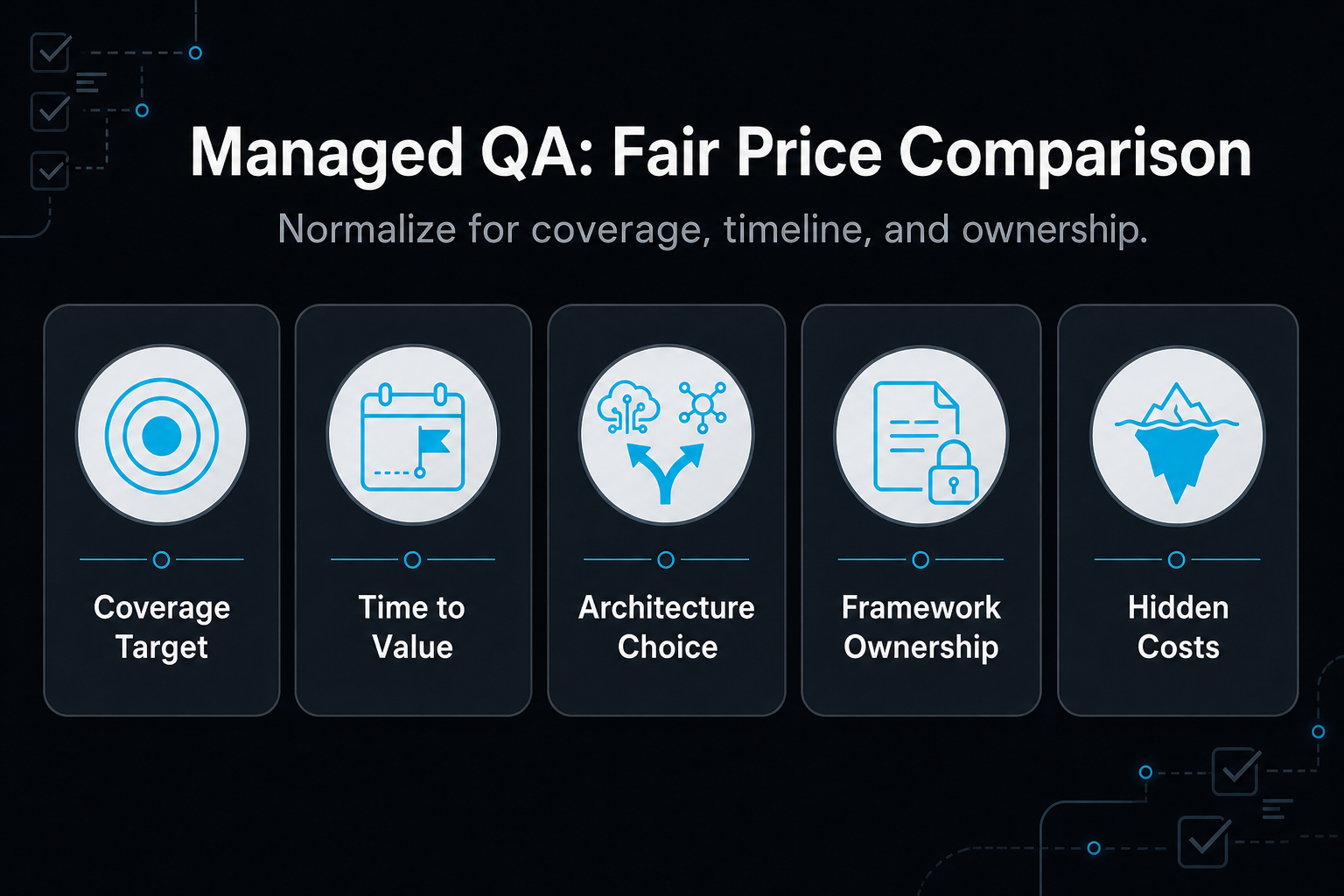
Pricing only becomes comparable once you normalize it against coverage percentage and timeline. QA Wolf, Rainforest QA, Bug0, Testlio, and A1QA all sell some version of "managed testing," but they differ in architecture, coverage targets, and what happens after the first test suite ships. The fair way to compare them is to normalize for coverage percentage, time to value, and total cost of ownership, not just the invoice.
TL;DR
- Price per month means little without a coverage target attached. QA Wolf typically starts around $8,000 per month for roughly 200 tests and scales with test volume, generally landing in the $40 to $44 per test per month range as coverage grows, while other providers price by team size or a flat monthly range.
- Architecture shapes long-term cost. Providers running on cloud orchestration (QA Wolf, Bug0, Rainforest QA) scale differently than those coordinating distributed human testers (Testlio, A1QA).
- Time to coverage is a hidden cost variable. Bug0 claims critical flow coverage in 7 days; QA Wolf targets 80 percent in four months; managed QA services like MuukTest target comprehensive coverage within 8 to 12 weeks.
- Ownership of the automation framework matters after the contract ends. Ask whether you keep the test suite or whether it lives inside a vendor's proprietary platform.
- In-house QA still costs more on paper ($25,000 to $50,000 per month) than most managed options, but the real comparison is coverage achieved per dollar, not headcount avoided.
What Does "Managed QA" Actually Mean Across Providers?
Managed QA means a vendor takes responsibility for building, running, and maintaining your test suite, rather than just handing you a tool and a login. That sounds like a single category, but the providers inside it split into two distinct architectures, and understanding which one you're buying determines almost everything else about cost and reliability.
Cloud-orchestrated AI testing: QA Wolf, Bug0, and Rainforest QA run tests through their own containerized or VM-based infrastructure, with AI agents handling test creation, execution, and self-healing when the UI changes. This looks like a factory assembly line: machines do the repetitive work, and humans intervene only when something jams.
Human-network testing: Testlio coordinates a vetted global tester community across more than 150 countries with access to over 600,000 real devices, while A1QA integrates dedicated engineering teams directly into your CI/CD pipeline as a professional services engagement. This is closer to hiring a distributed crew: you get breadth of device and locale coverage, but coordination across time zones is part of the deal.
Neither architecture is inherently better. The question is what your product needs: if you ship a web app with a handful of critical flows, cloud orchestration moves faster; if you need real-device coverage across dozens of locales, a human network earns its keep. MuukTest sits closer to the AI-driven model but keeps experienced humans in the loop on the test logic itself: Forward Deployed QAs decide what to cover and where the real risk is, while Amikoo, MuukLabs' AI testing tool, generates and maintains standard Playwright tests in the customer's own repository.
How Should You Compare Pricing Models Fairly?
Monthly costs across the managed QA market range from around $1,500 to over $12,000, with Rainforest QA estimates spanning $1,500 to $12,000 or more depending on scope, and QA Wolf typically starting around $8,000 per month for roughly 200 tests, scaling upward as test volume grows. Bug0's fully managed tier starts at $2,500 per month. Those numbers look wildly different until you ask: coverage of what, achieved by when?
Normalize by coverage target, not just price: A $2,500/month service that covers your five most critical user flows may deliver more practical risk reduction than an $8,000/month service still ramping toward 80 percent coverage of a sprawling app. Ask every vendor for their defined coverage percentage and the flows it applies to.
Normalize by time to first value: Bug0 states it reaches full critical flow coverage in 7 days. QA Wolf targets 80 percent coverage within four months. Managed QA services vary from 8 to 12 weeks to full coverage depending on scope and approach. A faster ramp means fewer weeks where your team is still manually regression-testing releases.
Normalize by volume-based fees: Platforms billing by test-run volume, as some do with Rainforest QA's model, and as QA Wolf does once you scale past initial setup, can produce overage charges that aren't visible in the advertised starting price. Request a worst-case monthly estimate based on your actual release cadence and expected test count, not the vendor's median customer.
Building a true cost comparison also means accounting for what you'd spend otherwise. In-house QA teams typically run $25,000 to $50,000 per month once salaries, benefits, and management overhead are included vendr.com, while outsourced QA services generally cost meaningfully less per month, though the exact savings depend on scope and coverage achieved rather than a fixed percentage. That gap is real, but it only holds if the managed provider actually reaches usable coverage, which is why the next question matters more than the price tag itself.
Why Does Coverage Percentage Vary So Much Between Providers?
Coverage percentage varies because providers define "coverage" differently and because their architecture determines how fast they can scale test creation. QA Wolf targets 80 percent coverage of user flows within roughly four months. Managed QA services document targets ranging from 8 to 12 weeks for comprehensive coverage. Bug0 claims full coverage of critical flows, a narrower but faster-to-reach scope, within 7 days.
The gap between "80 percent of all flows" and "100 percent of critical flows" is the real comparison point, not the percentage alone. A related but distinct question is how that coverage holds up over time: self-healing capability determines whether coverage decays as your app changes. Bug0 reports a 90 percent self-healing success rate; providers using smart locators and self-healing scripts exist for the same reason, to keep a test suite accurate without a human rewriting locators every sprint. For teams wrestling with legacy toolchains, our guide on choosing a test automation framework covers how Playwright's current 57.6 million weekly npm downloads and native parallelism are reshaping these coverage calculations across the industry.
What Hidden Costs Should You Watch for Beyond the Monthly Fee?
The advertised monthly fee is rarely the full cost of a managed QA engagement. Three categories of hidden cost show up consistently across provider types, and none of them appear on a pricing page.
- Onboarding and ramp time: Professional services models like A1QA require onboarding dedicated teams into your existing CI/CD environment, which takes calendar time before any test runs, time during which you're still shipping without full coverage.
- Vendor lock-in: If your automation framework lives entirely inside a vendor's proprietary platform, switching providers later means rebuilding your suite from scratch. Best-practice managed QA structures engagements so clients own the resulting Playwright, Selenium, or Appium framework outright.
- Human coordination overhead: Testlio's model, which spans testers across 150 countries, mitigates typical crowdsourcing risk by vetting its network, but coordinating feedback across time zones still adds a communication layer that a single cloud-orchestrated pipeline doesn't require.
- Maintenance drag: Teams that skip providers with strong self-healing architecture often find their in-house engineers absorbing broken-test triage, the exact overhead managed QA was supposed to remove. AI-driven maintenance approaches in the industry claim to reduce flaky test rates significantly, which is the real lever on long-term cost.
Once you've priced in onboarding, ownership, and maintenance drag, the comparison table looks different from the marketing page.
How Do the Major Providers Compare Side by Side?
| Provider | Model | Stated Coverage/Timeline | Pricing Signal |
|---|---|---|---|
| QA Wolf | AI agents + human engineers, cloud orchestration | 80% coverage in ~4 months | ~$8,000/month starting, for roughly 200 tests, scaling with test volume [vendr.com] |
| Bug0 | AI-native, forward-deployed engineers, Playwright cloud infra | Full critical flow coverage in 7 days | Starts at $2,500/month (vendor-stated) |
| Rainforest QA | AI-accelerated testing + dedicated test managers | AI-accelerated UI testing, self-healing | $1,500 to $12,000+/month, volume-based [vendr.com] |
| Testlio | Vetted global tester network + cloud test engine | 24/7 testing across 150 countries, 20+ test types | Varies by scope |
| A1QA | Dedicated teams embedded in client CI/CD | Full-cycle QA, vendor-neutral automation | Varies by engagement |
| MuukTest | Forward Deployed QAs + Amikoo (AI testing tool); tests in client's own repo | 95% Playwright coverage in 8-12 weeks. | Starts at $6,000/mo for up to 1,000 tests. Contact for pricing |
A table like this is a starting point for vendor calls, not a final answer. Ask each provider to confirm these figures against your specific app complexity before committing.
Frequently Asked Questions
Is QA Wolf more expensive than other managed QA providers?
QA Wolf typically starts around $8,000 per month for roughly 200 tests and scales with test volume from there, which sits above Bug0's $2,500/month starting price and within the broader $1,500 to $12,000+ range seen across the market. Whether it's "more expensive" depends on the coverage, test volume, and timeline you're comparing it against.
What's the difference between crowdsourced and AI-driven managed QA?
Crowdsourced models, like Testlio's global tester network, rely on distributed human testers for breadth across devices and locales. AI-driven models, like QA Wolf, Bug0, and other managed services, use software agents for test execution and maintenance, with humans focused on test design and edge cases rather than manual execution.
Does a faster coverage timeline mean lower quality?
Not inherently. Bug0's 7-day timeline applies to critical flows specifically, a narrower scope than QA Wolf's 80 percent of all user flows over four months. Compare scope alongside speed, not speed alone.
Do I own the test automation framework after the engagement?
This varies by provider and should be confirmed in the contract. Best-practice managed QA services build on industry-standard frameworks like Playwright, Selenium, and Appium specifically so clients retain the resulting suite rather than depending on a proprietary vendor platform.
Is managed QA cheaper than hiring an in-house team?
Generally yes on a direct cost basis. In-house QA runs $25,000 to $50,000 per month with salaries and overhead included vendr.com, while outsourced or managed QA services generally cost meaningfully less per month, though actual savings depend on coverage achieved, not sticker price alone.
How does self-healing affect long-term cost?
Self-healing reduces the ongoing labor of fixing tests broken by UI changes. Bug0 reports a 90 percent self-healing success rate, and providers using smart locators and self-healing architecture lower the hidden maintenance cost of any managed suite by reducing the need for manual test rewrites across sprints.
