

An ownable test automation framework is one where your team holds the actual source code, in a standard language like TypeScript, JavaScript, or Python, stored in your own repository and runnable on any infrastructure you choose. The opposite is a proprietary setup where your tests are stored inside a vendor's platform, written in a format only that platform understands. The difference determines whether switching QA providers takes a sprint or a quarter, and whether you negotiate pricing from a position of strength or from one of dependency.
TL;DR
- Vendor lock-in in QA happens at the code layer: proprietary platforms often store tests in formats that can't be exported into standard code, leaving you with nothing portable if you leave.
- Open frameworks like Playwright and Selenium are the antidote: tests written in these standards can run anywhere, with any provider, on any CI/CD pipeline.
- Exit costs are a real, documented problem: Forrester reports 74% of organizations cite vendor lock-in as a major barrier to modernization.
- Self-healing and codeless tools don't have to mean lock-in: the question isn't whether a tool is smart, it's whether its output is code you own.
- Ownership changes the ROI math: a framework you keep after a contract ends is a durable asset, not a recurring cost you restart from zero.
About the Author: This article is published by MuukTest, the QA services brand of MuukLabs. MuukTest delivers shift-left automated regression testing, from user stories to production, with expert Forward Deployed QAs always in the loop. Clients own the tests MuukTest builds.
What Does Vendor Lock-In Actually Look Like in Test Automation?
Vendor lock-in in test automation is the inability to take your test suite with you when you leave a provider or platform. It's not a hypothetical risk. Some proprietary test automation platforms store tests in internal formats or databases that can't be exported as standard code. When execution and access are tied to the vendor's cloud, ending the contract can mean losing access to the entire test suite.
Think of it like a furnished apartment lease. You can live comfortably for as long as you pay rent, but the furniture, the fixtures, even the layout belong to the landlord. Walk away, and you start over with empty rooms. A proprietary test suite works the same way: you get coverage while you're a customer, but the moment the contract ends, so does your access to the logic your team spent months refining.
This matters because test suites aren't static. They accumulate institutional knowledge about your application's edge cases, regression history, and failure patterns. Losing that isn't an inconvenience, it's a reset button on months or years of QA work.
Why Does Framework Choice (Selenium, Playwright, Appium) Determine Portability?
The framework underneath your tests is what determines whether those tests are portable at all. Open-source frameworks write tests as plain code files that live in your own version control, independent of any single vendor's runtime.
The current landscape breaks down clearly by use case:
- Playwright test automation: is now the new standard for web testing, prized for speed and built-in support for modern web apps.
- Selenium test automation: remains the established enterprise backbone despite flat growth, with the broadest browser and language support of any end-to-end testing framework.
- Appium: continues as the long-standing industry standard for native and hybrid mobile application automation.
What these three have in common matters more than their differences: all three produce code you can read, edit, move, and run without paying a licensing fee to execute it. That's the real dividing line, not which framework wins market share this year, but whether the output is yours. For a deeper technical breakdown of what code export actually requires, see Playwright's documentation on running tests in CI playwright.dev.
How Do Codeless and Self-Healing Tools Fit Into the Ownership Question?
Codeless test automation tools and self-healing test automation features are not inherently a lock-in risk, but they can become one depending on how the output is stored. Self-healing automation adjusts a test's locators automatically when an element's ID or position changes, so a button that moves doesn't break your entire regression suite overnight.
The useful analogy here is autocorrect on a document you own versus autocorrect inside a messaging app you don't control. Both fix your mistakes in real time. But one saves the corrected version to your own file, and the other only exists inside someone else's app, invisible and unusable the moment you switch platforms. Self-healing scripts that write their fixes back into your owned codebase give you the maintenance benefit without the dependency. Self-healing logic trapped inside a vendor's closed engine gives you the same convenience today and the same reset-to-zero risk tomorrow.
The same logic applies to codeless builders. A drag-and-drop interface that generates real Playwright or Selenium code underneath is fundamentally different from one that generates a vendor-specific script with no export path. Always ask what file format the tool produces, not just how easy the interface is to use.
At MuukTest, Forward Deployed QAs work with Amikoo, MuukLabs' AI tool. Amikoo generates standard Playwright TypeScript tests in the customer's own repository (GitHub or Azure DevOps), and its Repair Agent fixes broken tests while diagnosing each failure as a real product defect or a test issue.
What Does Vendor Lock-In Actually Cost an Engineering Team?
Building on the technical picture above, the harder question is what lock-in costs in dollars and time once a company is already committed. Vendor lock-in is widely cited as a major barrier to modernization, reflecting how often companies find themselves stuck maintaining a platform they've outgrown simply because leaving means starting over.
As low-code tooling grows, exit costs become a significant financial impact, forcing companies to rebuild test suites from scratch and giving vendors leverage to dictate pricing. That leverage shows up in two predictable ways:
- Price increases at renewal: a vendor knows that switching costs more than paying the new rate, so renewal negotiations rarely favor the customer.
- Feature stagnation: without competitive pressure from the threat of departure, there's less incentive for a vendor to keep improving the product you're locked into.
A related but distinct question is how this affects test automation ROI specifically. A framework's return on investment isn't just about coverage achieved this quarter, it's about whether that coverage remains an asset next year, regardless of who maintains it.
How Should You Evaluate Test Automation ROI With Portability in Mind?
Test automation ROI should be measured as coverage achieved per dollar spent, adjusted for what you keep if the relationship ends. A suite with excellent short-term coverage but zero portability has a hidden depreciation schedule: its value resets to zero the day you switch providers.
A few practical questions help separate durable ROI from a sunk cost waiting to happen:
- Can you export the full suite today? If the answer requires vendor cooperation or a special request, the suite isn't really yours.
- Does it run in your own CI/CD pipeline without the vendor's runtime? Tests that only execute inside a vendor's cloud aren't portable even if the code looks standard.
- Are automated regression testing tools and API testing automation tools part of the same owned codebase, or siloed in separate proprietary systems? Fragmented ownership across tools multiplies your exit complexity later.
This is where a fully managed but ownership-first approach changes the equation. Partnering with managed QA services that build Playwright-based automation frameworks and hand over full ownership of the resulting code lets your engineering team keep everything achieved even if the engagement structure changes down the road. That's a different model from paying indefinitely for access to logic you'll never hold.
What Should You Look for Before Committing to a Test Automation Provider?
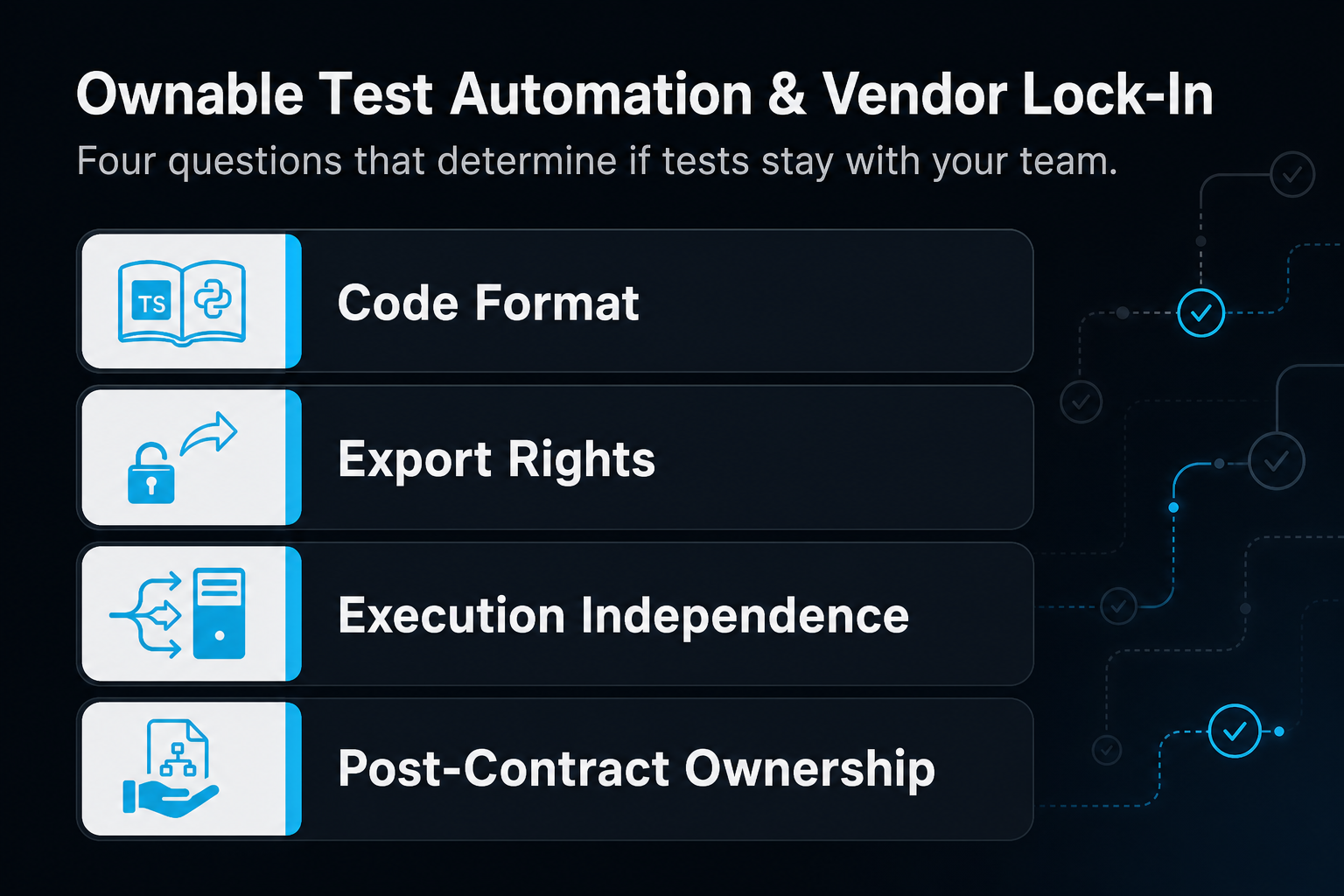
Before signing with any provider, verify three things in writing: code format, export rights, and execution independence. A provider that can answer all three clearly is giving you an asset; one that hedges is giving you a subscription.
| Question to Ask | Ownable Answer | Lock-In Warning Sign |
|---|---|---|
| What language are tests written in? | Standard code (Playwright, Selenium, Appium) | Proprietary scripting language or internal format |
| Can you export the full suite anytime? | Yes, via your own repository, no request needed | Export requires a support ticket or isn't offered |
| Does execution require the vendor's infrastructure? | No, runs in your CI/CD pipeline | Tests only run inside the vendor's cloud |
| What happens to the suite if you cancel? | You keep everything built | Access is revoked immediately |
Running through this checklist before a contract is signed costs an afternoon. Discovering the answers after signing can cost a full rebuild.
Frequently Asked Questions
What is vendor lock-in in test automation?
Vendor lock-in in test automation is a situation where your tests are stored in a format or platform you can't take with you, so switching providers means rebuilding your suite rather than migrating it.
Is Playwright better than Selenium for avoiding lock-in?
Both are open-source and produce portable, ownable code, so neither creates lock-in on its own. Playwright is now the new standard for web testing, prized for speed and built-in support for modern web apps, while Selenium remains the established choice for broad browser and language support.
Do codeless test automation tools always cause vendor lock-in?
Not always. The risk depends on whether the tool generates real exportable code in a standard framework or stores logic in a closed, proprietary format you can't retrieve.
Does self-healing test automation reduce ownership?
No, as long as the self-healing adjustments are written back into code you own. The risk only appears when the self-healing logic itself lives entirely inside a vendor's closed system.
How does vendor lock-in affect test automation ROI?
It lowers long-term ROI because coverage you can't keep after a contract ends has no residual value. Portable frameworks preserve the value of past investment even if you change providers later.
Can API testing automation tools also create lock-in?
Yes. Any testing layer, including API testing automation tools, can lock you in if test definitions are stored in a proprietary format rather than exportable, standard code.
What's the first step to check if we're already locked in?
Ask your current provider for a full export of your test suite in standard code format today. If that request is difficult, delayed, or impossible, you have your answer.
About MuukTest
MuukTest is a managed QA service that builds and maintains automated test suites for lean engineering teams. The company builds frameworks on industry-standard tools like Playwright, Selenium, and Appium, and clients fully own the resulting automation framework. This approach lets teams reach broad test coverage in weeks while avoiding the exit costs that come with proprietary testing platforms. MuukTest works as a managed QA partnership that extends lean engineering teams, covering web, mobile, API, regression, and end-to-end testing without requiring additional hires. Behind the service are expert Forward Deployed QAs, who decide what to cover, which workflows matter, and where the real risk is, working with Amikoo, MuukLabs' AI tool for test generation, repair, maintenance, and defect detection.
If your team wants a test automation framework built on open standards and fully owned from day one, get in touch with MuukTest to see how a managed QA partnership can extend your team without tying your test suite to anyone's infrastructure but your own.
