

Managed regression testing does not reduce developer time to zero, and a good engagement should not try to. It removes the open-ended work: writing tests, repairing broken selectors, and sorting real bugs from flaky noise. Your developers keep a small, predictable set of tasks. They explain intended behavior, keep environments reachable, review test code in your repository, and fix the real regressions the suite catches. From inside managed regression work, the pattern is clear: the time that remains is decision time, not maintenance time.
TL;DR
- Managed regression testing takes test authoring, script upkeep, and first-pass failure triage off developers' plates.
- Developers still own product intent: what "correct" means, which changes are coming, and environment access.
- Fixing confirmed bugs is product work, not testing overhead. Don't count it against the service.
- Self-healing test automation absorbs small UI changes. Redesigns still need a human qa decision.
About the Author: This article comes from the MuukTest team. MuukTest is a managed qa service. Its Forward Deployed QAs work with Amikoo, MuukLabs' AI tool, to build and maintain Playwright regression suites for lean engineering teams, so the division of labor described here is the one we work inside every week.
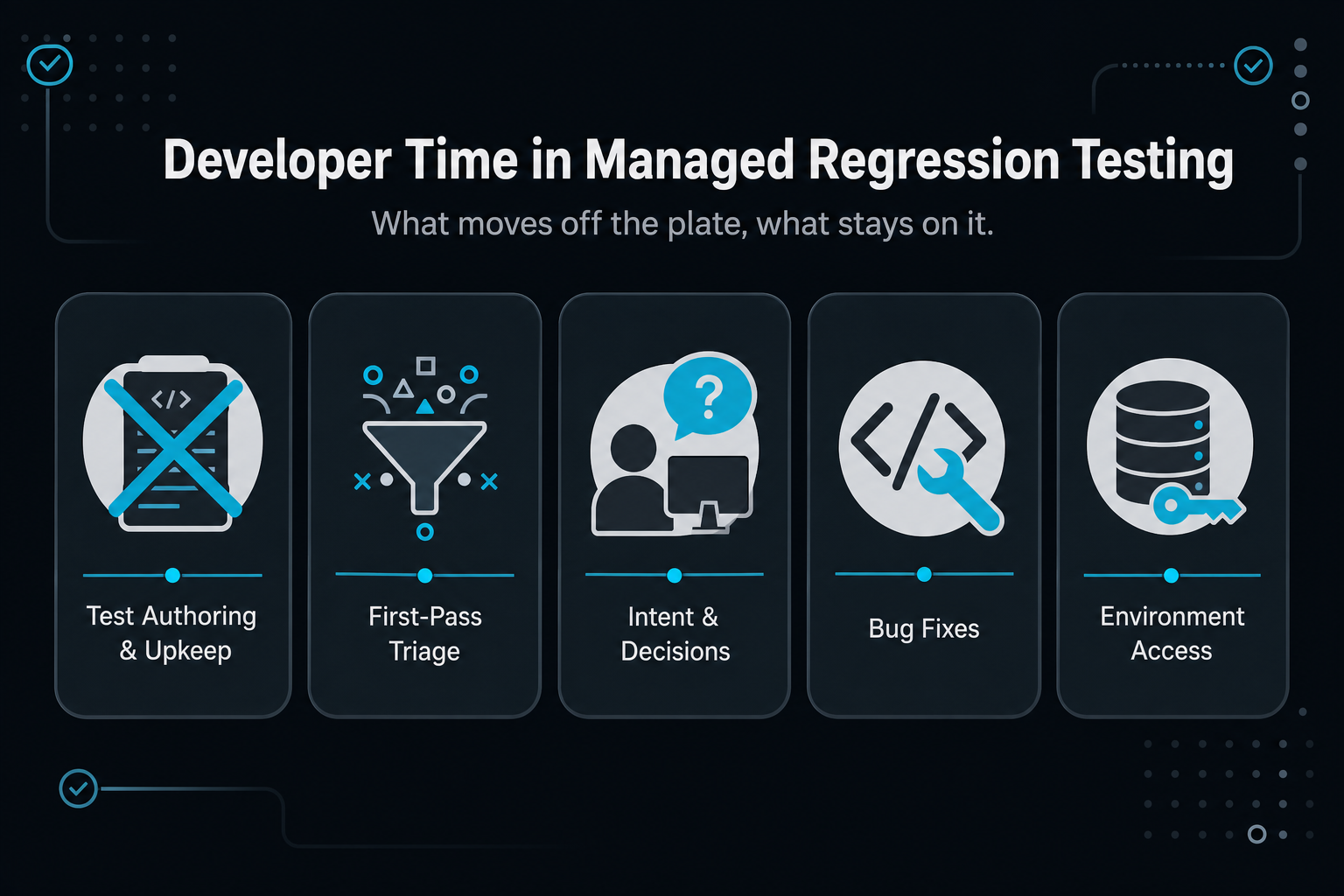
The developer work managed regression testing removes
The answer starts with the work that leaves your developers entirely. Managed regression testing is a model where an outside qa team designs, runs, and maintains your automated regression suite and owns the results. The suite's job is to confirm that new changes have not broken existing functionality. Keeping those suites current is one of regression testing's most persistent challenges.
- Test authoring: Developers stop turning user flows into scripts.
- Script upkeep: Broken locators and timing issues get fixed without a developer ticket.
- First-pass triage: A qa reviews each failure first, so developers see confirmed bugs instead of noise.
- Pipeline wiring: The suite runs automatically after every code change, which is the standard pattern in modern CI/CD.
The work that remains is a shorter list, and a different kind of work.
The developer time that remains
With maintenance gone, a smaller set of tasks is left, and only your engineers can do them.
| Task | Why developers own it | When it happens |
|---|---|---|
| Onboarding walkthrough | QAs need to learn which workflows carry revenue and risk | Front-loaded at kickoff |
| Intent questions | Only your team knows whether a changed behavior is a bug or a feature | As changes ship |
| Environment and data access | Credentials, seeded accounts, a stable staging build | At setup, then occasionally |
| Test code review | Tests are maintained in your repository | Alongside normal reviews |
| Roadmap heads-up | New flows and redesigns need new coverage | Per major release |
| Fixing confirmed bugs | The product code is yours | Whenever a regression is real |
The last row is product work, not testing overhead. Without the suite, you would fix the same bug after a customer reported it, only later. Leave it out when you judge what the service costs your team.
Why developer time never reaches zero
Every row in that table depends on knowledge that your team holds. A good accountant can prepare your whole return. They still cannot tell whether a deposit was income or a loan repayment without asking you, because the records show what happened and only you know what it meant. A failing test works the same way: it proves behavior changed, and only the people who changed it know whether that was intended. Maintenance time is about keeping existing tests alive. Decision time is about telling testers what should be true.
Is a service that never asks your developers anything a good sign? Usually not. It means someone is guessing, and coverage drifts toward easy paths instead of the workflows your customers pay for. The aim is near-zero maintenance and short, deliberate decision time.
How self-healing changes the maintenance math
How fast your UI changes is a separate question, and that rate decides how much maintenance a suite generates. More UI changes mean more commits, more regression runs, and more chances for a brittle locator to break.
- What self-healing handles: Renamed classes, moved buttons, and timing shifts where the user flow stays the same.
- What it cannot handle: A redesigned checkout or a new permission model. In these cases, someone has to decide what "correct" now means.
In MuukTest's model, the Forward Deployed QAs decide what to cover and where the real risk is. Amikoo generates, repairs, and maintains the Playwright tests. A major change therefore reaches developers as a question, not a broken pipeline. The next step is checking whether that trade pays off.
Measuring the time you get back
Hours saved is the obvious measure, but interruptions avoided is the better one. Every hour spent repairing tests costs developers focus and productivity. When comparing regression testing services, track these signals:
- Verdict time: How long it takes to go from a red build to a confirmed bug or test-issue call.
- Developer interruptions: How often engineers get pulled into test failures each sprint.
- Blocked merges: Pull requests held up by suite problems rather than product defects.
These signals show whether a service absorbs the work or just moves it somewhere else.
Keeping the remaining time small
Some of the time savings depends on your own team. A few habits keep the remaining decision time short.
- Run one focused onboarding: Walk the QAs through the workflows that touch revenue, data, and permissions.
- Add stable test IDs: Attributes like data-testid give tests locators that survive styling changes.
- Seed a stable staging environment: Synthetic accounts keep real customer PII out of testing.
- Send roadmap heads-ups: A one-line note before a redesign saves an investigation later.
With those habits in place, developer involvement settles into a few predictable touchpoints.
Frequently Asked Questions
Do developers write any tests with managed qa services?
No. The qa team creates and maintains the suite. Developers review test code when it lands in their repository, like any other pull request.
Is qa as a service the same as outsourcing testers?
No. qa as a service is accountable for outcomes, such as maintained coverage and triaged results. It is not a supply of people waiting for instructions.
Who owns the Playwright regression testing code?
It depends on the provider, so ask before signing. With MuukTest, the tests are standard Playwright TypeScript in your own repository, and you keep them.
Will developers still get pinged about flaky tests?
They should not. In a well-run service, a qa confirms each failure is real before escalating it.
Does automated regression testing replace exploratory testing?
No. Automated regression testing confirms that known behavior still works. Exploratory testing looks for problems nobody has written a test for yet.
About MuukTest
MuukTest is a managed qa service that builds and maintains automated test suites for lean engineering teams. The company builds frameworks on industry-standard tools like Playwright, Selenium, and Appium, and clients fully own the resulting automation framework. This approach lets teams reach broad test coverage in weeks while avoiding the exit costs that come with proprietary testing platforms. MuukTest works as a managed qa partnership that extends lean engineering teams, covering web, mobile, API, regression, and end-to-end testing without requiring additional hires. Behind the service are expert Forward Deployed QAs, who decide what to cover, which workflows matter, and where the real risk is, working with Amikoo, MuukLabs' AI tool for test generation, repair, maintenance, and defect detection.
If you want to see how regression testing works for your developers when maintenance is off their plate, learn more about MuukTest's approach at https://muuktest.com/.
