
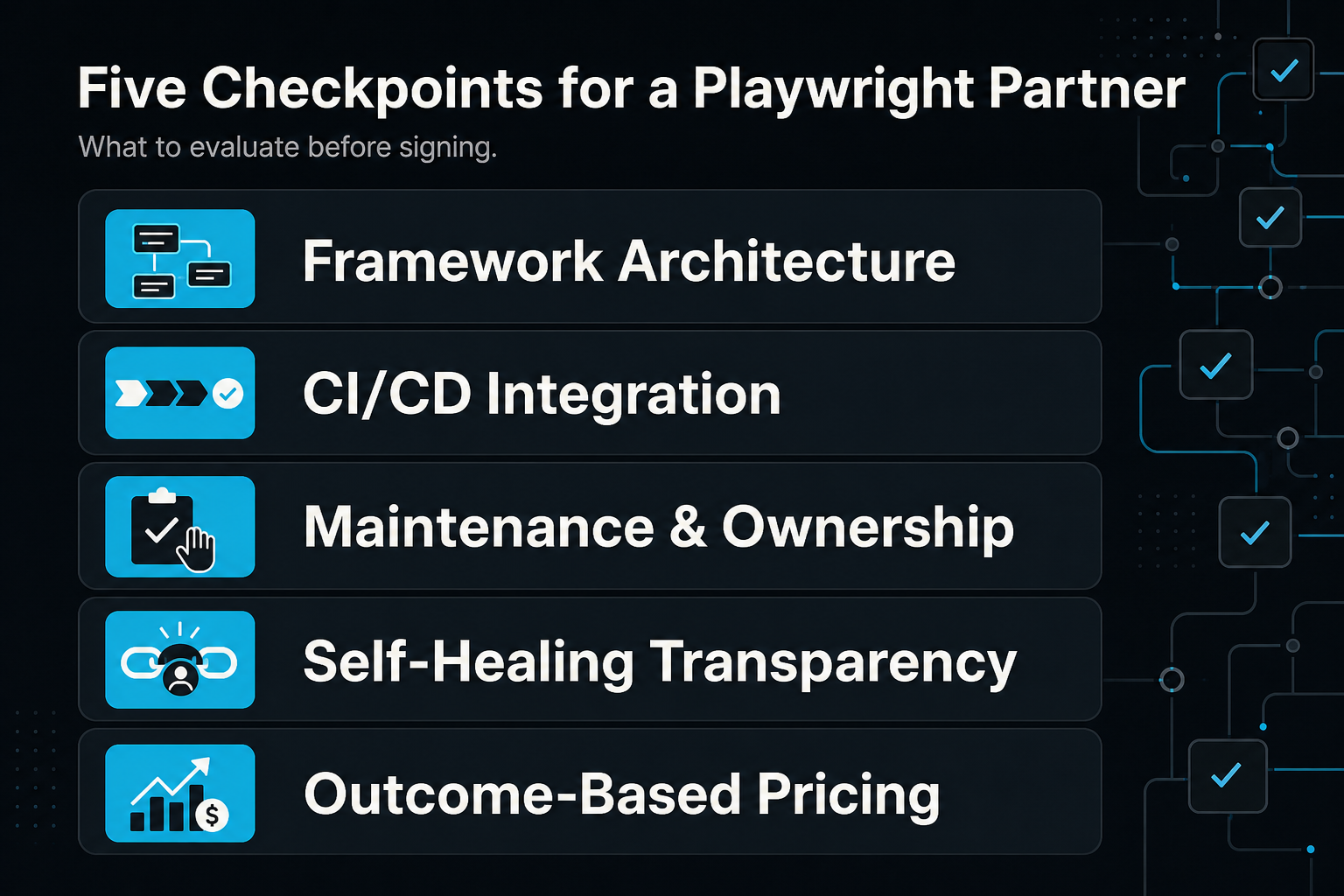
Choosing a Playwright automation partner comes down to five checkpoints: proven framework architecture, real CI/CD integration experience, transparent maintenance practices, a clear ownership model for the code they write, and pricing tied to outcomes rather than hours logged. Playwright has become the default framework for web test automation, with adoption now estimated around 45 percent among QA professionals and more than 57 million weekly npm downloads [testdino.com], which means most vendors will claim expertise. The evaluation work is figuring out which ones can actually back that claim with engineering discipline, not just familiarity with the syntax.
TL;DR
- Playwright fluency isn't enough: ask vendors how they structure test architecture, not just whether they "use Playwright."
- Self-healing claims need scrutiny: native Playwright locators are resilient, but true AI self-healing requires third-party tooling with real tradeoffs.
- Ownership matters more than price: confirm who owns the automation framework before you sign, not after.
- Compare total cost of ownership, not hourly rates, when weighing in-house QA engineers against a managed QA service.
- Test automation ROI depends on maintenance overhead as much as initial coverage speed.
About the Author: This article draws on MuukTest's experience building and maintaining Playwright-based automation frameworks for software and SaaS companies across industries, where the company's QA engineers and Amikoo AI agents work together to reach up to 95% test coverage in weeks rather than months.
What Does "Playwright Expertise" Actually Mean for a Vendor?
Most vendors can write Playwright test scripts that pass, but few design test architecture that scales. A useful analogy: anyone can follow a recipe to bake one loaf of bread, but a bakery that supplies a hundred stores needs standardized processes, quality checks, and a plan for when ingredients change. Playwright's own best practices guidance emphasizes writing resilient tests that survive UI changes, using user-facing locators over brittle CSS selectors, and isolating tests so failures are easy to diagnose playwright.dev. A partner worth hiring should talk about these practices unprompted.
Ask prospective vendors to walk through their approach to test isolation, locator strategy, and parallelization. If the answer is vague or focused entirely on tool familiarity rather than architecture decisions, that's a signal the team hasn't operated at scale. Teams that have scaled Playwright across large suites typically describe specific tradeoffs: how they handle flaky network calls, how they structure page object models, and how new engineers onboard into the suite within days, not weeks.
How Do You Verify Claims About Self-Healing Tests?
Self-healing in Playwright spans a spectrum from built-in resilient locators to full AI-driven element discovery. Playwright natively supports locators like getByRole and getByText that remain stable even when the underlying DOM structure changes, which already eliminates a large share of maintenance pain. True self-healing, where a test automatically adapts when an element is renamed or relocated, generally requires third-party integrations or custom LLM wrappers layered on top of Playwright.
At MuukTest, this is where Forward Deployed QAs stay in the loop. Amikoo's Repair Agent repairs broken tests and diagnoses each failure as either a real product defect or a test issue, and the QAs review that judgment instead of letting tests heal silently.
That added layer comes with documented tradeoffs worth asking about directly. Silent healing is the biggest risk: a test can attach itself to the wrong element and still report a pass, masking a real functional bug. High-volume LLM-based element discovery also adds API costs that scale with suite size, and reviewers still need a human in the loop to confirm that healed tests preserve the original business logic rather than just technically executing. A credible partner will explain exactly which layer of healing they use and where they insert human review, rather than presenting "AI self-healing" as a solved problem.
What Vendor Evaluation Criteria Should Be on Your Checklist?
Standard vendor evaluation criteria for test automation partners cover five areas: scalability, platform coverage, CI/CD integration, automation maturity, and security compliance. These criteria show up consistently in QA vendor selection frameworks because they predict whether a partner can support you past the pilot phase, not just during the sales demo.
| Criterion | What to Ask | Why It Matters |
|---|---|---|
| Scalability | Can the suite handle 10x the current test count without a rebuild? | Avoids a costly framework rewrite as your product grows |
| Platform coverage | Do they cover web, API, and mobile, or just web? | Playwright doesn't natively support mobile; Appium remains the standard there |
| CI/CD integration | How do they integrate with your existing pipeline and bug tracker? | Determines how fast feedback loops run for developers |
| Automation maturity | What percentage of tests are automated vs. manual exploratory? | Signals real coverage depth, not vanity metrics |
| Security and compliance | Do they have, or are they pursuing, a SOC 2 Type II report, and how do they handle your data? | Matters for regulated industries and enterprise procurement |
A structured checklist like this also protects you from vendors that demo well but can't answer specifics about framework architecture or CI/CD depth under direct questioning. If you're comparing multiple managed QA service options, run every finalist through the same checklist so the comparison is apples to apples.
Should You Compare In-House, Outsourced, and Managed QA Automation Costs?
Yes, because the three models carry meaningfully different cost structures, and headline pricing alone will mislead you. In-house QA teams carry the highest fixed costs, often exceeding $25,000 to $50,000 monthly for a full team once salaries, benefits, and tooling are included. Traditional outsourced QA typically reduces that spend by 60 to 70 percent through hourly rates in the $25 to $70 range, but hourly billing means costs scale with hours worked rather than outcomes delivered.
Managed QA automation services typically charge a flat monthly fee that scales with suite size. Instead of paying for hours, you're paying for coverage that's built, run, and maintained, with less management overhead on your side.
The decision to hire QA engineers directly versus engaging a managed partner becomes a real tradeoff rather than a cost question alone. Direct hires give you full control and institutional knowledge, but ramp-up time and hiring costs delay the benefit. A managed service, by contrast, can move faster because the team arrives with frameworks already built. Services like MuukTest are built around this middle path: a fully managed Playwright automation practice that extends a lean in-house team rather than replacing it, with pricing structured around tests under management instead of hours billed.
What Questions Should You Ask Before Signing?
Building on the cost comparison above, the harder question is what to ask during the sales process to confirm a vendor will perform as promised. Specific, pointed questions reveal more than any case study a vendor hands you.
- Who owns the code? Confirm in writing that the automation framework becomes your property, not something licensed back to you.
- What's the maintenance plan? Ask how they handle test flakiness and locator breakage after the initial build, since this is where most automation investments quietly fail.
- How is coverage measured? Get a specific coverage target and timeline, not a vague promise of "comprehensive testing."
- What's the escalation path? Ask what happens when a critical bug slips through, and who is accountable.
- Can they show real architecture decisions? Request a walkthrough of how they structure page objects, fixtures, and parallel execution, not just a finished report.
- How do they integrate AI tooling? If they use AI agents for test generation or healing, ask where human review sits in that workflow.
Vendors that answer these questions with specifics, rather than marketing language, are the ones worth moving forward with. What a complete service should include is detailed in MuukTest's guide on QA automation services, which walks through what to expect from a managed provider as your next step.
Frequently Asked Questions
Is Playwright better than Selenium for a new automation partnership?
Playwright has overtaken Selenium in adoption for web testing, offering faster execution and built-in resilient locators. Selenium remains deeply entrenched in legacy enterprise systems, so the right answer depends on your existing stack rather than a blanket preference.
Does Playwright handle mobile testing?
Partly. Playwright can emulate mobile browsers and viewports, but it doesn't automate native iOS or Android apps; Appium is widely used for that.
What's a reasonable timeline to reach solid test coverage?
Timelines vary by application complexity, but managed automation services that combine AI-assisted test generation with experienced engineers can typically reach substantial coverage in weeks rather than the months a from-scratch in-house build usually takes.
How do I measure test automation ROI?
Track reduced manual regression hours, time to release, and defect escape rate before and after automation, then weigh those against the monthly cost of whichever managed QA service or in-house model you choose.
Can self-healing tests fully replace manual test maintenance?
Not entirely. Self-healing reduces maintenance volume but introduces risks like silent healing, where a test keeps passing against the wrong element, so human review of healed tests remains necessary.
What should be in a vendor contract for Playwright automation?
Clear language on code ownership, coverage targets, maintenance responsibilities, and escalation procedures for critical defects. Avoid contracts that are vague about who owns the resulting test suite.
About MuukTest
MuukTest is a managed QA service that builds and maintains automated test suites for lean engineering teams. The company builds frameworks on industry-standard tools like Playwright, Selenium, and Appium, and clients fully own the resulting automation framework. This approach lets teams reach broad test coverage in weeks while avoiding the exit costs that come with proprietary testing platforms. MuukTest works as a managed QA partnership that extends lean engineering teams, covering web, mobile, API, regression, and end-to-end testing without requiring additional hires. Behind the service are expert Forward Deployed QAs, who decide what to cover, which workflows matter, and where the real risk is, working with Amikoo, MuukLabs' AI tool for test generation, repair, maintenance, and defect detection.
If you're weighing a Playwright automation partner against building in-house, talk to MuukTest about what a fully managed, outcome-based engagement could look like for your release cycle.
References
- Best Practices | Playwright (playwright.dev)
- Playwright Market Share: Usage Data, Downloads & Trends (testdino.com)
