

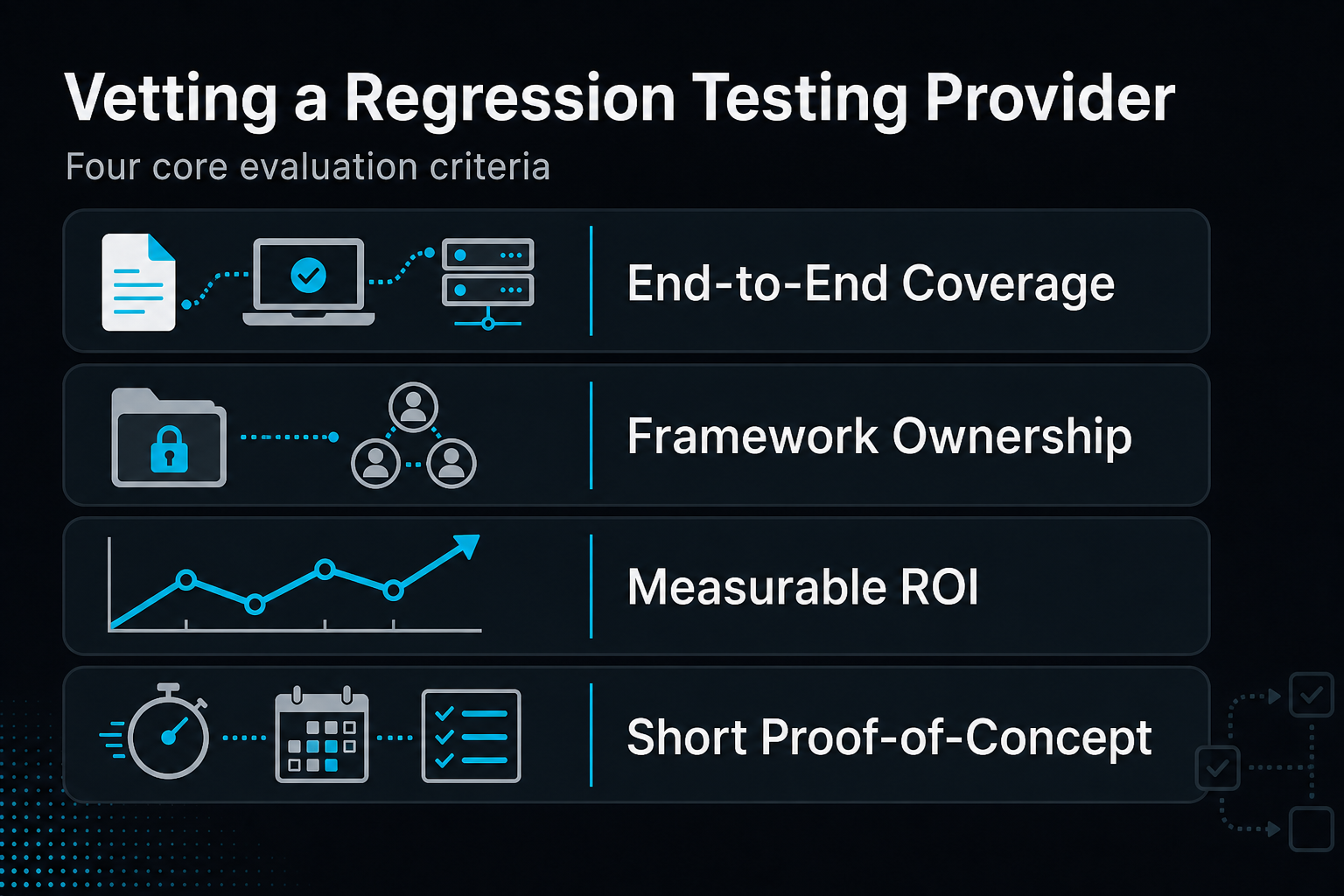
Vetting a regression testing provider comes down to four things: whether their process covers your product end-to-end, from user stories to what's actually running in production, how fast they can stand up a working suite, whether you keep the resulting automation framework if you ever leave, and whether their ROI claims hold up against real numbers instead of promises.
TL;DR
- End-to-end coverage means tracing a real user journey: from the story that described a feature to the behavior currently running in production, not just testing isolated screens or endpoints.
- Framework ownership prevents lock-in: ask who holds the automation scripts and configuration after the contract ends.
- ROI should be measurable within weeks: coverage growth, time-to-first-suite, and defect escape rate are better signals than a vague promise of quality.
- A short proof-of-concept engagement is the cheapest way to validate a provider's claims before committing to a full contract.
- Regression, functional, and end-to-end testing should work together, not as separate line items handled by separate vendors.
About the Author: MuukTest’s Forward Deployed QAs, bring more than 2 decades of QA experience in automated regression testing for software companies and for enterprises in logistics, media, admin, and financial services.
What Does "End-to-End Regression Coverage" Actually Mean?
End-to-end regression coverage means a test suite that follows a user's actual path, from the story or acceptance criteria that described a feature to the behavior currently running in production, rather than testing isolated functions or screens in a vacuum. A suite that only verifies that individual components still work in isolation can pass every test and still miss the fact that a multi-step checkout flow breaks halfway through.
A provider worth hiring can explain how their suite maps back to the user stories or acceptance criteria a feature was built against, not just which framework they use to click buttons. Ask any candidate provider to walk through one real example: a feature, the story behind it, and the test coverage that traces back to it. Also ask where coverage starts. Strong providers enable coverage at several points: user stories, development IDEs, pull requests and code changes, release pushes, and production. A provider that only tests after code is merged is testing late, not shift-left.
What Should a Regression Testing Checklist Actually Cover?
A thorough checklist treats regression, functional, and end-to-end testing as connected parts of the same picture rather than separate, disconnected line items. Ask a provider to show you their actual coverage and pass-rate numbers on a comparable project, not just industry benchmarks.
| Testing Type | What It Verifies | Key Vetting Question |
|---|---|---|
| Regression | New code hasn't broken existing functionality | How often do suites run, and how are flaky tests handled? |
| Functional | Each feature behaves as specified | Is coverage measured and reported, or assumed? |
| End-to-end | A full user journey works start to finish, not just isolated steps | Does the suite trace back to real user stories, or just click through screens? |
A provider who can't speak to these distinctions in a sales conversation likely doesn't track them internally either, which means you won't get them in a monthly report.
How Do You Measure Test Automation ROI Before Signing a Contract?
Return on investment from a testing provider should be visible within weeks, not quarters, and measured in concrete terms rather than promises. To evaluate automation ROI claims from any provider, ask for:
- Time to first working suite: weeks or months? A long ramp-up delays every other benefit.
- Coverage percentage over time: a chart showing coverage growth, not a single end-state number.
- Defect escape rate: how many bugs reached production after their testing was in place, compared to before.
- Framework ownership: if you ended the contract tomorrow, would you keep a usable, documented automation suite, or would it disappear with the vendor?
A managed QA approach that combines AI-driven agents with experienced engineers can help build a client-owned automation framework, so the coverage and the knowledge stay with your team rather than locked inside a vendor's proprietary system. That ownership question alone eliminates a surprising number of otherwise-attractive providers.
What Should a Proof-of-Concept Engagement Look Like Before You Commit?
A short, scoped pilot is the cheapest way to validate a provider's claims before signing a full contract. A focused proof-of-concept against one real, user-story-mapped workflow should produce a working, documented test suite within a few weeks. Longer timelines usually indicate the provider is still learning your system rather than applying established processes.
Before expanding a pilot into a full engagement, confirm the suite the provider built during the proof-of-concept is one you could keep running and extending yourself, in a standard framework, if the relationship ended there.
Frequently Asked Questions
What's the difference between regression testing and end-to-end testing?
Regression testing confirms that new code hasn't broken existing functionality. End-to-end testing confirms that a full user journey works from start to finish. A thorough provider treats them as connected, not as separate line items with separate tooling.
How long should a regression testing pilot take?
A focused pilot on one real, user-story-mapped workflow should produce a working, documented test suite within a few weeks, not months.
What does "owning the automation framework" actually mean in practice?
It means the test scripts, configuration, and documentation are written in a standard framework like Playwright and kept in your own repository, so your internal team can run and modify them without the vendor, avoiding dependency on proprietary tooling.
How is end-to-end coverage different from just having a lot of tests?
Coverage percentage alone doesn't tell you whether the right user journeys are tested. End-to-end coverage means tracing specific user stories through to the behavior currently running in production, not just counting test cases.
Should I expect to see ROI in the first month?
Early signals like time to first working suite and initial coverage show up within weeks. Defect escape rate takes a full release cycle or two to become a meaningful number.
About MuukTest
MuukTest is a managed QA service that builds and maintains automated test suites for lean engineering teams. The company builds frameworks on industry-standard tools like Playwright, Selenium, and Appium, and clients fully own the resulting automation framework. This approach lets teams reach broad test coverage in weeks while avoiding the exit costs that come with proprietary testing platforms. MuukTest works as a managed QA partnership that extends lean engineering teams, covering web, mobile, API, regression, and end-to-end testing without requiring additional hires. Behind the service are expert Forward Deployed QAs, who decide what to cover, which workflows matter, and where the real risk is, working with Amikoo, MuukLabs' AI tool for test generation, repair, maintenance, and defect detection.
If your team wants a regression testing partner that covers your product end-to-end, from user stories to what's live in production, get in touch with MuukTest to see how a short proof-of-concept engagement could work for your release cycle.
