

QA as a service and staff augmentation solve different problems, and confusing the two is the fastest way to blow a testing budget. Staff augmentation puts engineers under your direct management for a defined stretch of work, billed hourly, with you carrying the coordination and ramp-up cost. QA as a service hands you an outcome, a tested and maintained product, under a flat-rate or subscription model where the vendor owns the process, the tooling, and the maintenance burden. The budget impact isn't subtle: staff augmentation costs scale with hours worked and management overhead, while managed QA services scale with coverage delivered.
TL;DR
- Different pricing mechanics: Staff augmentation bills hourly (offshore rates around $18-$55, nearshore $60-$120) while QA as a service uses predictable flat-rate or subscription pricing.
- Hidden overhead is real: Coordination, rework, and management time add real overhead to a staff augmentation invoice that never shows up on the rate card.
- Control vs. accountability trade-off: Staff augmentation gives you direct control over prioritization; managed services give you an outcome under a service agreement.
- Market momentum favors managed models: Testing services are shifting toward managed QA models.
- Time to value varies by vendor: managed automation platforms generally reach initial coverage faster than standing up an in-house framework from scratch.
About the Author: MuukTest is a managed QA service that pairs senior QA engineers with its Amikoo AI agents to build owned automation frameworks for startups and scaleups. This piece draws on that operating experience to unpack where staff augmentation and QA as a service genuinely differ, and why that difference shows up directly on your P&L.
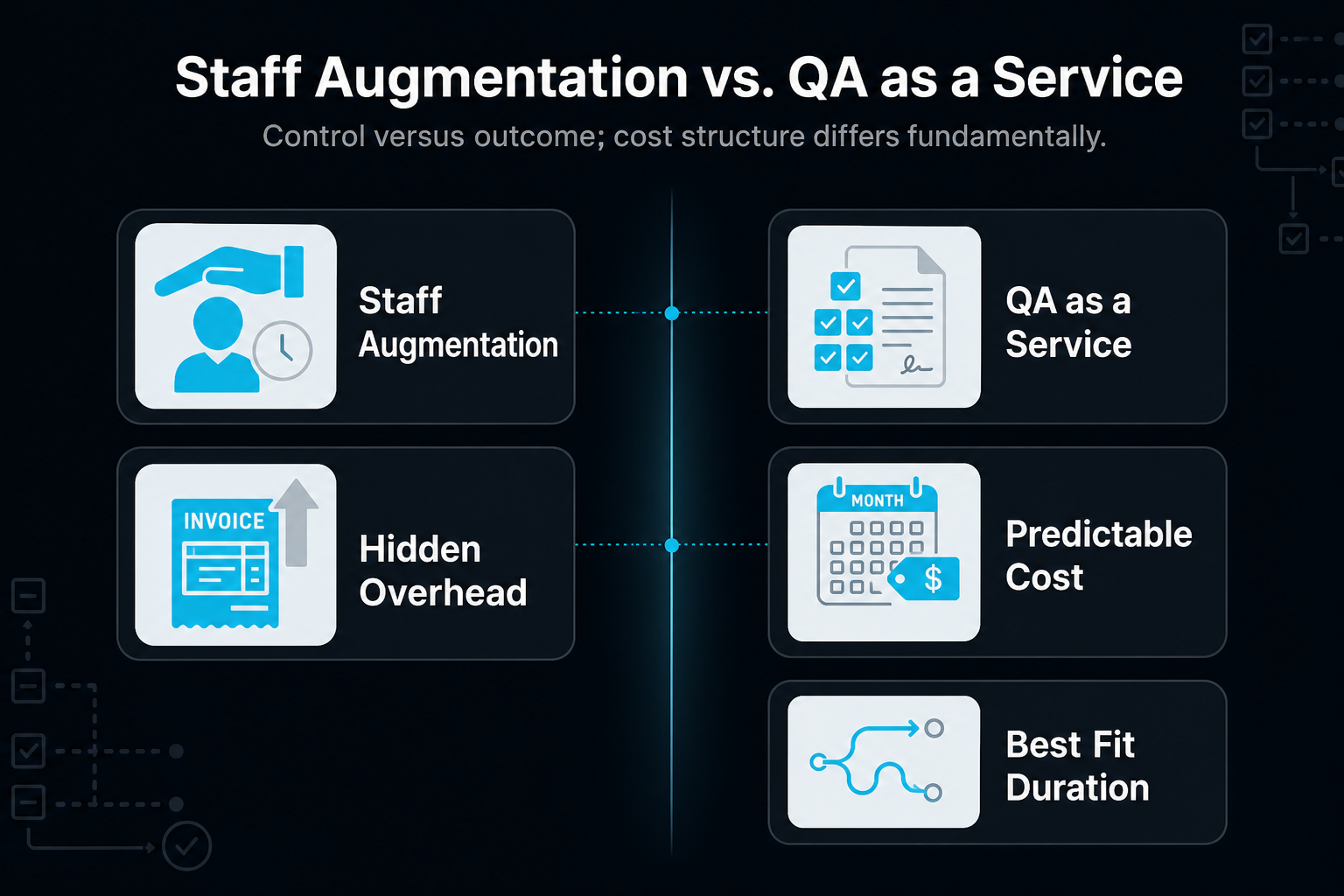
What Is the Real Difference Between QA as a Service and Staff Augmentation?
Staff augmentation means hiring individual contractors or engineers who work under your direction, using your tools, your process, and your management structure [valuecoders.com][cyntexa.com]. QA as a service, sometimes bundled under the broader term managed QA services, means contracting a provider to deliver a testing outcome, test coverage, defect detection, release confidence, under a service agreement where the provider owns the methodology.
Think of it like the difference between hiring a temp electrician for your office versus contracting a facilities management company to guarantee the lights stay on. The temp electrician works exactly the hours you assign and you supervise the job. The facilities company doesn't care how many electricians it takes; it's accountable for uptime. That distinction, who owns the outcome versus who owns the hours, is the single biggest driver of cost predictability.
Staff augmentation pros include rapid access to talent, with onboarding often measured in days, and direct control over work prioritization and tools [softura.com]. It also tends to reduce managerial complexity compared to larger managed engagements, since you're adding individuals rather than a full external process [360degreecloud.com]. The trade-off is that you still carry the management burden, the ramp-up time, and the risk of turnover disrupting a project mid-stream.
How Do Staff Augmentation and Managed Services Differ From Each Other?
Building on the ownership distinction above, it helps to separate staff augmentation from managed services proper, since the two get conflated constantly in vendor pitches. Staff augmentation integrates individual specialists directly into your existing team and workflow, while managed services transfer an entire project or function to an external organization that manages it independently [cyntexa.com]. In practice, staff augmentation gives you engineers under your supervision; managed services (and by extension, QA as a service) give you a deliverable under someone else's supervision.
CTOs evaluating staff augmentation vs managed services generally cite direct team integration, faster onboarding, and tighter alignment with internal priorities as the reasons they lean toward augmentation for short, well-scoped efforts [valuecoders.com]. That preference makes sense for a six-week sprint to clear a backlog. It makes less sense for an ongoing function like regression testing, which needs to run every release, indefinitely, without you re-managing it each time.
A useful rule of thumb: staff augmentation suits short-term projects in the three-to-six-month range, while managed services fit ongoing operations of twelve months or longer [multidots.com]. QA, almost by definition, is an ongoing operation. Every release needs testing, not just the next one.
Why Does Staff Augmentation Often Cost More Than It Looks?
The quoted hourly rate is never the full cost, and this is where budgets quietly erode. Offshore staff augmentation rates typically run $18 to $55 per hour, and nearshore rates run $60 to $120 per hour, but hidden overhead for coordination, context-switching, and rework can add 40 to 70 percent on top of the invoice. That overhead doesn't appear as a line item; it shows up as your engineering manager's time spent writing specs, reviewing output, and fixing gaps that a less-integrated contractor missed.
QA as a service, by contrast, uses a predictable subscription or flat-rate pricing model where the vendor absorbs the management and maintenance overhead. You're not paying for hours spent figuring out how your codebase works; you're paying for a maintained test suite that already runs against it. Managed QA services typically offer subscription-based pricing where you can forecast spend a year out, unlike an hourly augmentation contract where total spend depends on how smoothly the engagement goes.
Here's a direct comparison of where the cost actually lives:
| Factor | Staff Augmentation | QA as a Service / Managed QA |
|---|---|---|
| Pricing model | Hourly rate, variable total | Flat-rate or subscription, predictable total |
| Who owns outcomes | You (client manages the work) | Vendor (service agreement covers delivery) |
| Hidden costs | Coordination, rework, ramp-up (40-70% overhead) | Bundled into subscription; vendor absorbs maintenance |
| Best fit duration | 3-6 months, defined scope | 12+ months, ongoing operations |
| Time to initial value | Varies with onboarding and ramp-up | Typically 2-4 weeks for managed platforms |
Is QA as a Service the Same as Manual Outsourcing or Crowdtesting?
No, and this distinction matters when you're comparing vendors. Traditional software testing outsourcing historically meant handing a QA budget to a firm that staffed manual testers, sometimes a crowdsourced pool, to click through test cases. Modern QA as a service looks different: it combines automated test frameworks, frameworks like Playwright, Selenium, or Appium, with engineers who build and maintain them, rather than relying on manual labor alone.
The technical differences between those frameworks matter for coverage decisions. Playwright uses an out-of-process architecture with direct WebSocket control, giving fast, multi-browser web testing with built-in auto-wait. Selenium relies on the W3C WebDriver protocol, offering the broadest language and legacy browser support at the cost of higher network latency. Appium handles cross-platform mobile automation for native and hybrid iOS and Android apps without recompilation, though typically with slower execution and more complex setup.
This is where MuukTest differs from both crowdtesting and staff augmentation. MuukTest's Forward Deployed QAs aren't contractors you manage; they work as part of the service, deciding what to cover, which workflows matter, and where the real risk is, while Amikoo, MuukLabs' AI testing tool, handles test generation, repair, and maintenance. MuukTest owns the outcome, and the tests live as standard Playwright TypeScript in your own repository, so there's no vendor lock-in.
How Do QA Services Compare on Architecture and Approach?
Not all QA services solve the coverage problem the same way, and the architectural differences affect both cost and control. Some providers offer cloud orchestration infrastructure with parallel test execution via containers and VMs. Others run cloud-based platforms with self-healing test architecture and dedicated test managers, though pricing tied to test-run volume can mean overage fees as usage grows.
Some take an AI-native approach on Playwright-based infrastructure with managed tiers. Others lean on global tester networks layered with AI orchestration, useful for localization and accessibility testing across many markets. Still others embed dedicated teams into a client's CI/CD environment for vendor-neutral automation, which means an onboarding period before the team is fully productive.
Where this leaves you depends on what you're optimizing for: speed to initial coverage, breadth of manual device and locale testing, or a framework your own engineers can read and extend after the engagement. Our guide to evaluating managed QA partners walks through the selection criteria for finding the right fit.
Frequently Asked Questions
Is QA as a service more expensive than staff augmentation?
Not typically on a total-cost basis. Staff augmentation's hourly rates look lower upfront, but coordination and rework overhead can add 40-70% to the real cost, while QA as a service bundles that overhead into a flat subscription.
When does staff augmentation make more sense than managed QA services?
Staff augmentation fits short, well-defined projects (roughly 3-6 months) where you want direct control over prioritization and already have the management bandwidth to supervise contractors [multidots.com][softura.com].
Do I lose control of my test suite with a managed QA service?
That depends on the vendor. Some providers keep the automation framework proprietary; others, including MuukTest, deliver a client-owned framework: tests are standard Playwright TypeScript in your own repository, so your team can read, run, and extend them at any time.
How long does it take to see value from managed QA services?
It depends on scope, but managed QA services usually deliver first automated coverage of critical flows within weeks, much faster than building an in-house framework from scratch. MuukTest, for example, targets comprehensive regression coverage within 8 to 12 weeks, with critical user flows covered first.
What's the difference between staff augmentation vs managed services for QA specifically?
Staff augmentation embeds individual testers into your team under your management; managed services (including QA as a service) hand the entire testing function to an external provider accountable for the outcome [cyntexa.com].
Does QA as a service replace my in-house QA team?
No. Managed QA services are designed to extend a lean in-house team, handling automation build-out and maintenance so your existing engineers can focus on exploratory testing and higher-judgment work instead.
About MuukTest
MuukTest is a managed QA service that builds and maintains automated test suites for lean engineering teams. The company builds frameworks on industry-standard tools like Playwright, Selenium, and Appium, and clients fully own the resulting automation framework. This approach lets teams reach broad test coverage in weeks while avoiding the exit costs that come with proprietary testing platforms. MuukTest works as a managed QA partnership that extends lean engineering teams, covering web, mobile, API, regression, and end-to-end testing without requiring additional hires. Behind the service are expert Forward Deployed QAs, who decide what to cover, which workflows matter, and where the real risk is, working with Amikoo, MuukLabs' AI tool for test generation, repair, maintenance, and defect detection.
If your team is weighing staff augmentation against a managed approach to QA, it's worth running the numbers on both the visible rate and the hidden coordination cost before deciding. Visit MuukTest to see how a managed QA service with full framework ownership compares for your budget and timeline.
References
- How to Choose Between Staff Augmentation and Managed Services (multidots.com)
- Managed Services vs. Staff Augmentation (360degreecloud.com)
- IT Staff Augmentation vs Managed Services: Which Fits Your Roadmap? (softura.com)
- Staff Augmentation vs Outsourcing: What CTOs Prefer and ... (valuecoders.com)
- Staff Augmentation vs Outsourcing: Key Differences (cyntexa.com)
