
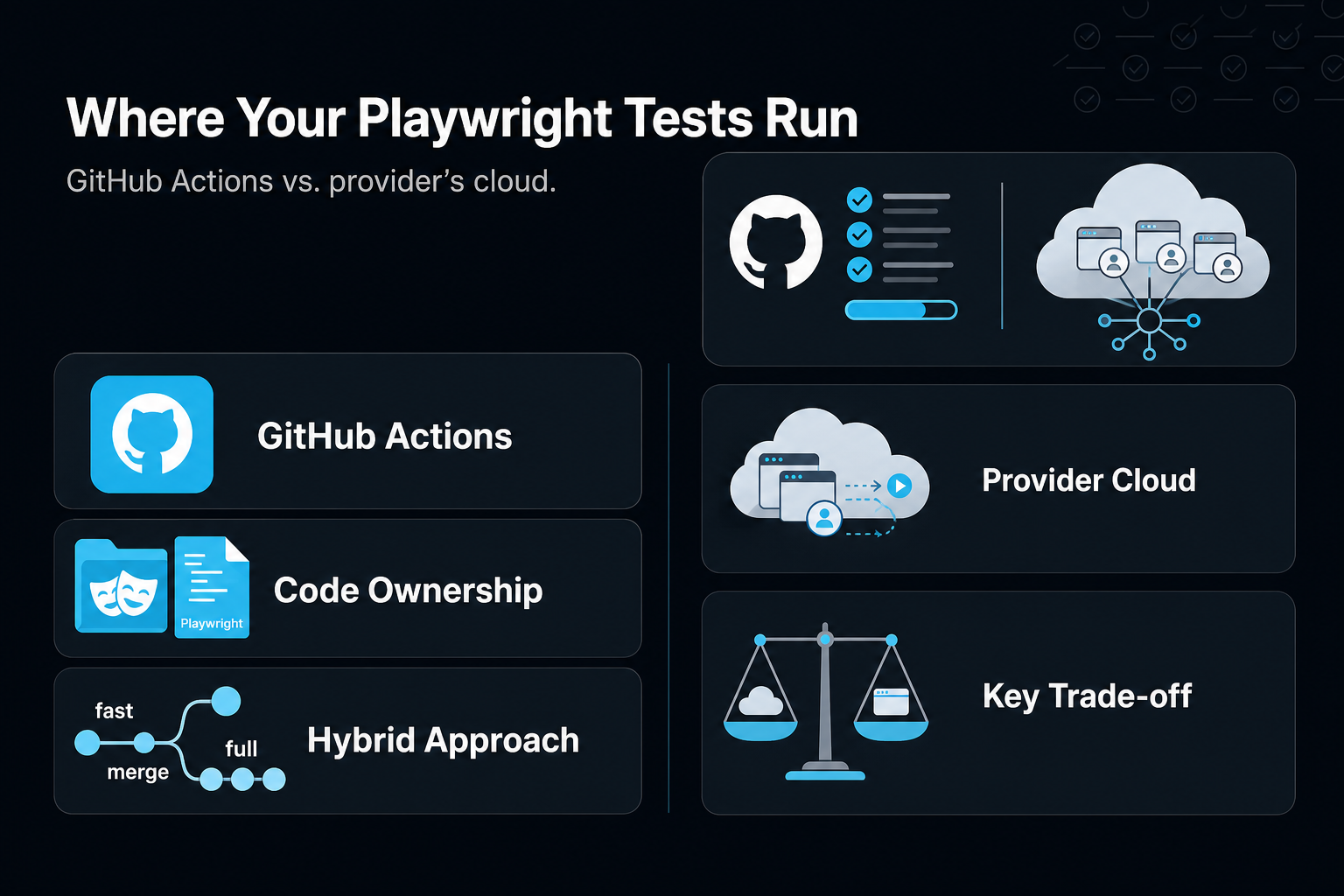
Where your Playwright suite runs is a smaller decision than most teams think, and whether you own the test code is a bigger one. A managed suite can run in your own GitHub Actions pipeline, where results appear as pull request checks and you pay for runner minutes. It can also run in the provider's cloud, where the provider maintains the infrastructure and your pipeline starts each run through an API or CLI. The choice comes down to three factors: how reachable your test environments are, how much parallel capacity you need, and who should maintain the runners.
TL;DR
- Code and compute are separate decisions: Who maintains the suite does not depend on where it executes, as long as the tests are in your repository.
- GitHub Actions keeps tests next to your code: Results can block merges as status checks, and Playwright supports GitHub-based CI out of the box.
- The provider's cloud takes infrastructure off your plate: In exchange, your environments must be reachable from the provider's network.
- A hybrid setup often works best: Run smoke tests on every pull request and full regression after each deploy.
About the Author: This guide comes from the team behind MuukTest, a managed qa service. Its Forward Deployed QAs decide what to cover and where the real risk is, while Amikoo, MuukLabs' AI tool, generates, repairs, and maintains Playwright suites that run either in clients' CI/CD tools (GitHub Actions, GitLab CI, Jenkins, CircleCI, and Azure DevOps) or on MuukTest's own cloud.
Code and compute are separate decisions
A managed Playwright suite is a set of Playwright tests that a qa partner designs, writes, and maintains. The partner is accountable for what gets covered, for keeping tests green, and for triaging failures. Execution can then happen on infrastructure that you operate or that the partner operates.
Think of the suite as a recipe you own. You can cook it in your own kitchen or in a rented commercial one. The dish comes out essentially the same because the instructions are identical. What changes is who buys the stove and who does the washing up.
- Your pipeline is about proximity: Tests run where your code is and report where developers already look.
- The provider's cloud is about handing off work: Someone else maintains the browsers, the runners, and the scaling.
This is why portability matters more than your first choice. If the code is yours, changing your mind later is cheap.
Running Playwright in GitHub Actions
Running in your own pipeline is the option closest to your code, and Playwright was built for it. Playwright's documentation provides sample configurations for common CI providers, including GitHub Actions. A typical Playwright GitHub Actions setup has five steps:
- Trigger: The workflow starts on pull_request or push events.
- Install: The job installs dependencies and browsers with npx playwright install --with-deps.
- Run: npx playwright test executes the suite. You can split it across a job matrix with the --shard flag.
- Report: The job uploads the HTML report and traces as artifacts, so you can debug failures.
- Gate: Branch protection makes the job a required check, so a failing suite blocks the merge.
According to GitHub's workflow syntax documentation, a matrix can generate up to 256 jobs per workflow run, which is far more shards than most suites need. Hosted runners are billed per minute, so a large suite that runs on every commit has a cost you will see. What if staging sits behind a VPN? Self-hosted runners put execution inside your network, but your team then has to maintain those machines.
Running the suite in the provider's cloud
A related but distinct model moves execution off your runners entirely. The provider hosts the browsers and parallel workers, and your pipeline starts each run through an API or CLI call. If that pipeline step waits for the result, cloud runs can still block pull requests.
- Infrastructure: Browser updates and runner capacity become the provider's job.
- Network access: Your test environment must be reachable from outside your network. This usually means IP allowlisting or a public staging URL.
- Secrets: Test credentials must be shared with the provider.
In our view, environment access settles this choice more often than compute cost does. With MuukTest, infrastructure, tools, and maintenance are all included in the service. It can also test against ephemeral environments such as Shipyard, which helps when each pull request gets its own preview build. Because the tests are standard Playwright TypeScript stored in your own repository, services like MuukTest let you run them in the provider's cloud or your own CI/CD and switch between the two without rewriting a single test.
Choosing the option that fits your team
Stepping back from the mechanics, the decision is a trade between control and operational load.
| Factor | Your GitHub Actions pipeline | Provider's cloud |
|---|---|---|
| Runner maintenance | You (or GitHub, for hosted runners) | The provider |
| Compute billing | Per minute on hosted runners | Set by the provider's terms |
| Private environments | Simple with self-hosted runners | Needs allowlisting or exposed staging |
| Exit cost | Low | Low only if the tests are standard code in your repo |
A hybrid setup is often the strongest choice. Run a fast smoke subset on every pull request in GitHub Actions, where quick merge decisions matter most. Then run full regression after each deploy, where parallel capacity matters more than being close to the code. MuukTest's pipeline integrations support both triggers.
Self-healing test automation works the same in both setups
Maintenance travels with the code, not the runner. Self-healing test automation updates tests when the UI shifts, for example when a button is renamed or a field moves. When those repairs are made to test code in your repository, the fixed test behaves the same on a GitHub runner as on a cloud worker. Self-healing has limits, though. A redesigned checkout still needs a person to decide what the test should now verify.
The same logic applies to Playwright test coverage: what counts is which workflows you test, not where they run. A platform sells you test-creation software you run yourself, while a managed service takes accountability for which tests exist and what they cover. In MuukTest's model, Forward Deployed QAs decide what to cover, which workflows matter, and where the real risk is. Amikoo, MuukLabs' AI tool, generates, repairs, and maintains the tests; those tests are standard Playwright TypeScript that live in the client's own repository. A human qa expert reviews failures before notifying your team, so alerts point to real issues.
Frequently Asked Questions
Can Playwright run in GitHub Actions without extra tooling?
Yes. Playwright's own documentation provides a sample GitHub Actions configuration that runs tests on push and pull request events.
Do we own the tests if the provider runs them?
Ownership depends on where the code lives, not where it runs. Standard Playwright code in your repository stays yours.
Can cloud runs block a pull request?
Yes, as long as your workflow starts the run and waits for the result.
How do we speed up a large suite in GitHub Actions?
Shard it across a job matrix, and run the full suite after deploys rather than on every commit.
Which option is cheaper?
It depends on suite size, how often you run it, and the provider's terms. Compare per-minute runner charges with what the provider includes in its price.
About MuukTest
MuukTest is a managed qa service that builds and maintains automated test suites for lean engineering teams. The company builds frameworks on industry-standard tools like Playwright, Selenium, and Appium, and clients fully own the resulting automation framework. This approach lets teams reach broad test coverage in weeks while avoiding the exit costs that come with proprietary testing platforms. MuukTest works as a managed qa partnership that extends lean engineering teams, covering web, mobile, API, regression, and end-to-end testing without requiring additional hires. Behind the service are expert Forward Deployed QAs, who decide what to cover, which workflows matter, and where the real risk is, working with Amikoo, MuukLabs' AI tool for test generation, repair, maintenance, and defect detection.
If you are deciding where your Playwright suite should run, MuukTest can review your pipeline and environments with you. Learn more at muuktest.com.
