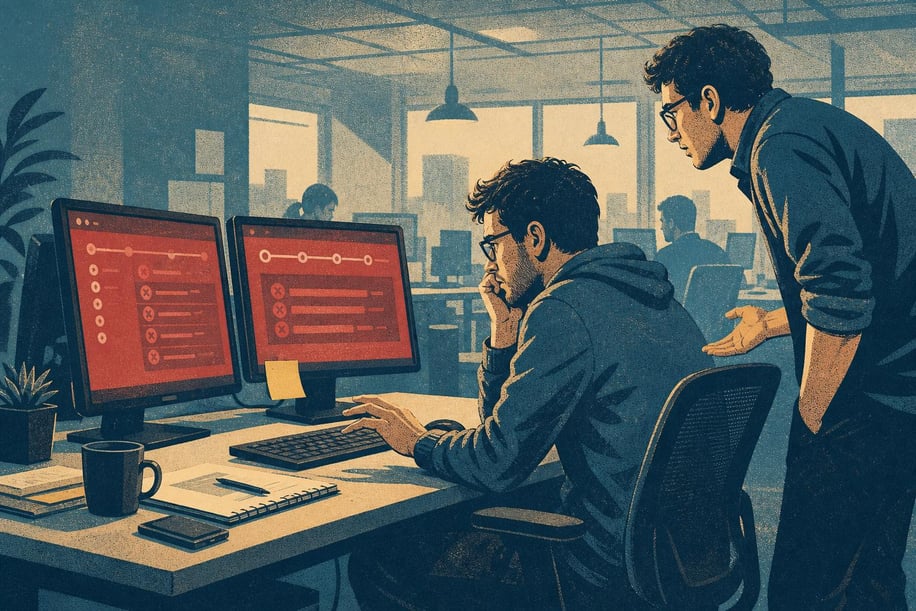
When your only SDET leaves, your automated test suite does not fail on day one. It decays. The tests keep running, but nobody remembers why specific checks exist. Flaky failures get muted instead of fixed. New features ship without coverage. Eventually the suite no longer reflects where your product can break. The fix is to move suite knowledge out of one person's head and into three places: readable code, documented coverage decisions, and a named maintenance owner.
TL;DR
- A suite loses context before it loses code. The reason behind each test disappears first.
- Muted flaky tests and "rerun until green" habits erode trust faster than any outright failure.
- Self-healing test automation repairs broken locators, but it cannot decide what deserves coverage.
- Rehiring alone recreates the single point of failure. Whatever option you choose, keep ownership of the code and the coverage decisions.
What actually breaks first when the only SDET leaves?
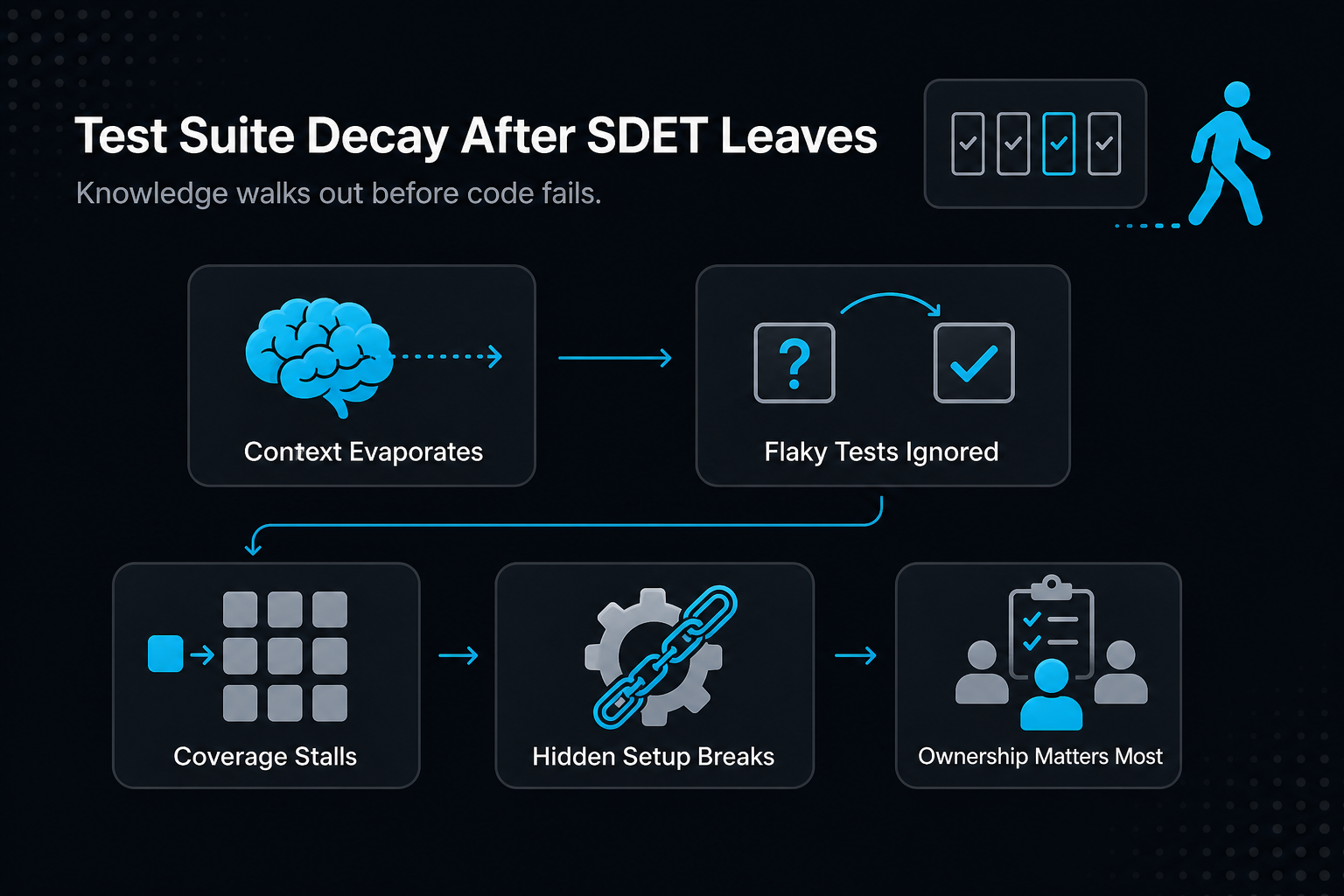
The suite rarely breaks loudly. What breaks first is context, and the damage follows a predictable order.
- Early on, everything looks fine: CI stays mostly green, so nobody treats the departure as a quality risk.
- Flaky tests get skipped: A test fails intermittently and nobody knows whether it is a timing hack or a real bug. So it gets disabled "for now."
- Coverage stops growing: New features ship without tests because writing them in an unfamiliar framework feels slower than shipping.
- Hidden setup surfaces: Test accounts expire, seeded data drifts, or a credential only the SDET managed stops working.
- Trust collapses: Developers rerun failures until they pass, then stop looking at results.
That last stage is the dangerous one. Once a team believes red builds are noise, a real regression looks exactly like every other ignored failure. The obvious next question is why one person's exit causes all of this.
Why a test suite depends on one person
The decay above has one root cause: a test suite holds two kinds of knowledge, and only one of them lives in the code. The code records how a test checks something. The author's head records why that check matters.
Think of a breaker panel with no labels. The next electrician can see every switch and flip any of them. What they cannot tell is which one powers the server room until something goes dark. Tests work the same way. The next engineer won't delete anything for fear of removing protection, and can't prioritize anything because nothing maps to business risk.
The knowledge that typically walks out the door includes:
- Intent: Which customer workflow each test protects, and which tests guard revenue paths.
- Known exceptions: Why a test is skipped, and which waits are workarounds for a slow environment.
- Custom abstractions: Homegrown helpers or wrappers around the framework that only their author fully understands.
- Environment setup: How test data gets created, reset, and isolated between runs.
Teams often hope tooling can cover this gap, which is the next thing to test honestly.
Can self-healing test automation keep the suite alive on its own?
Self-healing test automation detects when a locator breaks, for example a renamed button ID. It then finds the intended element through other attributes and updates the test. It reduces maintenance on routine UI changes. It does not replace the judgment the departed SDET carried.
| Change in your app | Can self-healing handle it? | What still needs a human |
|---|---|---|
| Button ID or class renamed | Usually | Confirming the healed locator points to the right element |
| Checkout gains a new step | No | Updating steps and expected outcomes |
| New feature ships | No | Deciding whether and how to cover it |
| A real bug changes behavior | It should not heal this | Triage to confirm the defect and route it to developers |
The last row matters most. A healer that is too eager can quietly turn a real regression into a passing test. That is why every healed change needs review by someone who knows what the product is supposed to do. With that limit clear, the practical work is protecting the suite itself.
How do you protect your test suite before or after your SDET leaves?
The goal is to make the suite understandable to someone who has never met its author. These steps work in either situation:
- Inventory and map: List every test and tie it to a business workflow. Tests that nobody can connect to a workflow are candidates for deletion, not preservation.
- Write down the "why": Add a short coverage map or comment explaining what each group of tests protects and what is deliberately out of scope.
- Stay on standard frameworks: Keep tests in Playwright, Selenium, or Appium inside your own repository. Avoid custom layers that need a specialist to read.
- Quarantine flaky tests properly: Give each quarantined test an owner and a review date so "skip for now" cannot become permanent.
- Move setup into CI configuration: Store test data scripts, environment variables, and account setup in version-controlled, documented config.
- Name a maintenance owner: Authorship ends when the PR merges. Ownership has to continue as the product changes.
If the SDET has already gone, start by running the full suite and sorting each failure into real bug, broken test, or environment problem. That triage tells you how much context is truly lost. It also frames the bigger decision about who owns quality next.
Should you rehire, spread ownership, or use a managed qa service?
Once the immediate risk is contained, the strategic question is ownership. Each path solves a different problem.
| Option | What it solves | What to watch |
|---|---|---|
| Rehire an SDET | Restores in-house ownership and product context | Hiring takes time, and one hire recreates the single point of failure unless documentation changes too |
| Spread tests across developers | Keeps tests close to the code | Test maintenance competes with feature work for the same hours |
| Managed qa service | A team, not a person, owns coverage and maintenance | You need clear code ownership and the ability to bring the suite in-house |
Managed qa services and qa as a service cover a wide range of models. So ask any provider three questions. Who owns the code? It should be your repository, in a standard framework. Who decides coverage? Someone should tie tests to your real risk. Who maintains it when the product changes? The answer should be a team with continuity, not one individual.
Services like MuukTest are built around those answers. Forward Deployed QAs decide what to cover, which workflows matter, and where the real risk is. Amikoo, MuukLabs' AI tool, generates, repairs, and maintains the tests, which are standard Playwright TypeScript that live in your own repository. The aim is to extend a lean team, not to replace the people who guide its priorities.
Frequently Asked Questions
How long does a test suite last without maintenance?
It depends on how often you release. Teams that ship frequently see drift quickly because every UI or API change can break untouched tests.
Should we pause releases after our SDET leaves?
Usually not. Run the full suite, triage failures, and manually verify your most critical workflows until ownership is reassigned.
Is a managed qa service the same as outsourced qa?
Not necessarily. The meaningful difference is whether the provider owns outcomes like coverage and maintenance, and whether you own the resulting code.
Can AI keep our tests running without an SDET?
AI can generate tests and repair routine breakage. Deciding what deserves coverage and confirming real bugs still needs human judgment.
What should a departing SDET hand over?
A coverage map tied to workflows, a list of quarantined tests and why, environment and test data setup steps, and all CI credentials moved to shared config.
Does a managed qa service mean developers stop testing?
No. Developers keep unit tests and code-level checks, while the service extends the team on regression and end-to-end coverage.
About MuukTest
MuukTest is a managed qa service that builds and maintains automated test suites for lean engineering teams. The company builds frameworks on industry-standard tools like Playwright, Selenium, and Appium, and clients fully own the resulting automation framework. This approach lets teams reach broad test coverage in weeks while avoiding the exit costs that come with proprietary testing platforms. MuukTest works as a managed qa partnership that extends lean engineering teams, covering web, mobile, API, regression, and end-to-end testing without requiring additional hires. Behind the service are expert Forward Deployed QAs, who decide what to cover, which workflows matter, and where the real risk is, working with Amikoo, MuukLabs' AI tool for test generation, repair, maintenance, and defect detection.
If your suite currently depends on one person, or that person has already moved on, you can talk through your options with the MuukTest team at https://muuktest.com/.