

Engineers writing their own tests isn't a bug in the system, it's a structural blind spot. When the same person who builds a feature also designs the tests meant to catch its failures, they tend to test what they already believe is true about the code rather than what might actually break it. The result is test suites that look comprehensive on a coverage dashboard but miss the edge cases, integration failures, and regressions that actually reach production. This article breaks down why that blind spot exists, what it costs engineering teams in dollars and velocity, and how a managed approach to quality assurance closes the gap without slowing development down.
TL;DR
- Developers testing their own code suffer from confirmation bias, writing tests that confirm their mental model instead of probing for failure.
- Bugs caught in production cost far more to fix than those caught during development, because the fix now requires reproduction, a hotfix release, and customer communication.
- AI coding assistants now generate roughly 41% of code, according to Sonar's 2026 State of Code report, and automate about 40% of routine development tasks, which is widening the gap between how fast code ships and how thoroughly it's tested.
- A common industry rule of thumb targets 70-80% unit test coverage for core business logic, but the right level of coverage actually depends on a project's risk level, industry standards, and regulatory requirements, and coverage percentage alone doesn't tell you whether the right things are being tested.
- QA as a service models, including managed QA services from providers like MuukTest, give engineers a second set of eyes without requiring a full in-house QA hire.
About the Author: This article is published by MuukTest, a managed QA service that has spent many years helping engineering teams build and maintain comprehensive test coverage for fast-moving software companies. MuukTest's QA engineers work daily with teams wrestling with exactly this problem: developers who are excellent at building features but stretched too thin to adversarially test their own work.
Why Is It Risky for Engineers to Test Their Own Code?
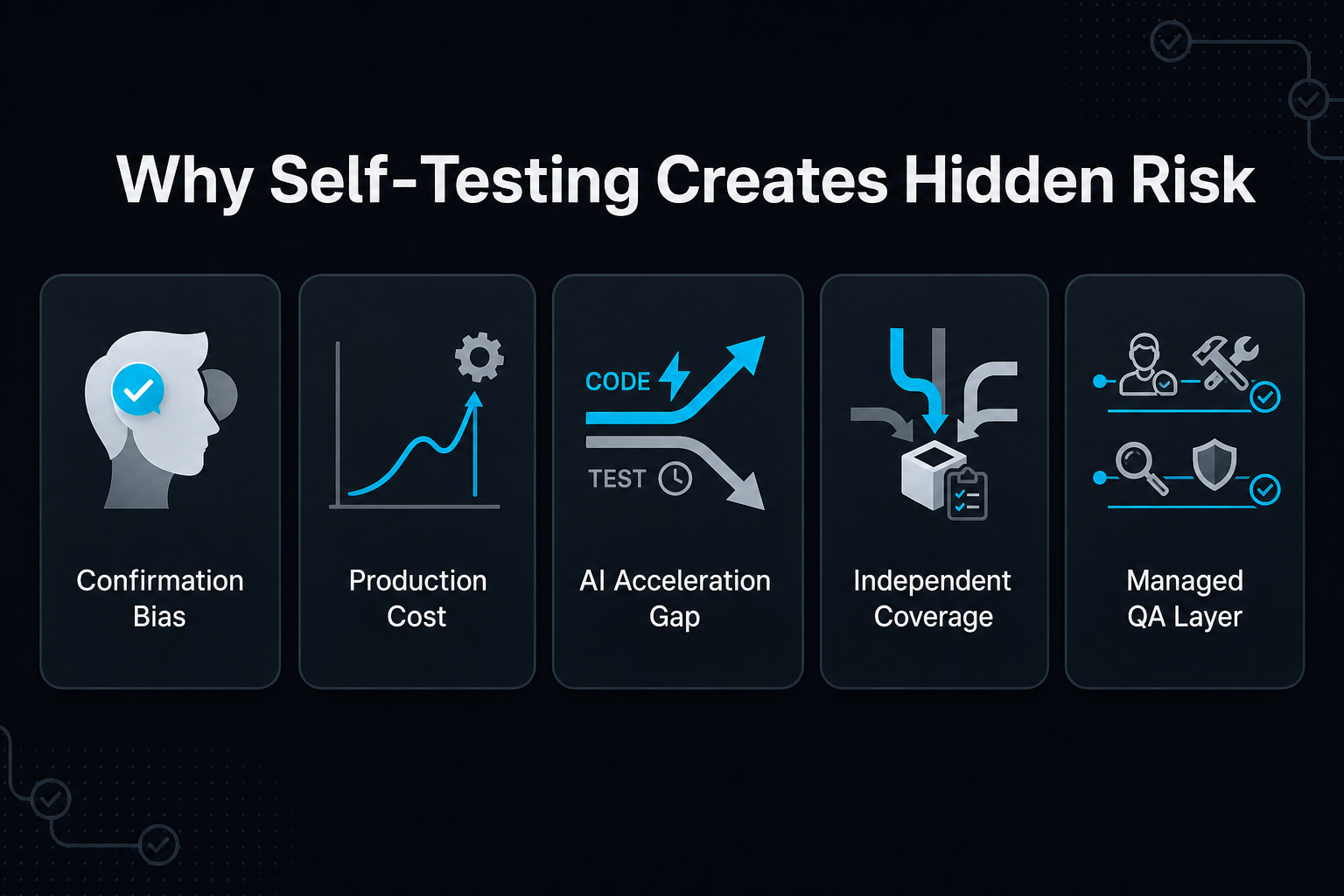
The core risk is psychological, not technical: developers unconsciously test for the behavior they intended to build, not the behavior a user or attacker might trigger. This is sometimes called confirmation bias in testing, and it's well documented in software engineering research. An engineer who just spent three days building a checkout flow has a mental model of how that flow should work. Their tests tend to walk through that same mental path, clicking the buttons in the order they expect, entering the data they expect. The bugs that matter most are usually the ones outside that path.
Think of it like a chef tasting their own dish. They know exactly what they intended it to taste like, so their palate is calibrated to confirm that intention rather than notice what an unbiased diner would flag as too salty or undercooked. The payoff of understanding this mechanism: independent review isn't a bureaucratic nicety, it's a structural correction for a bias every developer has, regardless of skill level.
This doesn't mean developers shouldn't write tests. ISTQB guidelines are explicit that testing and test maintenance should be a shared team responsibility rather than a separate phase owned solely by testers, with developers writing most automated tests. The issue isn't who writes the first draft of a test. It's whether anyone independent ever validates that the test actually probes for failure instead of just exercising the happy path.
What Does Self-Tested Code Actually Cost in Production?
For engineering leaders, the cost is where this gets concrete. A bug found in production costs far more to fix than one found during development.
There's also a velocity cost. Engineering teams are getting faster at writing code, but that speed doesn't always translate into software reaching production faster. Code that ships quickly but fails downstream testing, or worse, fails in a customer's environment, creates a rework loop that erases the speed gained upstream. Fast code with weak test coverage is not fast software delivery. It's deferred cost.
| Stage Bug Is Caught | Relative Cost to Fix | Who Typically Finds It |
|---|---|---|
| Design phase | Lowest | Architecture review, spec review |
| Development | Moderate | Developer self-testing, code review |
| Production | Highest | End users, monitoring, support tickets |
How Are AI Coding Tools Making This Problem Worse?
Stepping back from the cost data, a newer force is compounding the self-testing gap: AI-assisted development. As of 2026, AI assists in generating approximately 41% of all code and automates about 40% of routine development tasks. That acceleration is real and valuable. But faster code generation doesn't come with faster, more rigorous test generation by default.
There's a specific mechanism worth understanding here. One widely discussed critique of AI-assisted testing describes the theory this way: if you write enough tests, a coding agent will see that some of the code it wrote fails them, and it will repair the problems [eqengineered.com]. In practice, this creates a closed loop where the same system that wrote the code also validates it, which reintroduces the exact self-testing bias described earlier, just at machine speed.
As code generation accelerates, independent test design becomes more valuable, not less. A team shipping more code through AI assistance, without a matching increase in independent test rigor, is accumulating risk faster than before. AI can still help with testing, as long as independence is built in: someone other than the code's author decides what gets tested, and every failure is treated as a possible product defect, not just a test to make pass.
What Does Good Test Coverage Actually Look Like?
Given that speed without rigor is a trap, the next question is what "good" coverage means in practice. A common industry rule of thumb points to 70% to 80% unit test coverage for core business logic, but ISTQB guidance is clear that the right level of coverage depends on a project's risk level, industry standards, and regulatory requirements rather than a single universal number. Coverage percentage is a vanity metric if it only measures lines of code executed rather than scenarios validated. Eighty percent coverage of the happy path still misses the 20% where real users do unexpected things.
Comprehensive software testing best practices look across several test types, not just unit tests:
- Functional testing: validates that each feature behaves according to its requirements, independent of who wrote the underlying code.
- API testing: confirms that APIs return the right data and errors when the product calls them the way real users trigger them.
- Accessibility checks: automated checks for issues like missing labels or keyboard traps, which can run inside regression suites and which developers rarely test for themselves.
- End-to-end and regression testing: catch the cross-feature breakage that unit tests, by design, can't see.
The harder part is sustaining this coverage without devoting every engineer-hour to test maintenance.
How Can Teams Fix the Self-Testing Blind Spot Without Slowing Down?
Given the coverage gaps outlined above, the fix isn't asking developers to test more, it's giving them an independent layer that tests differently. One option is hiring a dedicated in-house QA team, which solves the independence problem but adds headcount cost and ramp-up time. A second option is managed QA, where a managed partner owns test design, execution, and maintenance while engineers stay focused on building.
MuukTest pairs expert Forward Deployed QAs with Amikoo, MuukLabs' AI tool, to design and maintain test coverage tailored to a team's actual product, not a generic template. The QAs decide what to cover and where the real risk is, and Amikoo diagnoses each failure as either a real product defect or a test issue. Because the testing is handled by a team independent from the engineers who wrote the code, the suites are built to probe for failure rather than confirm expectations, directly addressing the bias described earlier in this article. The goal isn't to replace the developers who write code; it's to extend what a lean engineering team can cover without adding full-time QA headcount.
Measuring test automation ROI in this model comes down to two numbers: how much faster coverage is achieved, and how much production-bug cost is avoided as a result. Teams considering this path can read more in MuukTest's guide to building a managed QA strategy for AI-accelerated development.
Frequently Asked Questions
Should developers write any tests at all?
Yes. Developers are usually best placed to write unit tests close to the code they just wrote. The risk isn't developer-written tests themselves, it's relying on them as the only line of defense.
What's the difference between unit tests and QA testing?
Unit tests validate individual functions in isolation and are typically written by the developer who wrote the code. QA testing, including functional, regression, and end-to-end testing, validates how the whole system behaves from a user's perspective, usually performed independently of the original author.
Does giving QA responsibility to another team mean giving up control of the test suite?
Not with a managed model built on client ownership. With MuukTest, for example, clients fully own the automation framework MuukTest builds and maintains, so test logic is never locked inside a third-party tool.
How much test coverage is enough?
A common industry rule of thumb targets 70-80% unit coverage for core business logic as a baseline, but ISTQB guidelines note that the appropriate level of coverage depends on the project's risk level, industry standards, and regulatory requirements. Coverage should be evaluated by scenario breadth (functional, API, accessibility, regression) rather than by a single percentage.
Does AI-generated code need more testing, not less?
Generally yes. As AI assists in generating a growing share of code, the volume of untested logic entering a codebase increases, which raises the value of independent, human-reviewed test design rather than reducing it.
What is QA as a service?
QA as a service is a managed model where an external team owns test strategy, automation, and execution on an ongoing basis, functioning as an extension of the engineering team rather than a one-time outsourced project.
About MuukTest
MuukTest is a managed QA service that builds and maintains automated test suites for lean engineering teams. The company builds frameworks on industry-standard tools like Playwright, Selenium, and Appium, and clients fully own the resulting automation framework. This approach lets teams reach broad test coverage in weeks while avoiding the exit costs that come with proprietary testing platforms. MuukTest works as a managed QA partnership that extends lean engineering teams, covering web, mobile, API, regression, and end-to-end testing without requiring additional hires. Behind the service are expert Forward Deployed QAs, who decide what to cover, which workflows matter, and where the real risk is, working with Amikoo, MuukLabs' AI tool for test generation, repair, maintenance, and defect detection.
References
- The Perils of Letting Coding Agents Write All of Your Tests by Ed Lyons - EQengineered (eqengineered.com)
- State of Code Developer Survey Report 2026 (sonarsource.com)
- Software Efficiency Report 2026 Week 36: Why Your Engineering Team… (stonetusker.com)
