
- Skipping QA shifts testing from teams to customers. When internal checks fail, users unknowingly become your QA team through real-world usage.
- Test coverage does not equal confidence. Unit tests can pass while critical end-to-end journeys break in production.
- Speed without QA creates chaos, not velocity. Fast shipping turns into regression loops and constant firefighting.
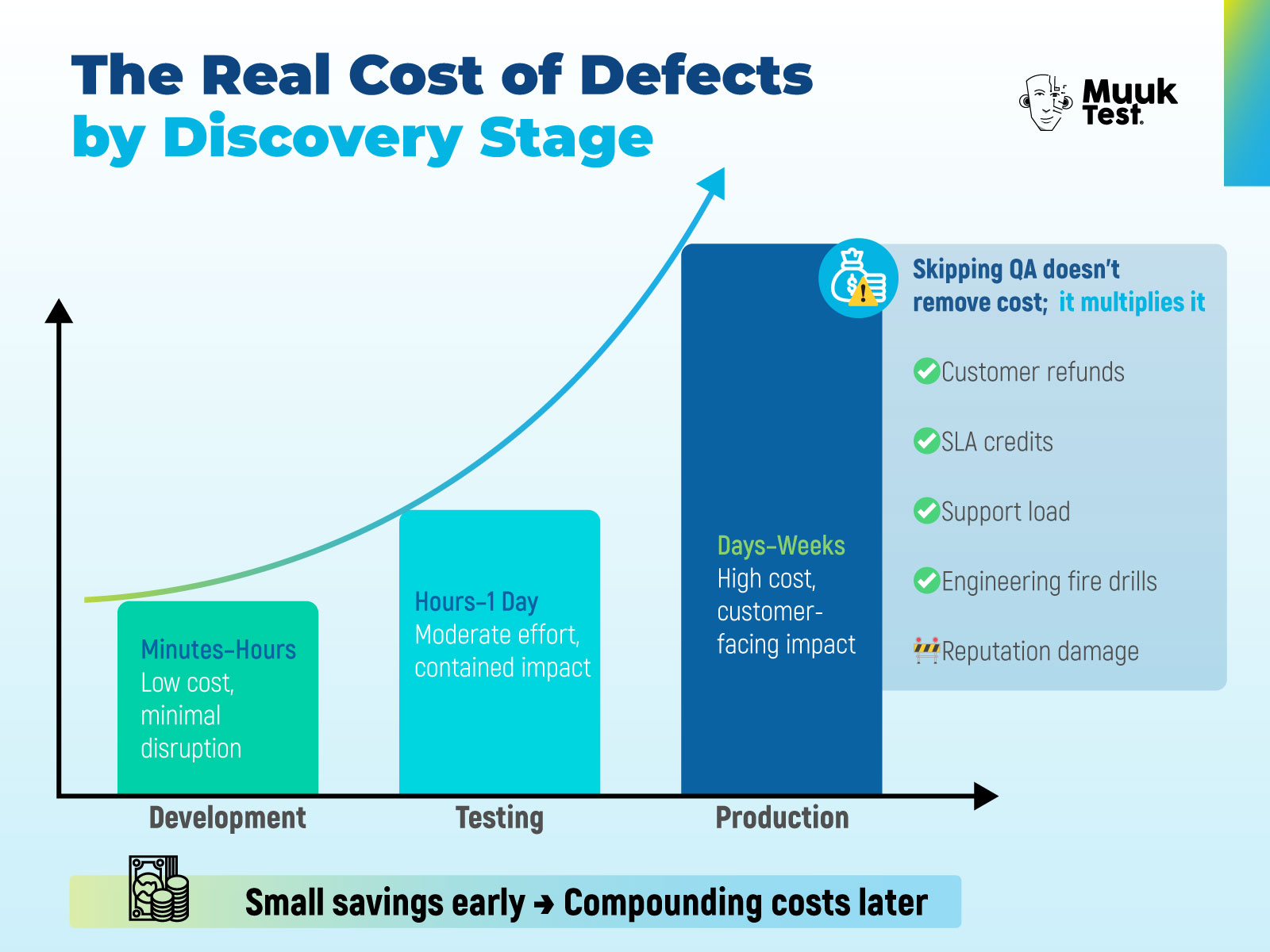
- The real cost of missing QA compounds over time. Defects found in production lead to refunds, downtime, support overload, and reputational damage.
- Trust erodes faster than features can ship. Once customers lose confidence, recovery takes far longer than prevention.
This post is part of a 4-part series, From Speed to Trust: The QA Maturity Journey for Scaling Software Teams:
- The Dev-Only Startup Dream: Why Skipping QA Breaks Software Teams
- When Customers Become Testers: The Real Cost of Missing QA ← You're here
- From Chaos to Control: How QA Stabilizes Software Teams - January 27th, 2026
- Quality as a Growth Engine: Beyond Bug Prevention - February 3rd, 2026

What Happens the Day Customers Become Your QA Team?
Companies that skip QA will still meet the next morning. The product is live, and the release party photos are still on Instagram, LinkedIn, and Facebook. And by 9 am, support tickets start lighting up like a Christmas tree. Early Christmas, huh?
- One customer cannot log in.
- Another reports ghost payments.
- A third tweets a screenshot of an error page with your brand name on it.
The team rushes back to Slack. “We have to revert? Hotfix? Who changed the API last night?” By lunchtime, the entire engineering floor is in firefighting mode. The photos are forgotten, and no one is even talking about them.
Welcome to the day your customers become your QA team.
The Unspoken Contract Between Software Teams and Users
Whenever we release software, we enter into an unspoken contract with our users. “We tested this, so you don't have to.” When that contract breaks, because there are no testers to test that, customers do not write defect reports; they write reviews. In a world where social media rules, just imagine those reviews appearing on various platforms, often social media.
In one retail tech startup that I mentored, the team proudly claimed 85% of test coverage, all unit tests, but they had zero end-to-end scenarios.
On Black Friday, their checkout service crashed because two microservices disagreed on the definition of the discounted amount. The logs told one story; the customer receipts told another. Their slogan was "frictionless shipping." That day, friction was all they sold.
As I often remind teams, coverage is not the same as confidence. Confidence comes from context, not code.
Why Speed Without QA Turns Into Chaos
In the early sprints, the team celebrated speed. Shipping felt like winning as new features rolled out quickly, every week, sometimes even every night. But without a test safety net, every deployment became a game of Russian roulette. Developers patched one bug and unknowingly resurrected three old ones.
“Regression” became the most-searched term in Jira.
I saw this firsthand with an SAS Analytics platform. They released a small UI improvement that changed a JSON key used by 20 dashboards. Overnight, half of their customers saw blank charts.
The fix was easy; finding it was very difficult. They had no monitoring, no automated regression, and no QA visibility. By the time they restored dashboards, users had already exported data to competitors.
Speed without structure had turned into chaos without recovery.
The False Economy of Skipping QA
Many founders justify skipping QA by citing numbers in their spreadsheets.
“One QA engineer costs X, our developers can test their code for free”.
- A defect found in development costs an hour to fix.
- Found in testing, half a day.
- Found in production, days of downtime, customer refunds, and reputation loss.
I once asked a CFO:
- How much did we save by not hiring QA? He said about $70k.
- I replied, and how much did the last outage cost? He paused and said, $310k in credits.
Numbers rarely lie; they just arrive late. Cutting QA might reduce burn rate in a particular quarter, but it taxes every future quarter with compound interest.
How Skipping QA Breaks Developer Confidence First
The cruelest irony is that skipping QA hurts developers first.
At one AI-based logistics firm, developers told me they dreaded deploy day. Not because of pressure, but because of fear. They would merge code at 6 pm and stay online until midnight, “just in case”. Every red Slack notification felt like a heart attack.
When they stop trusting their pipeline, the creativity dies. Innovation doesn't thrive in fear; it thrives in confidence.
The QA's absence turns every sprint into a trauma loop. Build, break, blame, repeat.
I remember quoting James Whittaker to them. “Testers don't break software, they break your illusions about it.”
Customers as Involuntary QA
Once internal checks fail, external feedback becomes the new testing framework.
- Your users start doing exploratory testing, by accident.
- They click every edge case you ignored.
- They combine flows you thought were unrelated.
- They stress your servers with real-world impatience.
- And they are faster than any internal tester could ever be.
Within hours, they surface scenarios your team never imagined. But unlike QA, they don't report calmly. They rant publicly. Screenshots on Twitter replace defect IDs. Hashtags become your new test logs.
.jpg "Infographic showing how, when QA is missing, customers become testers after release, comparing internal QA before release—structured test cases, defect tracking, and calm prioritization—with customers acting as QA after release through tweets, app store reviews, support tickets, and real-time brand damage.")
In 2022, a food delivery app I consulted launched OneTap Reorder.
- It worked beautifully in staging.
- In production, a race condition caused double charges for 0.4% of users.
- Their QA budget that year was $0.
- Their refund budget after that bug, $1.2 million.
As Edwards Deming said decades ago, “Quality is free, but only to those who are willing to pay for it.”
How Missing QA Erodes Trust -Inside and Outside the Company
Customer disappointment spreads faster than any marketing campaign.
- What was once curiosity becomes caution.
- Users stop updating your app.
- Partners delay integrations.
- Investors ask uncomfortable questions.
But the deeper loss is internal trust.
- Product managers stop believing in timelines.
- Leadership starts double-checking everything.
- Developers, once the heroes, became scapegoats.
In one scale-up, I witnessed the “Great Freeze”. After two failed releases, management banned deployments for six weeks. Velocity dropped to zero. Teams spend more time filling release approval spreadsheets than writing code. That's what happens when fear replaces feedback. Without QA, every line of code becomes a gamble no one wants to take.
When Leadership Finally Sees the Problem
Eventually every company reaches a moment of clarity, often delivered by a furious customer. For PayZen (the fintech from part 1 of this blog series), that moment came when a regulatory audit flagged inadequate validation of transaction paths. In plain language, “you did not test enough.”
The CEO told me later: "We thought we had a speed problem. In reality, we had a trust problem". That admission marked the turning point. Budgets opened, and QA hiring began.
But as I warned them, you can hire QA in a week, building a quality culture will take quarters.
The recovery begins, but not instantly.
When the first QA engineer joins, expectations are sky-high.
“They will fix everything”, but they walk into chaos.
No test data, no environments, no historical coverage. It's like being asked to build a lighthouse during a storm.
I've seen that first QA hires have to act more like diplomats than testers. They don't just write test cases, they build trust cases. They sit with devs, map pain points, and create sanity checks that give breathing room. This phase, which I call “stabilization before optimization”, usually lasts 8-12 weeks. It's messy, slow, and absolutely necessary.
What This Phase Teaches Every Scaling Team
When customers become testers, organizations learn three painful but transformative lessons:
- Quality is not negotiable.
Every shortcut today becomes a slowdown tomorrow. - QA is everyone’s responsibility.
Developers, PMs, and leadership must all participate in defining "done". - Trust is the ultimate metric.
You can eventually recover revenue; regaining credibility takes longer.
What Comes Next After QA Rock Bottom
By now, the fictional (but all-too-real) company in our story has hit rock bottom.
Customer complaints are public, morale is private, and leadership has finally admitted: “We can’t keep doing this.”
That’s when they bring in a QA lead - not to test code, but to rebuild confidence.
In part 3 of this series, we’ll explore what happens next: how QA stabilizes chaos, rebuilds rhythm, and transforms firefighting teams into predictable delivery engines.
Because the real product every company sells isn’t software—it’s trust.
👉 Next: From Chaos to Control - How QA Stabilizes Software Teams

Frequently Asked Questions
What does it mean when customers become testers?
When customers become testers, it means bugs and quality issues are discovered by users in production instead of internally by QA. These issues surface through support tickets, app store reviews, social media posts, and churn - often publicly and at scale.
Why do customers find bugs that internal teams miss?
Customers use software in unpredictable ways. They combine features, enter unexpected data, operate under real-world conditions, and scale usage beyond what internal testing environments simulate. This behavior exposes edge cases that unit tests and limited testing often miss.
How does skipping QA impact customer trust?
Skipping QA breaks the implicit promise that a product has been tested before release. When users repeatedly encounter bugs, trust erodes quickly. Even small failures can lead customers to delay updates, avoid new features, or switch to competitors.
Is high test coverage enough to prevent customers from finding bugs?
No. High test coverage, especially unit test coverage, does not guarantee quality. Coverage measures which lines of code were executed, not whether real user journeys were validated. End-to-end and exploratory testing are critical to preventing customer-visible failures.
What is the real business cost of customers acting as QA?
The cost includes refunds, SLA credits, support overload, engineering rework, reputational damage, and lost revenue. Defects found in production take significantly longer to fix and often trigger cascading issues that compound over time.
How can teams prevent customers from becoming their QA team?
Teams can prevent this by investing in QA early, validating end-to-end user journeys, maintaining regression coverage, and treating quality as a shared responsibility across engineering, product, and leadership rather than a last-minute step.