When a qa contract ends, the tests stay and the context leaves with the contractor. Unless someone plans for it, maintenance falls to whoever is closest to the failing pipeline. That is usually a developer who never wrote those tests and has no time to learn them. The real answer is that an owner must be named before the contract ends. That owner is either an internal qa engineer or SDET supported by a proper handoff, or a managed qa service that owns upkeep while you own the code.
TL;DR
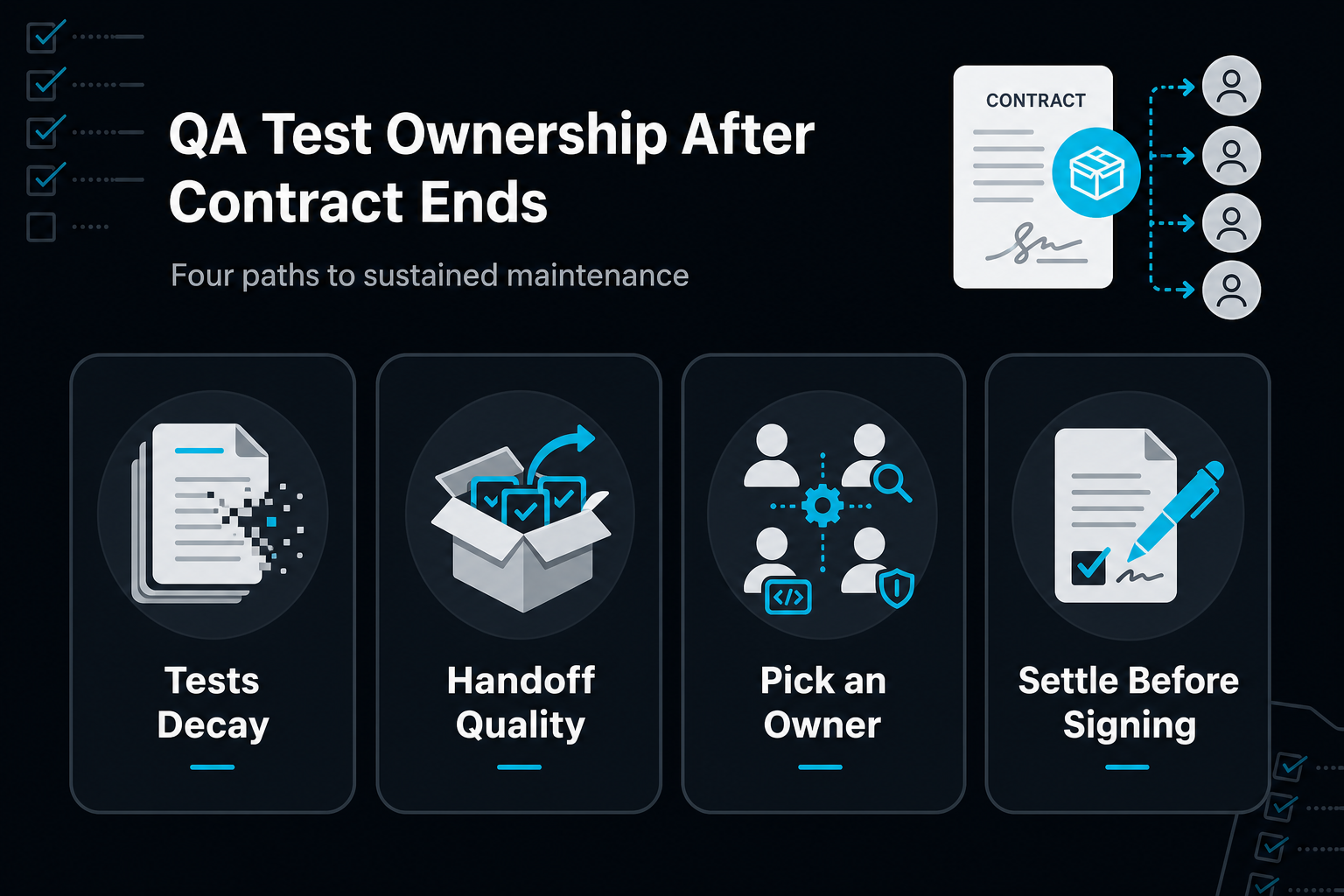
- Tests decay by default: every product change wears down a suite that nobody is assigned to maintain.
- Owning code is not owning upkeep: a repository of tests is only an asset if someone can tell a real failure from a stale expectation.
- Handoff quality decides the outcome: documentation, setup guides and recorded walkthroughs turn a contractor's suite into one your team can run.
- Self-healing has limits: self-healing test automation handles small UI shifts, but humans still decide what a test should verify.
- Settle maintenance before signing: agree on who owns the framework, where tests live, and what the last day looks like.
What happens to contractor-written tests when the engagement ends?
A contractor's suite starts losing accuracy the day the contract ends, because the application keeps changing and the tests do not. Contracting engagements commonly run anywhere from a few weeks to well over a year. That is long enough to build a sizeable suite, and short enough that its authors are gone before much of it needs rework.
Think of inheriting a colleague's spreadsheet full of formulas. You can read every formula, but you cannot see why one cell points at last quarter's tab. So when a number looks wrong, you cannot tell whether the data broke or the assumption expired. Tests work the same way, because each one encodes an assumption about how the product should behave. Without the author, a red build forces your team to reverse-engineer intent before fixing anything, which is why orphaned suites tend to get muted rather than repaired.
- Selectors break: a redesigned button or renamed field fails tests that still describe valid behavior.
- Flows drift: new onboarding steps or permissions leave old workflows incomplete, often without a loud failure.
- Trust erodes: once a few tests fail for unclear reasons, teams start rerunning, skipping or disabling them.
The cost of that drift is easy to underestimate, and that is where most plans fall short.
Test maintenance is the part teams underestimate
Building on that decay pattern, the build is a one-time project, while maintenance is a recurring expense that lasts as long as the product changes. Keeping automated scripts working takes ongoing hours every year, on top of the initial development effort. Contract scopes usually price the build. Fewer price the years that follow.
Many teams expect automation to fix itself. So does self-healing test automation solve the problem? Partly. Smart locators adjust tests when a UI element moves or its attributes change, and AI-driven test monitoring can run tests continuously and detect issues early. What it cannot do is decide whether a changed checkout flow is a bug or a new requirement.
Self-healing focuses on keeping a test running, while human qa judgment focuses on keeping a test correct. That distinction shapes what a good handoff has to transfer.
What should a contractor handoff include?
A handoff is the set of artifacts and sessions that lets someone who did not write the tests run, diagnose and extend them. Gaps in any of these items tend to resurface later as stalled pipelines.
- Test case documentation: what each test verifies and the business reason it exists.
- Setup guides: environment variables, test data, credential handling, and how to run the suite locally and in CI.
- System diagrams: which services, APIs and third-party integrations each flow touches.
- Knowledge transfer sessions: live or recorded walkthroughs of the suite structure and its fragile spots.
- A known-issues list: flaky or skipped tests, with the reason for each.
Test data should be synthetic, which keeps real cardholder data and PII out of the suite and the handoff. Even a perfect handoff transfers knowledge, though, not capacity.
Who can realistically own the suite after the contractor leaves?
Stepping back from artifacts, the capacity question comes down to four realistic owners, each with a different balance of cost, context and continuity.
| Owner | Strength | What to watch |
|---|---|---|
| Product developers | Know the code and recent changes | Test upkeep competes with feature work |
| In-house qa engineer or SDET | Dedicated focus and long-term context | Requires a hire; one person can become a single point of knowledge |
| A new contractor | Fast to start | Faces the same handoff problem when their contract ends |
| Managed qa services | Provider is accountable for ongoing maintenance | Confirm you own the code and can run it independently |
Contracting focuses on adding skilled hours under your direction, while managed qa services focus on delivering a maintained outcome the provider answers for. Either can work. The mistake is choosing one without deciding who handles maintenance a year from now.
How do you prevent the ownership gap before signing?
The cheapest time to solve post-contract maintenance is before the contract starts, and a few direct questions do most of the work.
- Who owns the code? Tests should be your property, written in a standard framework such as Playwright.
- Where do the tests live? In your repository, not a hosted environment you cannot export from.
- Can you run them without the provider? If the suite only runs inside a proprietary system, ownership is in name only.
- Who triages failures? Someone must separate real bugs from test issues on every run.
- What does the last day look like? Put handoff deliverables in writing at kickoff.
Services like MuukTest are built around these answers. Forward Deployed QAs decide what to cover, which workflows matter and where the real risk is, while Amikoo, MuukLabs' AI tool, generates, repairs and maintains the tests. The tests are standard Playwright TypeScript in your own repository, so maintenance can continue with MuukTest or move in-house without a rewrite.
Frequently Asked Questions
Do we own tests written by a qa contractor?
That depends on the IP terms in your contract. Confirm in writing that test code is assigned to you and stored in your repository.
How long does an unmaintained suite stay useful?
There is no fixed shelf life. Teams that release often see drift quickly, because every release can invalidate assumptions.
Can self-healing test automation maintain a suite on its own?
No. It absorbs minor UI changes, but a person must decide when expected behavior has legitimately changed.
What is the difference between qa as a service and managed qa services?
Both describe a provider that owns testing outcomes rather than supplying hours, and the terms are often used interchangeably in practice.
What if a contractor already left without a handoff?
Run the full suite and sort failures into broken, stale and real. Delete tests nobody can explain, then rebuild your most critical flows first.
About MuukTest
MuukTest is a managed qa service that builds and maintains automated test suites for lean engineering teams. The company builds frameworks on industry-standard tools like Playwright, Selenium, and Appium, and clients fully own the resulting automation framework. This approach lets teams reach broad test coverage in weeks while avoiding the exit costs that come with proprietary testing platforms. MuukTest works as a managed qa partnership that extends lean engineering teams, covering web, mobile, API, regression, and end-to-end testing without requiring additional hires. Behind the service are expert Forward Deployed QAs, who decide what to cover, which workflows matter, and where the real risk is, working with Amikoo, MuukLabs' AI tool for test generation, repair, maintenance, and defect detection.
If you are planning a qa engagement or inheriting a suite with no clear owner, we are happy to talk through your options. Learn more at https://muuktest.com/.