- How MuukTest Closes Both the Easy 80% and the Hard 20% Hybrid QA Model: AI + humans = full QA coverage. Hybrid QA combines AI testing agents and human QA experts to cover both the easy 80% and the critical hard 20% of testing. Ensuring speed, scale, and deep risk coverage that neither can achieve alone.
-
MuukTest handles both scale and strategy. AI agents run broad regressions while embedded QA engineers tackle complex flows, integrations, and triage. Removing flakes, false positives, and testing slowdowns.
-
In a hybrid QA feedback loop, your test suite gets smarter, not heavier. In a hybrid loop, AI adapts as QA experts guide. Your test coverage sharpens with every release. No bloat, no decay.
-
QA that actually moves the business. Engineering leaders using MuukTest's hybrid model gain faster, safer releases, reduced QA overhead, and 50%+ cost savings over in-house alternatives.
-
The future of QA is hybrid. For fewer bugs, confident releases, and scalable quality that keeps up with growth, this is the model modern teams are already adopting.
- Why DIY AI Testing Tools Only Cover the Easy 80%
- Why DIY AI Testing Tools on their own Struggle with the Hard 20%
- How CTOs Can Maximize ROI from AI Testing Tools
- MuukTest’s Hybrid QA Model: AI Agents + Expert Oversight ← You're here

The Future of QA Isn’t AI or Human. It’s Hybrid.
Quality assurance is at a crossroads. On one side, AI testing tools promise to automate everything, yet they hit a ceiling when faced with complex scenarios. On the other side, traditional human-only QA can handle complexity, but hits a bottleneck as products grow. After exploring the “easy 80% vs. hard 20%” testing dilemma in this series, one thing is clear: the future of QA isn’t about choosing either AI or humans; it’s about combining both in a hybrid model.
A hybrid QA model is an approach that pairs AI-driven test automation (AI agents) with human QA expertise to get the best of both worlds. In this model, AI handles the repetitive high-volume tests at lightning speed, while human experts focus on the tricky 20% of scenarios that demand reasoning, context, and creative insight.
The thesis is simple: AI alone eventually leaves dangerous gaps, and human-only QA can’t scale efficiently. But together, they cover for each other’s weaknesses. AI hits a ceiling; human QA hits a wall; hybrid QA breaks through to deliver scalable, reliable quality.
In this final article of our four-part series, we’ll show why a hybrid approach is the only truly scalable QA strategy for modern teams. We’ll see how a coordinated AI+human system works in practice, and how MuukTest’s hybrid model yields the highest ROI in real engineering outcomes. Let’s dive in.
Why Pure AI and Pure Human QA Both Break at Scale
Relying solely on AI or exclusively on humans might work for a while, but at scale, both approaches crumble in different ways.
The limits of AI-only testing
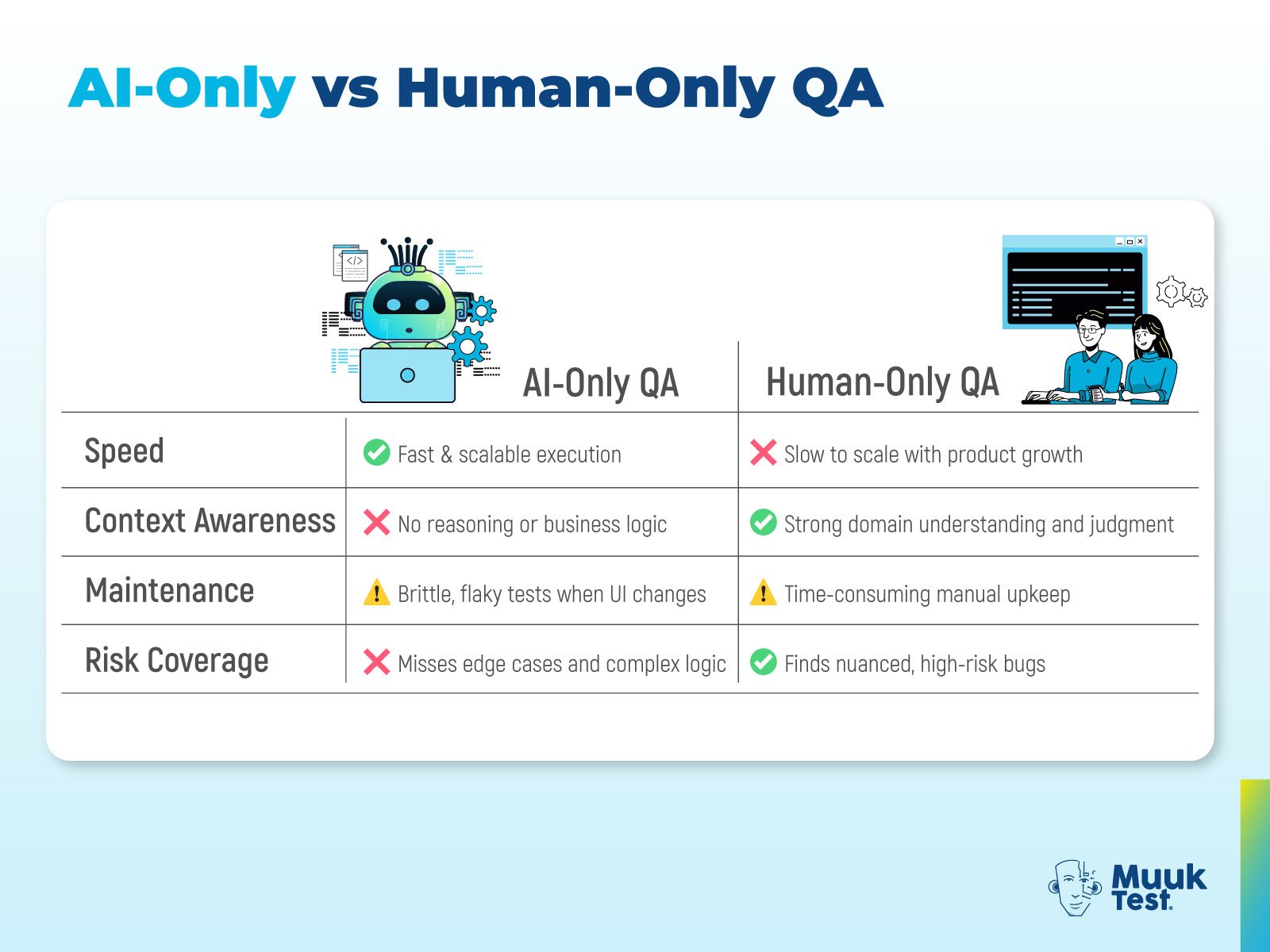
AI tools are great at blasting through predictable happy path scenarios: login forms, CRUD operations, basic flows. But when complexity enters the picture, they hit a wall. They lack context, business logic, and risk awareness, so they skip over the edge cases where bugs hide.
As we explored in Part 2 of this series, AI struggles most in the hard 20% of testing: conditional flows, dynamic data, async behavior, and multi-system dependencies. That’s where flakiness spirals, regressions sneak through, and false confidence builds.
Without human judgment, AI-only testing delivers fast results but fragile quality. Automating the easy 80% doesn’t equal covering the 80% of risk that matters.
The limits of human-only testing
Manual QA shines in complex logic and exploratory work, but it doesn't scale. As your product grows, so does the testing load, and expanding a QA team fast enough to keep up is expensive and slow.
Even top testers burn out running repetitive regressions, and inconsistency creeps in across individuals. Manual testing also lacks breadth: you simply can’t cover 1,000 scenarios by hand on every release. To scale coverage, you’d need to linearly increase headcount, which is neither feasible nor efficient for most teams.
Over time, human-only QA becomes a bottleneck, slowing releases or letting critical bugs slip through from sheer volume and fatigue.
The takeaway is that both extremes have a breaking point. Neither approach alone gives engineering leaders what they need: fast, thorough, and reliable testing at scale. This sets the stage for a combined approach that leverages the strengths of each.
Enter Hybrid QA: A System Where Each Strength Amplifies the Other
If pure AI and pure human approaches both fall short, the solution is to blend them into a coordinated system where each compensates for the other’s weaknesses. Hybrid QA isn’t just “AI with humans double-checking,” or vice versa; it’s a thoughtfully designed process where automation and experts work in tandem, each focusing on what they do best. AI’s speed and breadth are enhanced by human insight and vice versa.
Let’s break down the complementary strengths in a hybrid QA model:
- What AI agents do best: Speed, repetition, and scale. AI testing agents can generate and run thousands of tests in minutes, scanning your UI to build flows for every button, form, and link. They’re perfect for broad coverage of stable, predictable paths. Modern tools even adapt on the fly, auto-healing when locators or UI elements shift, reducing flaky test failures without human input. They never tire, never skip steps, and provide instant feedback as your code evolves.
- What human QA experts do best: Creative thinking, judgment, and deep context. Humans understand product logic, user intent, and risk. They know which edge cases, integrations, and workflows matter most and design tests accordingly.
Where AI clicks buttons, experts ask, “What could go wrong here?” They think through conditions, roles, and real-world usage that AI would miss. They also verify across systems (UI, API, DB) to ensure that success isn’t just a message on screen, but an actual backend action.
Most critically, they bring judgment: reviewing failures, filtering out noise, and guiding the AI to test what truly matters. In short, humans give automation depth, direction, and purpose.
Now, hybrid QA amplifies each side’s strengths by letting each do what it does best together. The AI agents handle the heavy lifting of broad regression coverage and quick adaptation to change, while the human testers steer the ship, targeting high-risk areas and continuously improving the tests.
The AI scales the routine so that no obvious bug is missed, and the experts deepen the meaningful coverage so that tricky bugs are caught. It’s a feedback loop of mutual reinforcement.
MuukTest’s own approach calls this “expert-in-the-loop”: our embedded QA engineers continuously train and guide the AI agents, and in turn those agents provide ever-better automation productivity for the experts. The result is a system smarter than AI alone and faster than humans alone.
In practical terms, a hybrid model means that when your software changes, AI agents instantly cover the basics (so you’re never without regression tests), and QA experts focus on the hard stuff that actually keeps you up at night. This synergy ensures that each strength truly amplifies the other – giving you wide and deep coverage, speed, and quality.
The MuukTest Hybrid Model: How It Works Behind the Scenes
So how does hybrid QA actually play out day-to-day? Let’s pull back the curtain on MuukTest’s hybrid QA model to see how AI agents and human experts work together in a real system. Here’s a breakdown:
A. The AI Agent Layer - Meet the MuukTest A-Team
At the core of MuukTest’s hybrid model is our A-Team: five specialized QA AI agents (so far!) powered by our proprietary engine, Amikoo. Each agent plays a unique role: automating tests, accelerating releases, and catching bugs before they reach production. Together, they act as your digital QA teammates, built for speed, scale, and zero maintenance drama, so your team can move faster with confidence.
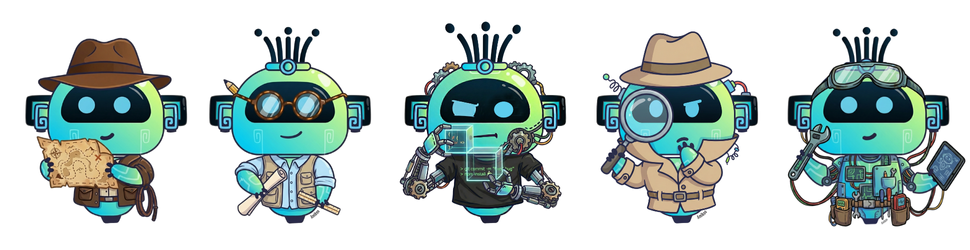
Here’s how they power wide, reliable coverage from day one:
- Explorer Agent – Maps Real User Paths
Explorer navigates your app unscripted to uncover real user flows and surface hidden interactions humans often miss, giving you full UI visibility. - Designer Agent – Transforms Specs into Tests
Designer user stories, acceptance criteria, or even scribbled notes into structured, logical test cases, filling gaps and covering edge cases with clarity. - Automation Agent – Builds and Runs at Scale
Automation converts Designer’s blueprints or test plans into clean, stable Playwright tests, fast, and runs them in parallel across environments for instant feedback. - Detective Agent – Diagnoses Failures Fast
Detective reviews failed tests, explains root causes clearly, and filters real bugs from false alarms, saving hours of triage. - Repair Agent – Keeps Tests Healthy
Repair auto-fixes broken selectors and flaky steps, keeping your suite green as your product evolves, no manual cleanup needed.
Together, the A-Team delivers on the promise most AI tools can’t:
- Fast test creation (Explorer + Designer)
- CI/CD-ready automation (Automation)
- Low-flake, low-maintenance coverage (Repair)
- Actionable failure insights (Detective)
All of this happens with near-zero overhead for your team. It ensures that the routine but important checks are always done quickly and reliably. It adapts instantly to small changes and scales to cover your whole application at high speed. However, it’s only one half of the equation. Next, let’s see how the human expert layer plugs in to provide the depth and brains of the operation.
B. The Expert QA Layer — Strategic Depth and Risk Management
Running alongside the AI is MuukTest’s Expert QA layer – a team of seasoned test engineers (QA architects and analysts) who are embedded with your team. These experts are hands-on in guiding the testing strategy. Here’s what they contribute:
- Designing high-risk workflows: Early on, a MuukTest QA Architect works with your team to identify the most critical user journeys and edge cases. They ask, “What are the worst things that could break?” and ensure tests are designed for those. By focusing on high-risk and business-critical flows, they make sure the “hard 20%” is not neglected. The expert essentially acts as a test strategist, deciding where to devote attention for maximum risk reduction.
- Multi-system assertions and integration testing: A single user action in a modern app can trigger front-end changes, back-end database updates, API calls, and third-party integrations. MuukTest’s experts ensure the tests validate end-to-end behavior across these layers. For instance, if an order is placed, the test might verify the UI confirmation, the API response, and that an order record exists in the database. This kind of cross-system verification is something only a human with system knowledge can set up. MuukTest’s methodology explicitly covers these multi-layer checks (from the UI to the database). Our tests assert that all components work together seamlessly. Which means deeper coverage that catches issues an isolated UI test would miss.
- Interpreting ambiguous failures: Not every test failure means there’s a bug in the product. It could be a test environment glitch, a timing issue, or an anticipated change that wasn’t updated in the script. Our QA experts play a crucial role in analyzing test results and triaging failures. When a test fails, they review the detailed logs and video replays, investigate whether it’s a true product defect or a “false positive” (e.g., the app was a bit slow and a timeout triggered). This expert review process filters out noise so that developers aren’t swamped with false alarms. It also provides immediate feedback on real issues. When there is a legitimate bug, the QA will document it with clear reproduction steps and evidence. This human judgment ensures the automated suite remains trustworthy and devs only spend time on real problems.
- Providing guardrails and continuous improvement: QA experts essentially act as the brain guiding the AI. They configure the AI agents with testing priorities, refine test scripts, and give feedback to the system. For example, if the AI generates a test that doesn’t make logical sense, the expert will adjust or remove it. If the AI misses an important edge case, the expert will add a new test and perhaps adjust the AI’s parameters to be more exploratory in that area. This human-in-the-loop training makes the AI smarter over time. The experts also maintain the test suite, they decide when to expand coverage, when to prune redundant tests, and how to optimize the suite for maximum effectiveness. They are effectively the QA team leads, ensuring the automation is doing the right things. The AI agents are powerful, but the experts keep them aimed at the right targets and operating within defined quality standards.
In the MuukTest hybrid model, this expert layer is built-in. You get dedicated QA professionals who know your product and are continually aligning the testing to your evolving needs. They provide the strategic depth and quality control that pure automation lacks, making sure the overall QA system is hitting your goals (not just hitting a quantity of tests).
C. The Hybrid Feedback Loop - Continuous Improvement
One of the most exciting aspects of a hybrid QA model is how it gets better over time. Every test execution feeds a learning loop between AI agents and human experts, as shown in the cycle below.
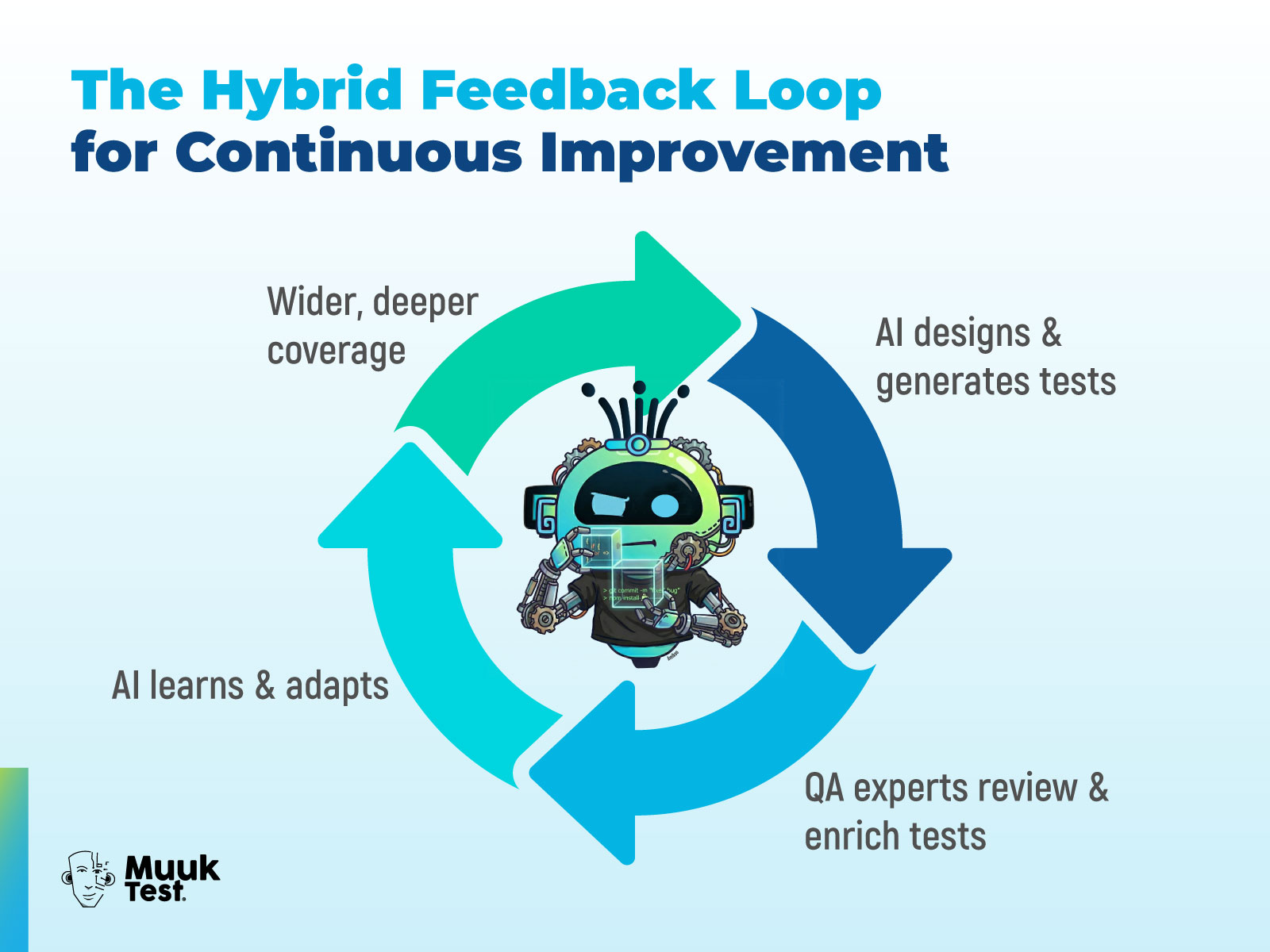
Traditional test suites often bloat and decay, each release you add more tests (never removing old ones), flakiness creeps in, and maintenance becomes a nightmare. A hybrid approach avoids that fate through a continuous feedback loop between AI and humans that keeps the test suite lean, relevant, and reliable:
- AI generates, QA enriches: Amikoo agents designs and runs tests at scale; QA experts review results, add edge cases, and fine-tune for quality.
- AI learns & adapts: When humans correct failures or optimize logic, the AI agents retain those insights: stabilizing locators, recognizing patterns, and reducing flakiness.
- Coverage sharpens, not bloats: In a hybrid model, more tests is not the goal, better tests is the goal. The expert oversight ensures that the suite doesn’t just accumulate redundant or low-value test cases. If some auto-generated tests overlap or aren’t adding unique coverage, the QA team can trim them. If new risks emerge (say a new integration), they’ll design targeted tests for those. Every test has a purpose, tied to a user risk or requirement. Instead of piling on redundant tests, the suite stays lean, focused, and deeply aligned to product risk.
The hybrid feedback loop means your QA automation is a living system that continuously evolves with your software. The longer you run a hybrid model, the more dialed-in your tests become. This continuous improvement translates into a very high long-term payback: less maintenance effort, more reliable bug catching, and a suite that scales with confidence.
D. Seamless CI/CD Integration
A key requirement for any modern QA solution is that it plays nicely with CI/CD and agile workflows. A hybrid QA model like MuukTest’s is designed from the ground up to integrate with your development pipeline, so you get all these benefits without slowing down delivery:
- Plug-and-play pipeline integration: We slot directly into your stack with out-of-the-box support for GitHub Actions, Jenkins, CircleCI, Azure DevOps, and more. Tests run in the cloud, results report to your tools. No heavy setup, just add a step to your pipeline and go.
- Fast, scalable test execution: Our AI agents run hundreds of tests in parallel across devices and browsers, so even large suites complete in minutes. No bottlenecks. No flake-induced breakpoints. Just quiet confidence every build.
- Actionable alerts, not noise: Get Slack or Jira notifications with rich context (screenshots, logs, videos) when something breaks. Since failures are pre-vetted by QA experts, you only get pinged when it matters.
- Zero maintenance for devs: We handle the test infrastructure, updates, and flaky fixes behind the scenes. No babysitting frameworks. No wasted engineering cycles. Just clean, reliable feedback that keeps up with your delivery pace.
In summary, the hybrid QA model slots into a modern DevOps environment effortlessly. It brings speed and stability to CI/CD: tests run fast, failures are real, and everything is automated and maintained for you.
With MuukTest, CI/CD and QA aren’t in tension; they move in lockstep. You ship faster, with trust.
How MuukTest Closes Both the Easy 80% and the Hard 20%
By now, we’ve addressed the “easy 80%” and “hard 20%” concept a few times. The core promise of a hybrid model is that it’s the only approach that effectively covers both: the broad base of functionality and the critical edge cases.
Let’s clarify how MuukTest’s hybrid QA actually achieves this, and why covering both layers is critical for true QA maturity.
- AI agents conquer the easy 80%: Amikoo agents instantly generate and run tests for login flows, form submissions, navigation, and other stable paths. It’s fast, scalable, and catches regressions in the core experience, so the obvious bugs never slip through.
- Experts + AI agents tackle the hard 20%: Our QA architects design tests for the tricky workflows (such as multi-step transactions, conditional logic branches, security edge cases, weird combinations of inputs) and then use AI-assisted automation to maintain those tests.
- Complete coverage and risk reduction: MuukTest doesn’t just boost coverage—it ensures it counts. Every critical path, from routine flows to nightmare edge cases, is continuously validated. That means fewer regressions, fewer incidents, and far more confidence with every release.
In essence, MuukTest’s hybrid QA model addresses the full spectrum of testing needs. AI agents give you breadth (lots of coverage, fast), and human experts give you depth (targeted, intelligent coverage). This comprehensive approach is critical: in software quality, the last 20% of cases often matter more than the first 80% when it comes to user trust and business impact. By attacking QA from both angles, you achieve a level of reliability that neither approach can deliver on its own.
AI agents + human experts = highest ROI – because you’re catching all classes of bugs with minimal waste. In the next section, we’ll quantify what that means for engineering leaders.
What Engineering Leaders Gain With MuukTest’s Hybrid Model
It’s clear how hybrid QA works, but what does it actually mean for your software organization’s outcomes? For CTOs, VPs of Engineering, and QA Directors, the value of MuukTest’s hybrid model can be distilled into real, tangible benefits. Here’s what you stand to gain by adopting an AI + human QA strategy:
- Faster, more predictable release cycles: With the hybrid model in place, testing no longer stalls your deployments. Automated tests run quickly on each build, and manual testing firefights are minimized. This means you can ship updates with clockwork regularity. Teams see their release cadence increase because they’re not waiting on lengthy test passes or emergency bug fixes at the last minute.
"MuukTest helps move the product along faster. Working on the regression projections ensures our product is more stable with the calculations. I think the value is just peace of mind."

Taylor Perkins
CTO and Co-founder | Slope
- Higher confidence in green pipelines: Because the automated tests cover so much and experts ensure the suite is high-quality, your CI pipeline becomes reliable. Engineering leaders gain the peace of mind that when all tests pass, there’s a very low chance of a serious bug in that release. No more gut feelings or gambling on quality, you have data-backed assurance. This confidence extends to product managers and executives too, easing the typical anxiety around releases.
- Dramatically reduced maintenance overhead: One of the highest hidden costs in test automation is maintenance: hours spent fixing broken tests or updating scripts for new features. MuukTest’s model slashes this overhead. Auto-healing handles minor app changes, and our QA experts take care of the rest of the updates as part of the service. Your engineers and in-house QA don’t have to sink time into maintaining the test suite. For many clients, this means they avoided having to hire multiple additional QA engineers or burden developers with test scripting. You’re effectively getting a highly optimized QA function without adding headcount. In fact, MuukTest typically delivers the output of a 5-person QA team at roughly half the cost of a single in-house QA engineer. That’s how efficient the hybrid approach is when delivered as a service.
- Lower costs and higher ROI: Speaking of cost, the hybrid model is extremely cost-effective. You’re leveraging AI to do a ton of work and experts to direct efforts smartly, so there’s very little waste. MuukTest’s clients pay for results, and often see 50%+ cost savings compared to trying to staff and build similar capabilities internally. From a budgeting perspective, you turn QA from a big fixed cost (hiring, tools, etc.) into a flexible service that scales with your needs. And because quality issues are caught earlier (preventing costly production defects and firefights), the ROI is amplified beyond just testing cost – you save money on support, patches, and reputation damage by avoiding those incidents.
- Healthier test suites that improve over time: An underrated gain is the long-term health of your QA assets. With hybrid QA, your QA process actually gets better with time, which is rare in our industry. Engineering leaders can invest in quality infrastructure knowing it will stay relevant and keep delivering value, release after release. You’re building a lasting competitive asset (a robust regression suite and quality process) rather than something that will crumble and need replacement.
- Fewer bugs and regressions in production: Ultimately, the biggest benefit is higher product quality. By covering both the easy and hard test cases, the hybrid model catches bugs that would have slipped through gaps in other approaches. Our clients have seen significant drops in the number of hotfixes and critical issues post-release once the hybrid system is fully in place. Fewer escaped bugs mean better user satisfaction, less churn, and a stronger brand reputation. It also frees up your developers from firefighting mode – instead of scrambling to fix production issues, they can build new features. This is a direct boost to your team’s productivity and morale.
"MuukTest found things that we didn't know were even a problem in the product, which is huge for us. I'd rather MuukTest find something than a customer, even if it's minor."

Wendy Murray
COO | Pienso
- Scalability and flexibility as you grow: For fast-growing companies, scaling a QA operation is traditionally a headache. But a hybrid QA model scales with your product seamlessly. If your application usage doubles and you roll out lots of new features, the AI agents simply run more tests and the MuukTest team adds coverage where needed. You don’t have to scramble to recruit testers or buy new testing infrastructure – it’s handled. Our approach can deliver new automated tests in days as your needs expand. Your team can surge ahead with new releases or new platforms (web, mobile, API – all covered) and trust that QA can instantly flex to support it. For engineering leaders, that’s one less constraint in the growth equation.
All these benefits boil down to a simple but powerful shift: better quality, faster, and at lower cost. The hybrid model transforms QA from a slow, onerous task into a streamlined, intelligent function that adds significant business value.
As a leader, you gain predictability (no more surprise quality fires), efficiency (more output for the same or less cost), and confidence (you know your team is building on solid ground). Practically, it enables your teams to innovate faster and with less risk.
The New Standard for Scalable QA
Just as DevOps transformed software delivery, hybrid QA is redefining how we ensure quality at scale. Manual testing alone can’t keep up, and AI-only tools miss too much. The future isn’t either/or, it’s both. AI + human expertise is the only model that scales while maintaining quality.
That’s the hybrid advantage: automation for speed, humans for depth, and together, a QA system that adapts, scales, and delivers results.
Engineering leaders who champion this model empower their teams to release faster, reduce risk, and operate with confidence. When hybrid QA is well-implemented, you don’t choose between velocity and reliability; you get both.
Forward-thinking teams are already moving this way. MuukTest offers the fastest path: a seamless solution that blends smart AI agents with expert QA guidance. It's proven, it's practical, and it's designed to grow with you. If you're ready to ship better software, faster, and eliminate the QA bottleneck, MuukTest is your unfair advantage.
Regardless of how you implement it, embracing the hybrid mindset will position your organization to deliver better software faster, with confidence. And in the end, that means happier customers, prouder developers, and the ultimate ROI of doing QA the modern way.

Frequently Asked Questions
What is hybrid QA, and how does it work?
Hybrid QA combines AI-driven test automation with expert human oversight to deliver scalable, reliable software testing. AI agents handle repetitive, high-volume test cases quickly, while QA professionals focus on complex, high-risk scenarios that require human judgment. Together, they cover both the easy 80% and the hard 20% of testing, ensuring full coverage and minimal bugs in production.
How is MuukTest’s hybrid QA different from traditional test automation?
Unlike traditional automation that relies heavily on scripts and requires constant maintenance, MuukTest’s hybrid model uses proprietary AI agents to generate, execute, and repair tests at scale while embedded QA experts continuously guide strategy and logic. The result is a fully managed, low-maintenance QA system that scales with your product and integrates easily into CI/CD pipelines.
How does MuukTest reduce QA costs and improve ROI?
MuukTest replaces manual effort and in-house scripting with AI speed and expert oversight. Clients often achieve the output of a 5-person QA team for less than the cost of a single person. Maintenance is handled for you, false positives are filtered out, and bugs are caught earlier: reducing post-release expenses, support tickets, and patch cycles.
What types of applications can MuukTest test?
MuukTest supports web, mobile, and API applications across industries. Whether you're testing a modern e-commerce site, a SaaS dashboard, or a complex enterprise workflow, MuukTest’s hybrid model adapts to cover front-end UI, APIs, and third-party integrations.
Is MuukTest suitable for startups or for larger businesses?
MuukTest is built to scale. Startups benefit from rapid setup, lower costs, and fast automation without hiring a QA team. Medium-sized businesses leverage it to reduce QA overhead, improve release velocity, and gain deep test coverage across large, complex applications. Whether you're scaling or stabilizing, MuukTest flexes with your needs.