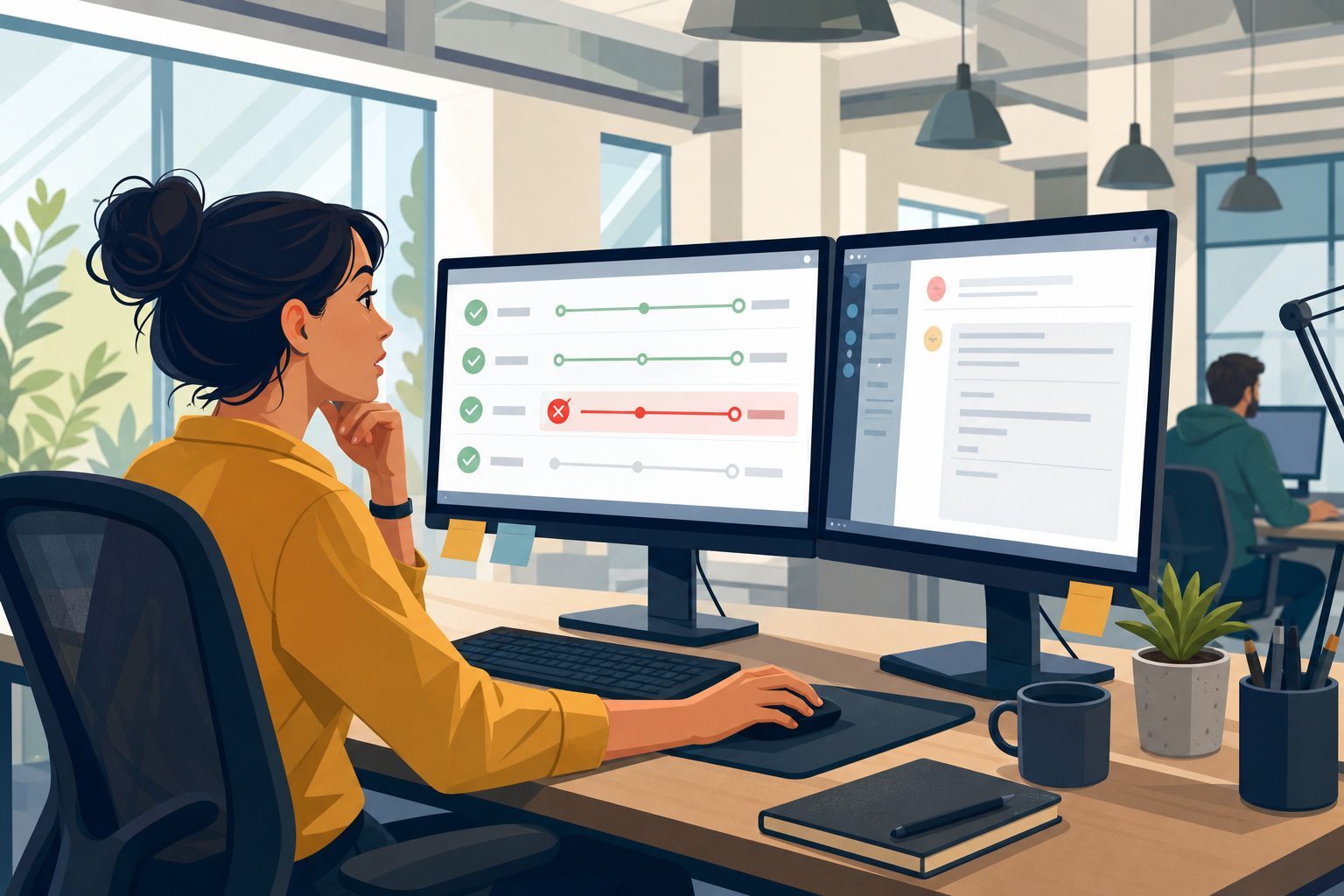

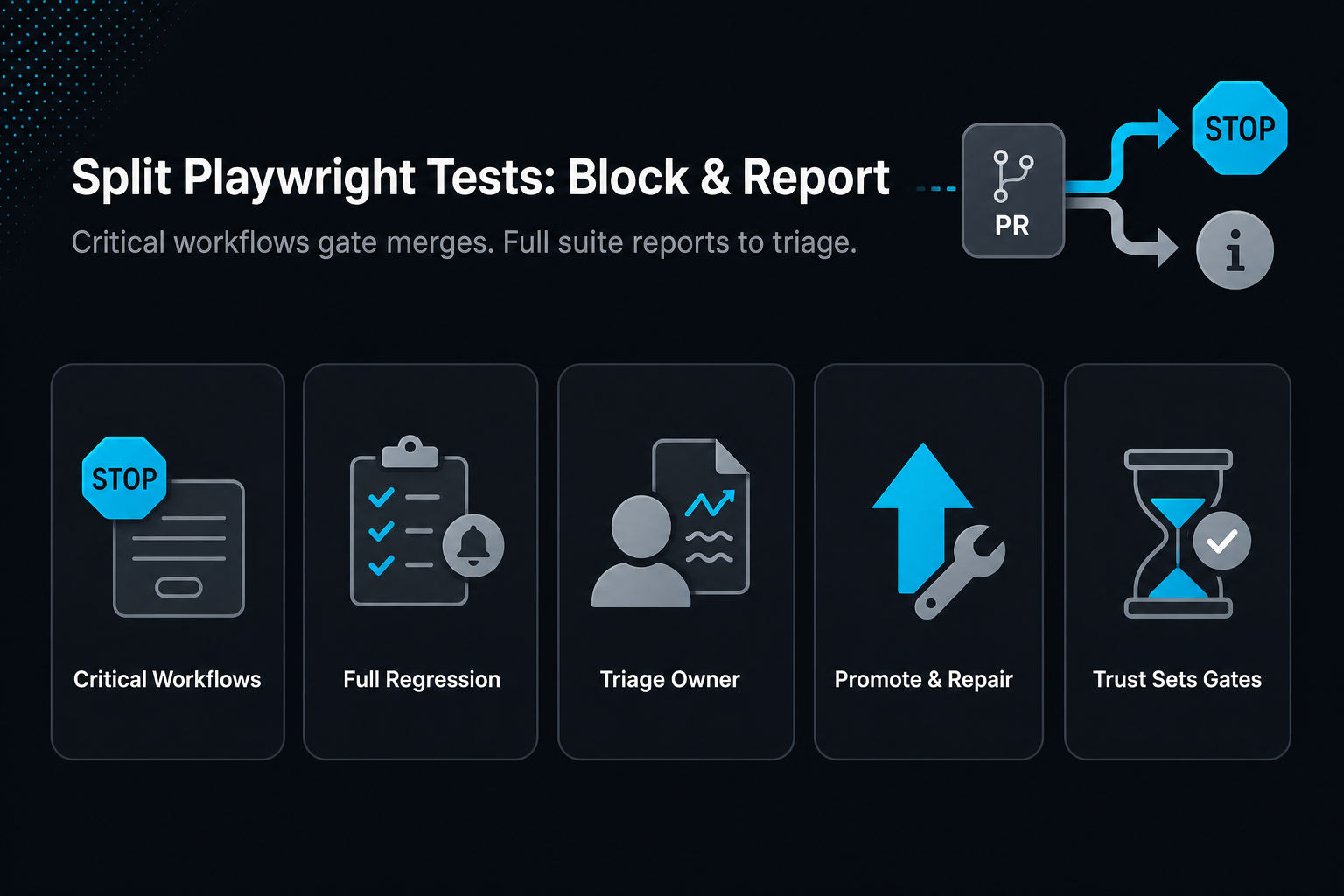
Blocking every pull request on a managed Playwright suite is the fastest way to teach developers to ignore it. The better answer is a split. A small tier of fast, stable tests that cover your highest-risk workflows should block merges. The broader regression suite should report its failures to someone who triages them quickly. When managed Playwright suites run inside client CI pipelines, a human qa expert reviews every failure before developers are notified.
TL;DR
- Block on a trusted tier: Gate merges only on stable tests that cover workflows where a regression would reach users.
- Report the rest: Run the full suite on every pull request or post-merge, but send its failures to triage instead of the merge button.
- Triage speed sets blocking authority: A test should block only if someone can confirm a failure is real faster than a developer would wait.
- Promote rather than default: New tests start as report-only and earn blocking status. Flaky tests get demoted until someone repairs them.
About the Author: This article comes from the MuukTest team, which has many years of qa experience. Our Forward Deployed QAs decide what to cover and where the real risk is, while Amikoo, MuukLabs' AI tool, generates, repairs, and maintains Playwright regression suites that run in client pipelines on GitHub Actions, GitLab CI, Azure DevOps, and Jenkins, so merge-gating policy is a decision we make with teams in practice.
Blocking by default works for tests your developers own
The industry default says yes, and that default works well for tests your own developers write. Standard CI/CD practice makes automated test failures blocking checks so the main branch stays deployable. Report-only checks are kept for experimental features, known flaky tests, or non-critical checks. Playwright's own guidance is to run tests on each commit and pull request [google.com].
Managed tests change one assumption. When an outside qa team maintains the suite, a red check can mean the code broke or the test broke, and the developer looking at it may not know which. How quickly someone answers that question decides whether blocking helps or hurts.
Why does blocking on low-trust tests backfire?
Building on that uncertainty, the main cost of blocking on unreliable tests is lost trust. Slower merges come second. A blocking check works like a smoke alarm mounted over a toaster. It does its job on the day of a real fire, but every false alarm before that day teaches someone to pull the battery.
In CI, pulling the battery looks like admin overrides, a habit of re-running until the check turns green, or a request to make the check optional. A small gate that people respect protects more than a large one they route around.
Blocking checks focus on stopping a known-bad change from merging, while report-only checks focus on surfacing risk without stopping work. Your pipeline needs both, applied to different tests.
Which Playwright tests should earn blocking status?
A related question is selection, because you decide blocking status one test at a time, not for the whole suite. We look for four things:
- Stability record: The test passes consistently on unchanged code. If it recently needed a retry to pass, it stays report-only.
- Runtime: The tier finishes quickly enough that developers wait for it instead of switching tasks. Playwright parallel execution and sharding across CI machines keep it short as it grows.
- Business risk: The test covers a workflow like login, checkout, or billing, where a regression reaches users directly.
- Triage owner: A named person is accountable for classifying its failures during working hours.
Test impact analysis can narrow each pull request's run further by selecting the tests mapped to the files that changed. Code-to-test mapping misses indirect dependencies, though, so keep your critical workflows running on every pull request.
| Tier | Runs on | Blocks merge? | Failures go to |
|---|---|---|---|
| Critical workflows | Every pull request | Yes | Developer, after qa confirms the failure |
| Full regression | Every pull request or post-merge | No | qa triage first |
| New or quarantined tests | Every run | No | Test maintainer for repair |
Once you have defined the tiers, the remaining work is wiring them into your CI.
How do you configure blocking in GitHub Actions, GitLab, and other CI tools?
Each platform turns the tier model into an actual merge rule, but none of them handle it the same way.
| Platform | How blocking is enforced |
|---|---|
| GitHub Actions | Branch protection rules that require the check |
| GitLab CI | The "Pipelines must succeed" project setting |
| Azure Pipelines | "Build Validation" branch policies |
| Jenkins | Not native. Plugins report build status back to your version control system. |
For a Playwright GitHub Actions setup, a clean pattern uses two jobs. The critical-workflows job is listed as required in your branch protection rules. The full-regression job runs but is left off that list. In GitLab merge request pipelines, mark the regression job allow_failure: true so it reports without failing the pipeline.
For Playwright test reporting, the official documentation favors the trace viewer over videos or screenshots for CI failures, with traces recorded on the first retry through trace: 'on-first-retry'. Soft assertions collect every failed check from a run instead of stopping the test at the first one. Playwright's error output also shows which part of the test failed [google.com], which shortens triage.
What should happen when a blocking managed test fails?
Stepping back from configuration, the policy that matters most covers the minutes right after a check turns red:
- Classify: Decide whether the failure is a real defect, a test issue, or an environment problem.
- Route: Real defects go to the developer with a trace. Test issues go to the suite maintainer.
- Quarantine: A test that fails for non-product reasons drops to report-only until someone repairs it.
- Override with a record: A named person can merge past a confirmed false failure, and the override is logged.
- Promote back: A repaired test returns to the blocking tier after it rebuilds a clean record.
Managed qa services can take the classification step off your developers. With services like MuukTest, Forward Deployed QAs decide which workflows carry enough risk to block a merge. A human qa expert confirms each failure is real before your team hears about it. Amikoo, MuukLabs' AI tool, repairs brittle selectors and timing issues. The tests are standard Playwright TypeScript in your own repository, so the gating rules stay under your control.
Frequently Asked Questions
Can report-only tests still catch regressions before release?
Yes, if someone owns them. Give each report-only failure an owner and a deadline, such as before the next release. Otherwise the failures become background noise.
Should flaky tests ever block a pull request?
No. Quarantine a flaky test, keep it running as report-only, and fix the cause before you restore its blocking status.
Does test impact analysis replace a blocking smoke tier?
No. It reduces how many tests each pull request runs, but your critical workflows should still run on every change.
How does blocking work with qa as a service?
The CI rules are the same. The difference is ownership. The provider should commit to triaging blocking failures quickly so developers don't have to diagnose tests they didn't write.
Can Jenkins block pull requests on Playwright failures?
Not natively. It needs plugins that report build status back to your version control system, which then enforces the merge rule.
About MuukTest
MuukTest is a managed qa service that builds and maintains automated test suites for lean engineering teams. The company builds frameworks on industry-standard tools like Playwright, Selenium, and Appium, and clients fully own the resulting automation framework. This approach lets teams reach broad test coverage in weeks while avoiding the exit costs that come with proprietary testing platforms. MuukTest works as a managed qa partnership that extends lean engineering teams, covering web, mobile, API, regression, and end-to-end testing without requiring additional hires. Behind the service are expert Forward Deployed QAs, who decide what to cover, which workflows matter, and where the real risk is, working with Amikoo, MuukLabs' AI tool for test generation, repair, maintenance, and defect detection.
If you'd like help deciding which of your Playwright tests should gate merges, and a team to own the failures that follow, you can learn more at muuktest.com.
References
- Best Practices | Playwright (google.com)