
Teams that prioritize speed over quality often ship faster in the short term, but pay a much higher price later. Rushed releases introduce avoidable bugs, frustrate customers, and slowly erode trust in the product.
This blog explains:
-
Why “ship it now, fix it later” creates quality debt that compounds over time
-
How skipping or rushing QA leads to production issues, customer churn, and internal firefighting
-
Why speed without discipline damages customer trust more than delayed releases
-
How the real cost of poor software quality extends beyond engineering into support, sales, and morale
-
Why high-performing teams treat quality assurance as a strategy, not a release gate
-
How teams can move fast and protect customer experience with smarter QA practices
The takeaway: sustainable speed isn’t about shipping faster at any cost, but about delivering reliable, trustworthy experiences that customers want to keep using.

The Pressure to Ship Faster in Modern Software Teams
Have you ever noticed the long lines outside popular restaurants? People are willing to wait because they trust the experience will be worth it. But in software, patience has become rare. Teams are under constant pressure to release faster, fix defects immediately, and keep everything moving at speed.
Faster shipping often feels like the only option. Deadlines are tight, roadmaps are aggressive, and customers expect rapid updates. Too often, quality becomes the tradeoff. Features get pushed out quickly, testing gets rushed or skipped, and teams tell themselves they’ll “fix it later.”
But what actually happens when you ship software faster to market? Users may try the product, but are they truly satisfied? Does the application reliably meet their needs, or does it cause frustration due to bugs, broken flows, and inconsistent behavior? When speed comes at the expense of quality, customer experience quietly suffers and trust becomes the real casualty.
A Real Example of Speed Over Quality Backfiring
I still remember one morning, our product lead walked into the sprint retrospective and said, "We shipped on time. That's what matters." Three days later, our support tickets had tripled. Two weeks after that, people lost interest in using our product, saying it’s buggy, annoying, and so on!
But here is the truth. Every time a team chooses speed over quality, a quiet debt accumulates in the background. It does not shout. It does not break the sprint velocity chart. It simply waits for the right moment to surface. And when it does, it tends to cost more than anyone expected.
Having managed Testing, Automation, and Service Delivery for the past few years, I have witnessed the adrenaline of fast releases and the heartbreak of customer escalations that could have been prevented with one more round of thoughtful testing. Over the years, one lesson became impossible to ignore: Rushing features might win you a sprint, but they can slowly erode the one thing no team can afford to lose: Customer trust.
The Illusion of Speed in Software Development
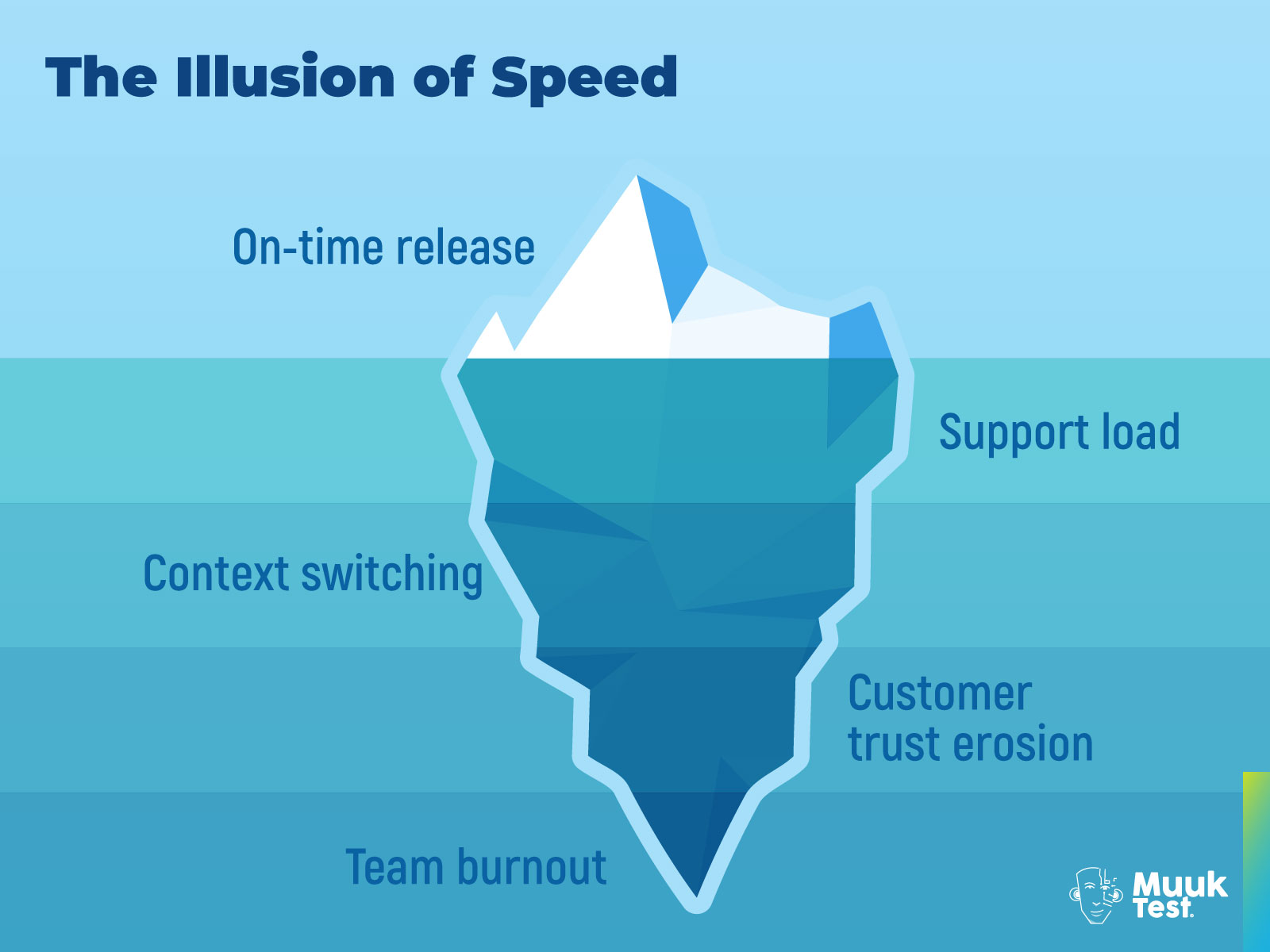
We have all been there. The deadline is tomorrow, and QA hasn't finished testing, but the business is waiting. Someone in the room says, "Let's ship it now and fix any issues later."
It feels decisive. It feels like progress. It feels like winning.
But here's what nobody tells you at that moment. You are not just deferring technical debt. You are gambling with something valuable and harder to rebuild.
Every untested feature you push to production is a risk, because of the blind confidence that the users will not encounter the edge cases you didn't have time to explore or test in depth.
When reality hits, and when your customers face those bugs, they are not just frustrated; they are questioning whether they can rely on your product for their business. Support teams scurry to triage issues, QA teams validate live environments, developers pause their development to patch broken flows, and product managers deal with customer dissatisfaction.
What initially felt like a sprint victory becomes a marathon of firefighting. The cost is no longer technical. It becomes emotional and reputational.
The Real Cost of Skipping QA and Fixing Issues Later
Let me break down what actually happens when you skip the proper QA phase to meet a deadline.
- Week One: Your feature launches. Marketing celebrates. Management is happy. The sprint board shows green. Everyone goes home happy.
- Week Two: Bug reports start trickling in. Your support team is fielding questions they weren't prepared for. Your developers are context-switching between new features and emergency fixes. That context switching alone costs you 20-30% of your productivity, which we miss in our effort estimation.
- Week Three: A critical bug surfaces in production. The hotfix requires a few developers/architects to be taken off their current sprint. The QA team has to stop everything to test the fixes. Your next feature gets delayed anyway.
- Week Four: You discover that the hotfix introduced a regression. Customer satisfaction scores start dropping. Your sales team mentions that prospects are asking about "stability concerns" during demos.
- Month Two: You are still dealing with issues from that rushed release. Product roadmap is wobbling. Your team's morale is suffering. Your team is tired of the constant firefighting.
This is how the cost compounds. It's not linear. It's exponential.
I remember moments in service delivery where a single production issue pulled engineers from three different sprints, delayed an upcoming release, and triggered an escalation from the top. Everyone worked hard. Everyone cared. But the pressure could have been avoided if testing had been given the time it deserved.
How High-Performing Teams Balance Speed and Quality
When testing is integrated early and intelligently into the development process, it stops being a bottleneck and becomes a momentum builder. Leaders who understand this treat QA as a partner, not a checkpoint.
Here are a few approaches that protect both quality and deadlines:
Shorter Feedback Loops
Unit tests and automated checks executed throughout development help teams catch issues before they spread. Developers get quick signals, and QA teams avoid being overloaded at the end of the sprint.
Context Driven and Risk-Based Testing
Not every feature requires the same depth of testing. Teams that prioritize based on business impact deliver faster while still protecting critical workflows.
Also, not every feature carries the same risk. A cosmetic UI change in a non-critical flow needs less scrutiny than a payment processing update. Work with your QA team to assess risk and allocate testing effort accordingly. This lets you move fast where it's safe and thorough where it matters.
Shift Left with Purpose
Involve testers in requirements discussions, design reviews, and story refinement. When testers understand what you are building before code gets written, they catch issues that would have taken days to debug later. This isn't slower. It's dramatically faster.
Automate Smartly
Not everything needs to be automated. It is about automating the right things. But your critical paths and regression scenarios absolutely do, and that allows testers to focus on exploratory analysis and customer experience. For instance, you can focus heavily on API tests, which help to uncover bugs early and give you the confidence to ship quickly without the risk of breaking core functionalities.
Track the right metrics
Stop measuring only velocity and feature output. Start tracking escaped defects, time to resolution, customer-reported bugs, and support ticket trends. These metrics tell you whether your speed is sustainable or just creating downstream chaos.
Speed With Discipline Creates Long-Term Customer Trust
The world does not reward the teams that move the fastest. It rewards teams that move consistently, reliably, and with respect for the customer experience.
Speed and quality are not rivals. They are partners. When supported by smart QA practices and thoughtful leadership, speed becomes meaningful, and quality becomes effortless.
So the next time someone says: “Let’s ship it now and fix it later”, pause for a moment. Ask what the decision will cost tomorrow. Ask how it will shape your relationship with customers. Ask how much trust you are willing to trade for a sprint win.
Choosing quality is not choosing slowness. It is choosing longevity. It is choosing loyalty. And most importantly, it is choosing the kind of product experience your customers will remember with confidence.

Frequently Asked Questions
Why is “ship it now, fix it later” bad for customer experience?
“Ship it now, fix it later” often leads to rushed releases with insufficient testing. While users may initially adopt the feature, recurring bugs, broken workflows, and inconsistent behavior quickly erode trust. Over time, customers associate the product with frustration rather than reliability, which directly harms retention and brand credibility.
Does shipping faster always improve product success?
No. Shipping faster only helps when speed is paired with discipline. Teams that prioritize velocity without quality controls often spend more time later fixing production issues, handling customer escalations, and rebuilding trust. Sustainable success comes from delivering reliable software consistently, not just releasing features quickly.
How does MuukTest help teams balance speed and quality?
Teams using MuukTest often adopt a more disciplined approach to speed by combining smart automation with experienced QA oversight. This hybrid model helps catch critical issues earlier, reduce regression risk, and maintain confidence in releases, without slowing teams down or overwhelming internal resources.
How does poor software quality affect customer trust?
Customers judge software based on reliability. Even small recurring issues can signal instability. When users encounter bugs in critical workflows, they begin to question whether they can depend on the product for their business, leading to churn, negative feedback, and lost opportunities.
How can teams move fast without sacrificing quality?
High-performing teams integrate testing early, focus on risk-based coverage, and automate critical paths while preserving human exploratory testing. By shortening feedback loops and involving QA throughout the development lifecycle, teams reduce late-stage surprises and maintain both speed and confidence.