
The most reliable way to split test strategy decisions is by the kind of knowledge each decision needs. Your internal team should own the decisions that depend on product and business context. That means risk tolerance, release criteria, and which user outcomes can never break. Embedded qa engineers should own the decisions that depend on testing craft: coverage design, test structure, regression tiering, and failure triage. The guidance below reflects how that division holds up inside working engineering teams.
A test strategy rarely fails because the document is wrong. It fails because nobody agreed who gets to change it. When an embedded qa engineer joins your team, every open question needs a single owner, or it gets decided twice or not at all. That includes what to automate, what blocks a release, and which flaky test gets deleted. Below we cover who should own each decision, how to record ownership, and where the split tends to break.
TL;DR
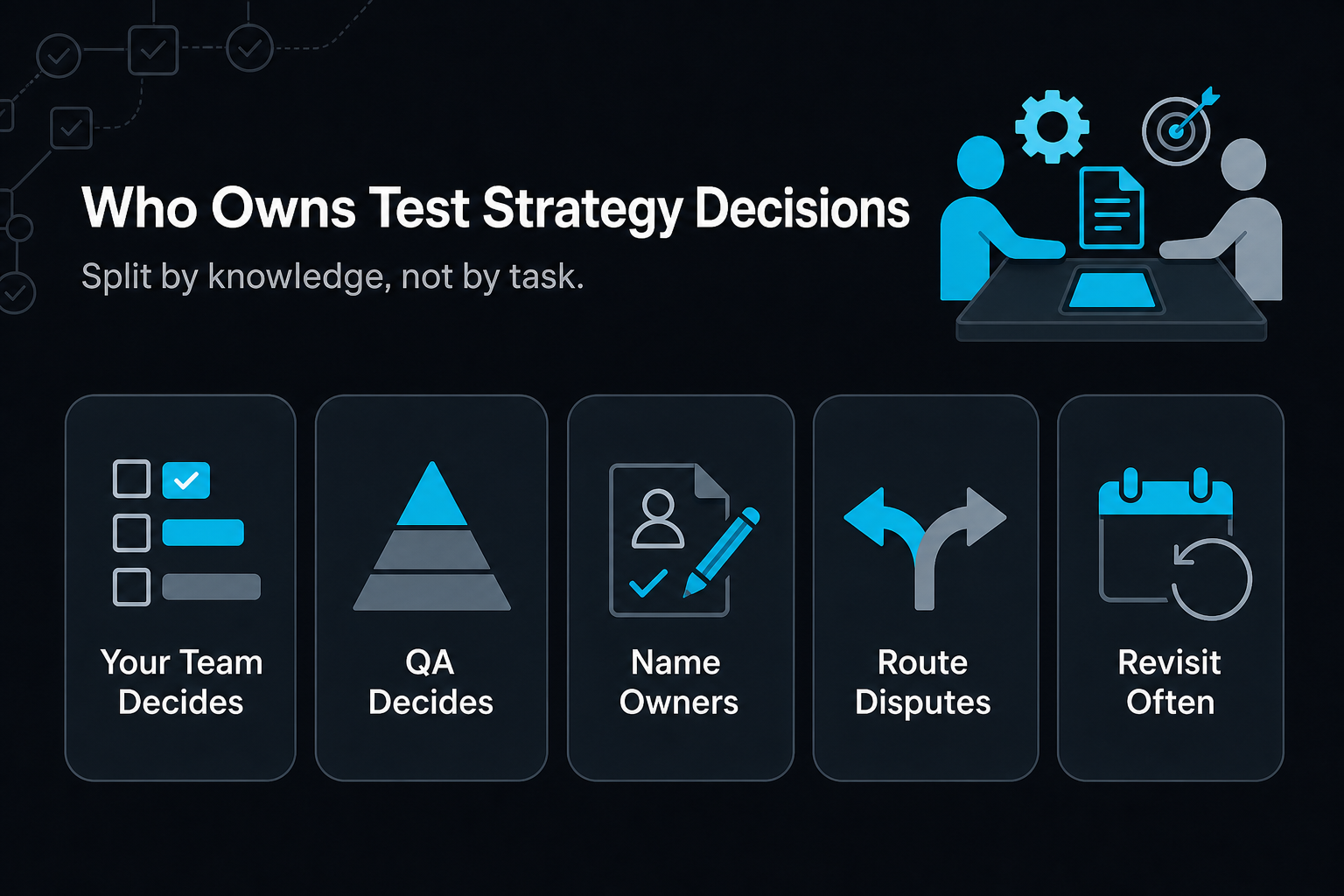
- Split by knowledge, not by task: Product-context decisions stay with your team. Testing-craft decisions go to embedded qa engineers.
- Your team owns the boundaries: This covers priorities, risk tolerance, release criteria, and budget.
- qa owns the execution design: This covers coverage, automation choices, regression tiers, and flake triage.
- Write owners into the document: A test strategy document that names decision owners survives turnover.
- Route disagreements by type: Priority disputes go to your team. Coverage and technique disputes go to qa.
About the Author: This article was written by the MuukTest team. MuukTest is a managed qa service whose Forward Deployed QAs work alongside lean engineering teams, deciding what to cover and where the real risk is, while Amikoo, MuukLabs' AI tool, generates, repairs, and maintains automated coverage across web, mobile, and API applications. Deciding who owns which testing call is a daily part of that work.
Split test strategy decisions by knowledge, not by task
A decision right is the authority to make a call and live with its consequences. That is different from the work of carrying the call out. Most teams split qa by task: developers write unit tests and qa writes end-to-end tests. This divides the labor but leaves authority fuzzy. A qa engineer can end up automating dozens of checkout tests while nobody has confirmed that checkout is the top business risk this quarter.
Think of a homeowner working with an architect. The homeowner decides how many bedrooms they need and what they can spend. The architect decides where the load-bearing walls go. Each one owns the call that requires knowledge only they have, and trouble starts when either reaches across. The same thing happens when a CTO dictates locator strategy, or when a qa engineer guesses at revenue risk. Clear decision rights make your strategy faster to change and harder to break.
Decisions your internal team should keep
Which decisions stay in-house? Following that principle, your team should keep every decision that requires knowing the business, the customers, or the roadmap. No outside engineer can infer these from the codebase.
- Risk tolerance: How much failure each product area can absorb. A billing bug and a tooltip typo are not equal, and only your team knows by how much.
- Release criteria: What must pass before shipping, and who can override a red build.
- Priorities: The business outcomes and user goals that qa uses as input when deciding which workflows matter.
- Roadmap timing: Which features are about to change, so no one automates something scheduled for a rewrite.
- Quality budget: How much engineering time goes to testing versus features.
These calls set the boundaries. Everything inside them is where an experienced qa engineer earns their place.
Decisions embedded qa engineers should own
The other half of the split covers the decisions that turn your priorities into a working suite. Someone who designs test suites for a living makes these calls better. Automating repetitive, time-consuming checks frees qa effort for exploratory testing and user experience validation. Choosing which checks qualify for automation is itself a skill.
- Coverage design: The scenarios, edge cases, and negative paths that protect each critical workflow.
- Automation choices: What to automate, what to explore by hand, and at which layer, API or UI.
- Regression tiering: Which tests run on every pull request and which run before deployment.
- Flake triage: Deciding if a failure is a real bug, a test defect, or an environment problem.
- Maintenance: When to repair, rewrite, or retire a test.
Why hand these over? A developer testing their own feature tends to exercise the path they built. A qa engineer looks for the paths users actually take. Forward Deployed QAs decide what to cover and which workflows matter, working with Amikoo, MuukLabs' AI tool, to generate, repair, and maintain the tests as standard Playwright TypeScript in your own repository.
Mapping qa roles and responsibilities so nothing falls through
How do you make sure nothing falls through? Once both sides know their decisions, the remaining gaps appear at the seams. A simple ownership table closes them.
| Decision | Owner | Gives input | Why |
|---|---|---|---|
| Which workflows are critical | Forward Deployed QAs | Your team | Your team sets priorities; Forward Deployed QAs decide which workflows matter |
| Release go/no-go | Your team | qa | Your team carries the release risk |
| Scenarios and edge cases | Embedded qa | Product managers | Requires testing craft |
| Regression suite tiers | Embedded qa | DevOps | Depends on test speed and pipeline design |
| Real bug or flaky test | Embedded qa | Developers | Requires failure analysis |
| Testing budget | Your team | qa | Trade-off against feature work |
Settle disagreements by type
Priority disputes go to your team. If priorities or risk tolerance are in question, your team sets them, and qa decides where coverage goes using those priorities as input. Technique disputes go to qa. If a developer wants a UI test that belongs at the API layer, qa has the final word. Routing disputes this way keeps arguments short, and it also lets the strategy itself change without friction.
Recording the split in your test strategy document
How should the document reflect all this? A test strategy document is the written record of what you test, how, and why. Adding decision owners turns it from a reference into an operating agreement. A practical test strategy template includes these sections:
- Scope and risk ranking: Owned by qa, who decide what to cover and where the real risk is, with input from your team on priorities, and reviewed whenever the roadmap shifts.
- Test approach by layer: Owned by qa, covering unit, API, and end-to-end responsibilities.
- Regression testing strategy: qa owns the tiers and triggers. Your team approves which tests block a release.
- Entry and exit criteria: Owned by your team, since they define "ready to ship."
- Decision log: A record of who changed what and why, so new hires inherit the reasoning along with the rules.
A shift left testing strategy moves the split earlier. Embedded qa engineers review acceptance criteria before any code is written. Your team, in turn, agrees that a story without testable criteria isn't ready for development. That single agreement pulls defect discovery into planning, where fixes are cheapest.
Where managed qa services fit in this division
Stepping back from the document, a related question is who your embedded qa engineers should be. Hiring in-house gives you direct control, but recruiting and ramping take time. qa as a service works differently. Managed qa services own the testing outcome, while your team keeps the decisions in the "your team" rows of the table.
The test for any provider is whether it respects the split. Does it ask for your risk priorities? A good partner asks before writing tests rather than guessing. Who owns the code? The tests should live in your repository. MuukTest states that its service is not a replacement for qa leadership, so your team still guides priorities. Forward Deployed QAs decide coverage and review failures before they reach your developers.
Frequently Asked Questions
Who should own the test strategy document?
Ownership is shared by section. Your team owns priorities and exit criteria. qa owns scope, risk ranking, the test approach, and the regression sections. Name one editor per section.
Can embedded qa engineers block a release?
They should recommend, not decide. The go/no-go call stays with your team, unless you agreed in advance that failing critical tests block a release automatically.
What is the difference between a test strategy and a test plan?
A test strategy sets the approach and ownership across the whole product. A test plan describes the testing for a specific release or feature.
How often should we revisit the split?
Revisit it whenever the roadmap changes direction, the team structure shifts, or a release surprises you.
Does a managed qa service replace an in-house qa team?
No. It extends lean teams. Internal qa leads keep setting priorities while the service carries automation and maintenance.
About MuukTest
MuukTest is a managed qa service that builds and maintains automated test suites for lean engineering teams. The company builds frameworks on industry-standard tools like Playwright, Selenium, and Appium, and clients fully own the resulting automation framework. This approach lets teams reach broad test coverage in weeks while avoiding the exit costs that come with proprietary testing platforms. MuukTest works as a managed qa partnership that extends lean engineering teams, covering web, mobile, API, regression, and end-to-end testing without requiring additional hires. Behind the service are expert Forward Deployed QAs, who decide what to cover, which workflows matter, and where the real risk is, working with Amikoo, MuukLabs' AI tool for test generation, repair, maintenance, and defect detection.
If you are working out who should own which testing decisions on your team, you can learn how Forward Deployed QAs fit alongside your engineers at MuukTest.
References
- Playwright documentation (playwright.dev)