

A flaky test suite does not just produce false alarms. It quietly taxes every engineer who touches your CI pipeline, and that tax compounds daily until it shows up as missed deadlines, eroded trust in your test results, and budget lines nobody can fully explain. The direct cost is measurable: developers spend as much as 1.28 percent of their working time repairing flaky tests, according to one industrial case study [mediatum.ub.tum.de], and investigation time can translate to 5 to 10 hours per week per team spent chasing failures that were never real bugs. For a 50-person engineering organization, that pattern alone can add up to a meaningful annual loss in productivity.
TL;DR
- Flakiness is not rare: Google reports that roughly 16 percent (about 1 in 6) of its tests exhibit flaky behavior, and 1.5 percent of all test runs hit a flaky failure, with 84 percent of pass-to-fail transitions in its systems involving flaky tests rather than real regressions [testing.googleblog.com].
- The cost is mostly hidden: it shows up as rerun time, investigation time, and delayed releases, not as a single line item on an invoice.
- A blended engineer rate of $50 to $100 per hour turns "a few flaky reruns a day" into a calculable, often startling, annual figure.
- Framework choice matters: Playwright suites tend to run faster and flake less often than Selenium equivalents, but both still couple tests to the UI, so maintenance cost scales with how often your interface changes.
- Fixing flakiness has measurable test automation ROI once you track engineering hours recovered, not just defects caught.
About the Author: This article is produced by MuukTest, a managed QA service that builds and maintains automated test suites for growth-stage engineering teams, with a specific focus on eliminating flaky test results through its Amikoo-powered QA process and the proprietary EAT Method.
What exactly counts as a "flaky test," and why does it cost more than it looks like?
Flaky tests produce inconsistent outcomes across repeated runs of the same code without any change to the underlying logic. The cost is not the failed run itself. It's everything that happens after: an engineer stops what they're doing, checks the CI log, re-runs the job, and either confirms it was noise or digs deeper to rule out a real regression.
Think of it like a smoke detector that goes off every time someone makes toast. The first few times, people investigate. After a month, they just pull the battery out, and that's exactly the moment a real fire goes undetected. The same pattern appears in CI pipelines: once engineers start auto-rerunning jobs without reviewing them, the suite has already lost its value as a signal [club.ministryoftesting.com].
Industry reports indicate flakiness is not shrinking. The share of teams experiencing flaky tests rose from 10 percent to 26 percent between 2022 and 2025, according to Bitrise’s analysis of over 10 million CI builds [bitrise.io]. A meaningful share of the "failures" your team investigates every sprint were never bugs at all. That means a meaningful share of the "failures" your team investigates every sprint were never bugs at all.
How do you calculate the hidden engineering hours lost to flaky tests?
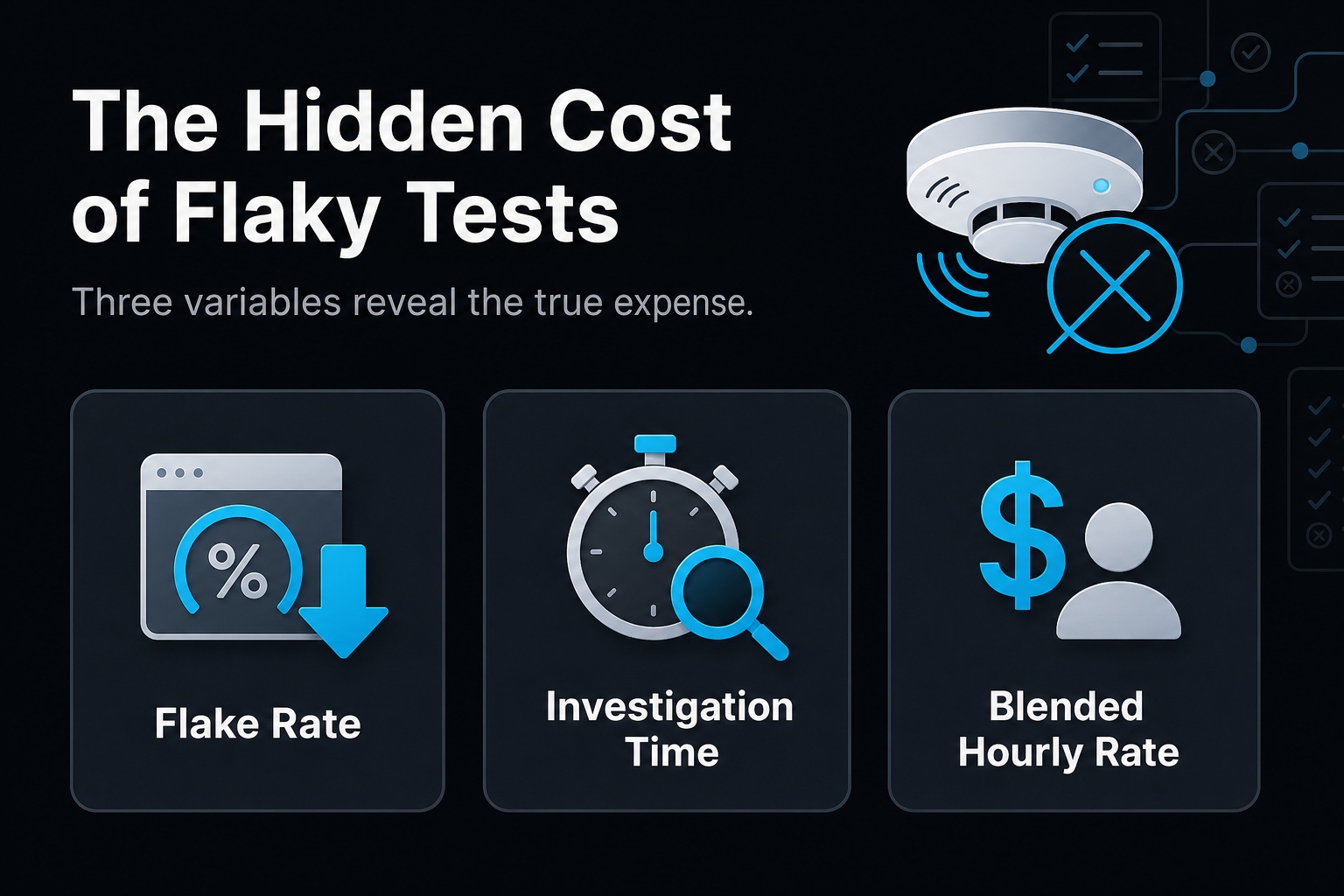
Calculating the real cost starts with isolating three variables: how often tests flake, how long each investigation takes, and what an engineering hour is worth to your organization. Once you have those three numbers, the math is straightforward, and usually uncomfortable.
- Flake rate: the percentage of test runs that fail without a corresponding code defect. Pull this from your CI dashboard over a rolling 30-day window rather than guessing.
- Time per investigation: the average time an engineer spends diagnosing a failure before concluding it's flaky. This typically includes reading logs, re-running locally, and checking recent commits.
- Blended hourly rate: the average hourly cost of a software engineer, commonly estimated in the $50 to $150 per hour range in the US and lower in other regions, depending on experience and location. Many finance and engineering teams use a blended rate of $50 to $100 per hour for this kind of calculation.
A simple formula: (Flaky failures per week) x (average investigation time) x (blended hourly rate) = weekly cost. Multiply by 52 for an annual figure. Teams that run this calculation for the first time are often surprised to find it rivals the cost of a full-time QA hire, even before counting the opportunity cost of delayed features.
That opportunity cost deserves its own line item. Every hour spent re-litigating a false failure is an hour not spent on the feature roadmap, and in AI-accelerated development cycles where code ships faster than ever, that tradeoff happens more often, not less.
Why do flaky tests erode trust faster than they erode velocity?
Building on the time calculation above, the harder problem is behavioral, not mathematical. Once a test suite flakes often enough, engineers stop trusting red builds, and that shift in behavior is more expensive than the hours lost to any single rerun [club.ministryoftesting.com].
Trust and velocity move together but fail independently. A team can still ship fast with a flaky suite for a while, simply by ignoring failures, right up until a real regression slips through because it looked like "just another flaky one." At that point the cost stops being engineering hours and becomes production incidents, which carry their own remediation time, customer impact, and on-call burden.
A related but distinct question is whether automated reruns solve this. They don't, they just hide it. Auto-retry logic can mask a flake rate problem by passing on the second or third attempt, but it adds CI minutes, delays feedback, and does nothing to fix the underlying instability, whether that's a timing issue, an execution-order dependency, shared test data, or an unstable test environment, all of which are the most commonly cited causes of flakiness.
Does framework choice actually change the flakiness equation?
Stepping back from the behavioral cost, a more technical question is whether your tooling choice changes the baseline flake rate. It does, measurably. Published benchmarks consistently show Playwright running faster than Selenium with a meaningfully lower flakiness rate, though exact run times and flake percentages vary by test suite and benchmark.
| Factor | Selenium | Playwright |
|---|---|---|
| Typical suite runtime | 60-90 minutes | 30-40 minutes |
| Typical flakiness rate | ~15 percent | ~3 percent |
| UI coupling | High | High |
That gap matters for anyone tracking Playwright test coverage as a KPI, since a lower flake rate means the coverage number actually reflects real risk rather than noise. But framework choice is not a complete fix. Both tools couple tests to UI implementation details, which means maintenance cost still scales with how frequently your interface changes, regardless of which framework runs the assertions. Teams that treat a framework migration as a cure-all for flakiness are usually disappointed six months later when UI churn reintroduces the same instability in a faster wrapper.
Self-healing locators and AI-assisted test maintenance reduce maintenance burden by absorbing minor UI changes without requiring manual rewrites, directly lowering the ongoing hours that drive test automation ROI calculations.
How do you turn flaky test reduction into a measurable automated testing ROI?
With the technical and behavioral costs established, the practical next step is building a before-and-after comparison your finance team will actually accept. Automated testing ROI is best expressed as hours recovered multiplied by blended engineer cost, compared against the investment required to stabilize the suite.
- Baseline your current flake-related hours: Use the formula above to establish a monthly cost figure before making any changes.
- Track CI time separately from investigation time: Reruns consuming 15 to 30 percent of CI minutes is a compute cost; engineer investigation is a labor cost. Report both.
- Measure trust recovery, not just pass rate: Survey your engineers on whether they still review red builds manually. A rising "ignore and rerun" rate is a leading indicator of hidden cost, even if the dashboard looks fine.
- Re-run the cost formula quarterly: Flakiness tends to creep back in as the codebase and UI evolve, so this isn't a one-time audit.
Teams that lack the internal bandwidth to run this kind of ongoing stabilization work often turn to a managed partner rather than hiring additional QA headcount. With MuukTest, Forward Deployed QAs decide what to cover and where the real risk is, while Amikoo, MuukLabs' AI testing tool, repairs broken tests and separates real product defects from test issues, so engineers stop investigating failures that were never bugs. The tests are standard Playwright TypeScript in the client's own repository. The goal isn't to replace your team's judgment; it's to give them a signal they can trust again.
For teams further along, that same cost model extends naturally into questions of broader QA ROI, which MuukTest covers in more depth in its guides on test coverage strategy.
Frequently Asked Questions
What is considered a "high" flake rate for a test suite?
There's no universal threshold, but any flake rate that's rising, or high enough that engineers rerun red builds without reviewing them, warrants investigation.
How much does flakiness actually cost a mid-sized engineering team?
Using a blended rate of $50 to $100 per hour as an illustrative example, a 50-person team spending even 5 to 10 hours per week investigating false failures could lose roughly $13,000 to $52,000 a year in productivity, before counting delayed releases or production incidents caused by ignored failures.
Does rewriting tests in Playwright eliminate flakiness?
No. Playwright suites tend to run faster and flake less often than Selenium suites, but both remain coupled to UI implementation, so ongoing maintenance and occasional flakiness are expected as the interface changes.
Can AI testing tools fix flaky tests automatically?
AI-driven capabilities like self-healing locators and natural language test authoring reduce the manual maintenance burden that causes flakiness, but they work best alongside human review rather than as a full replacement for test design oversight.
How often should a team audit its test suite for flakiness?
Quarterly at minimum, since UI changes and new code paths reintroduce instability over time. Teams shipping frequently with AI-assisted development may benefit from monthly reviews.
Is a flaky test suite worse than having no automated tests at all?
In practical terms, a highly flaky suite can be worse because it trains engineers to ignore failures, including real ones, while still consuming CI time and engineering hours. A smaller, reliable suite often delivers more actual risk coverage than a large, flaky one.
About MuukTest
MuukTest is a managed QA service that builds and maintains automated test suites for lean engineering teams. The company builds frameworks on industry-standard tools like Playwright, Selenium, and Appium, and clients fully own the resulting automation framework. This approach lets teams reach broad test coverage in weeks while avoiding the exit costs that come with proprietary testing platforms. MuukTest works as a managed QA partnership that extends lean engineering teams, covering web, mobile, API, regression, and end-to-end testing without requiring additional hires. Behind the service are expert Forward Deployed QAs, who decide what to cover, which workflows matter, and where the real risk is, working with Amikoo, MuukLabs' AI tool for test generation, repair, maintenance, and defect detection.
If flaky tests are quietly draining your team's engineering hours, it may be time to calculate the real number and see what a stabilized suite could look like. Learn more at MuukTest.
