
Traditional QA staffing models were built around a headcount math problem: more releases meant more testers, hired and trained on a timeline measured in months. That math no longer works. AI coding assistants now let engineering teams ship code faster than any linear hiring plan can match, and the result is a structural mismatch between release velocity and QA capacity, not just a temporary crunch. Fixing it requires rethinking QA as a managed, continuously scaling function rather than a static team size, which is exactly where services like MuukTest have built their model.
TL;DR
- AI coding tools have decoupled development speed from QA capacity: commit volume can rise sharply while test coverage growth lags behind.
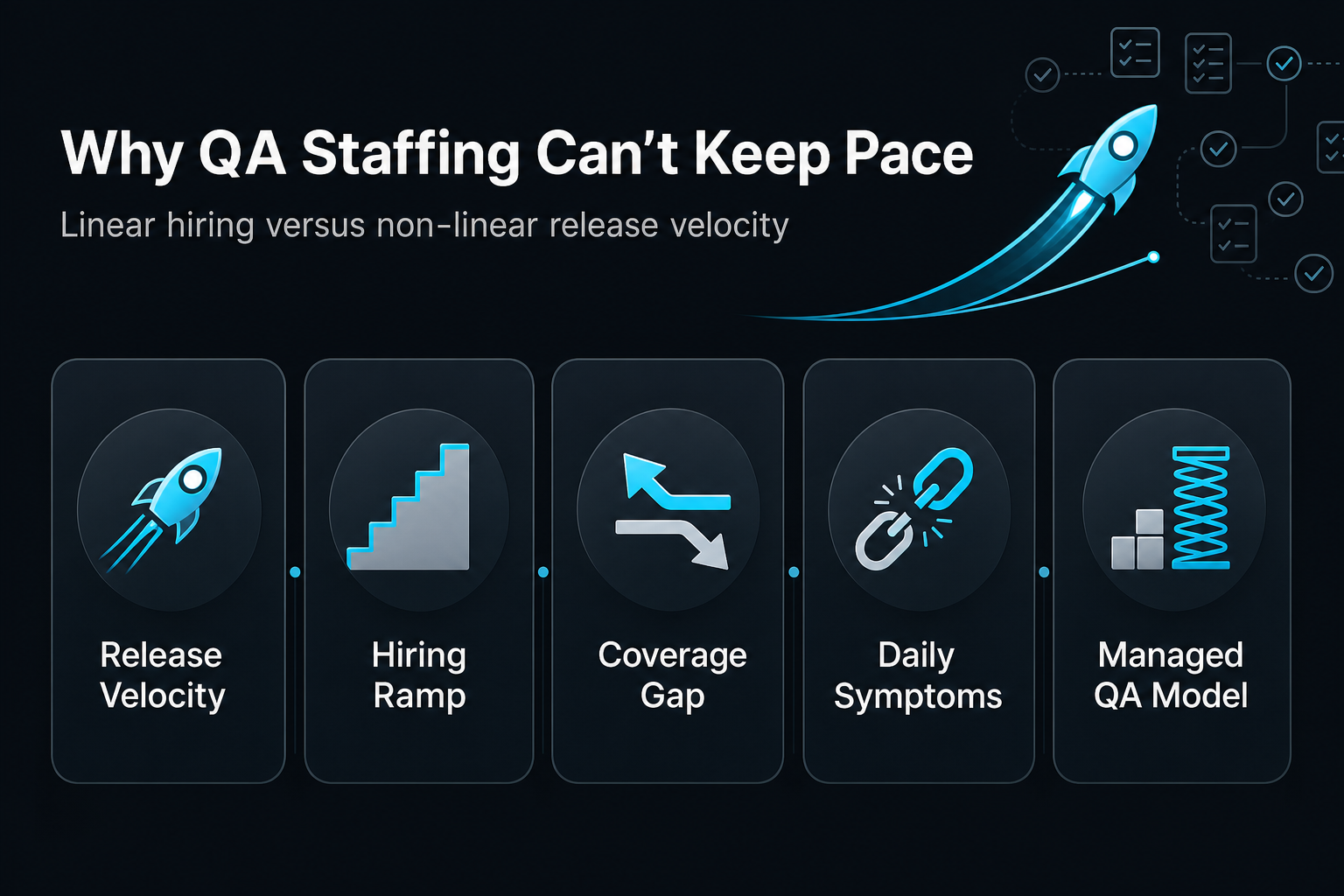
- Headcount-based QA staffing scales linearly, but release velocity now scales non-linearly, creating a widening coverage gap.
- Flaky, unreliable automation and broken feedback loops are the most common symptoms of a staffing model under strain.
- Managed QA services that pair AI-driven testing tools with experienced engineers can scale test coverage without proportional headcount growth.
- Playwright-based automation, API testing, and regression suites need continuous maintenance, not one-time setup, to keep pace with faster releases.
About the Author: This article is published by MuukTest, a managed QA and test automation company that has spent over a decade building automated test coverage for scaleups and engineering teams shipping on compressed release cycles. MuukTest's QA engineers and Amikoo-powered testing agents work inside client CI/CD pipelines daily, giving the team direct visibility into where staffing-based QA models break down under AI-accelerated development.
What's Actually Breaking in Traditional QA Staffing?
Traditional QA staffing assumes a predictable ratio between developers and testers, usually planned around quarterly hiring cycles. That assumption breaks when the input side of the ratio changes faster than the output side can be rehired for. AI coding assistants have been documented to increase deployment frequency and reduce lead time for changes. Commit volumes can climb significantly in some teams, but the realized increase in shipped releases is usually far smaller once review and integration bottlenecks absorb the rest.
That gap between commit growth and release growth is where QA staffing models strain hardest. Engineering leaders see code arriving faster, assume releases will follow at the same pace, and staff QA for a volume that doesn't fully materialize at first, then spikes once review bottlenecks clear. A QA team sized for last quarter's commit rate is already behind by the time it's fully onboarded.
Think of it like a restaurant kitchen that hires line cooks based on last month's reservation count. If a new delivery app suddenly triples incoming orders, the kitchen doesn't get three times the staff overnight. It gets a backlog, dropped tickets, and food going out cold. QA teams staffed on a lagging indicator face the same mechanism: the test backlog grows faster than the team sized to clear it, and coverage quality degrades exactly when it matters most.
Why Does Faster Development Create a Coverage Gap, Not Just a Workload Spike?
A workload spike is temporary and resolves once a team catches up. A coverage gap is structural, meaning it persists because the underlying system wasn't designed to scale at the new rate. The distinction matters because many engineering leaders still treat QA strain as a scheduling problem, something solvable with overtime or a short-term contractor, when it's actually a capacity design problem.
Traditional in-house QA teams write and maintain test cases largely by hand, even when using automation frameworks. Each new feature from AI-assisted development needs new test scenarios, updated regression suites, and revalidated integrations. When code output accelerates but test-writing capacity doesn't, teams default to shortcuts: skipping edge cases, deferring regression runs, or shipping with partial coverage.
Those shortcuts compound. Skipped edge cases become production incidents. Deferred regression runs become multi-day scrambles before a release. Partial coverage becomes the normal state rather than the exception, and QA leads start seeing persistent challenges including flaky, unreliable tests and broken feedback loops between development and QA [accelq.com].
How Does This Show Up Day to Day for QA and Engineering Teams?
Building on the structural gap above, the daily symptoms are specific and measurable, not abstract. QA leads typically notice the same cluster of problems regardless of company size or industry.
- Flaky tests: Automated tests that pass and fail inconsistently without code changes, usually from environment instability or poor test design, erode trust in the suite until teams start ignoring failures altogether.
- Regression debt: Full regression testing automation gets deprioritized under release pressure, so teams run a thin slice of critical-path tests and hope the rest still works.
- Review and merge bottlenecks: Faster commits mean more pull requests competing for limited reviewer and QA bandwidth, which is part of why shipped releases lag behind raw commit growth.
- Manual test maintenance overload: Every UI or API change breaks brittle locators and selectors, consuming engineering time that should go toward new coverage instead of upkeep.
- Tool sprawl without ownership: Teams adopt multiple AI-driven testing tools piecemeal, but no one owns the overall test strategy, so coverage gaps hide in the seams between tools.
Left unaddressed, QA bottlenecks don't just slow releases, they reduce confidence in every release that does ship, as persistent challenges in testing infrastructure create friction across engineering organizations [mev.com]. A related but distinct question follows: if hiring more testers isn't the fix, what is?
Why Doesn't Simply Hiring More QA Engineers Solve the Problem?
Hiring more QA engineers adds linear capacity to a problem that's growing non-linearly. A new hire takes weeks to ramp on the codebase, the existing test framework, and the team's release process before they contribute meaningfully, and by the time they're fully productive, release velocity has often increased again. The hiring cycle simply can't track the acceleration curve created by AI-assisted development.
There's also a cost dimension. A fully loaded in-house QA engineer or SDET represents a significant fixed cost regardless of release volume that month. Teams that staff for peak velocity carry excess cost during slower periods; teams that staff for average velocity fall behind during spikes. Neither approach matches cost to actual testing demand.
This is the mechanism-level reason managed QA services have gained traction: they decouple coverage capacity from headcount by combining AI-driven testing tools with experienced engineers who can scale effort up or down without a hiring cycle. MuukTest, for example, is built around this model, pairing Amikoo AI QA agents with human testing experts to achieve comprehensive Playwright test coverage in weeks rather than the months a hiring-based ramp-up typically requires. It's a way to extend a lean in-house team's capacity rather than replace it, which matters for teams that want to keep ownership of their QA strategy while offloading the heavy lift of building and maintaining automation.
What Does a QA Model Built for AI-Accelerated Releases Actually Look Like?
A QA model built for this pace treats test coverage as a continuously maintained asset, not a project with a start and end date. That's a meaningful shift from the traditional view, where a test suite is "done" once it passes a certain coverage percentage.
In practice, that means:
- Automated regression testing that runs on every merge: not weekly or pre-release, so failures surface while context is still fresh.
- API testing automation integrated early: catching contract breaks before they reach the UI layer, where they're more expensive to diagnose.
- Playwright test automation with self-healing locators: reducing the manual maintenance burden that normally scales with every UI change.
- Mobile app testing and accessibility testing run in parallel with web testing, rather than treated as separate, lower-priority tracks.
- Clear ownership of the automation framework: whether in-house or through a managed partner, so the suite doesn't become a black box no one wants to touch.
Teams evaluating qa automation companies for this shift should weigh whether a vendor's approach genuinely reduces maintenance overhead or just shifts the same manual work to a different team. Our guide on building a sustainable test automation strategy covers the evaluation criteria in more depth.
| Staffing Approach | Scales With Release Velocity? | Ramp-Up Time | Maintenance Burden |
|---|---|---|---|
| Traditional in-house hiring | No, linear and lagging | Weeks to months per hire | High, grows with every new hire's onboarding |
| Tools-only automation (self-serve) | Partially, limited by internal bandwidth | Fast to start, slow to mature | High, scripts break without dedicated upkeep |
| Managed QA services (AI + experts) | Yes, elastic to workload | Days to weeks | Low, maintenance is part of the service |
Frequently Asked Questions
What is a managed QA service?
A managed QA service combines AI-driven testing tools with experienced QA engineers who design, run, and maintain test automation on a client's behalf, while the client retains ownership of the resulting framework and strategy.
How is this different from outsourced or offshore testing?
A managed QA service stays accountable for coverage results and integrates directly into the client's CI/CD pipeline, rather than operating as a detached vendor that hands over execution without shared ownership of outcomes.
Does faster development always mean more bugs?
Not inherently. The risk comes from testing capacity failing to scale alongside commit volume, not from speed itself. Teams with elastic, well-maintained automation can ship faster without a corresponding rise in defects.
What's the biggest sign a QA staffing model is breaking?
Rising flaky test rates and deferred regression runs are the clearest early indicators, since both signal that coverage maintenance has fallen behind release volume [accelq.com].
Can AI testing tools fully replace human QA engineers?
No. AI-driven testing tools handle repetitive execution and maintenance well, but experienced engineers are still needed to design test strategy, interpret edge cases, and judge risk, which is why effective models pair both.
How quickly can a team realistically achieve strong automated coverage?
With a managed, AI-assisted approach, teams can reach substantial Playwright coverage in weeks; building the same coverage manually in-house typically takes months.
About MuukTest
MuukTest is a managed QA service that builds and maintains automated test suites for lean engineering teams. The company builds frameworks on industry-standard tools like Playwright, Selenium, and Appium, and clients fully own the resulting automation framework. This approach lets teams reach broad test coverage in weeks while avoiding the exit costs that come with proprietary testing platforms. MuukTest works as a managed QA partnership that extends lean engineering teams, covering web, mobile, API, regression, and end-to-end testing without requiring additional hires. Behind the service are expert Forward Deployed QAs, who decide what to cover, which workflows matter, and where the real risk is, working with Amikoo, MuukLabs' AI tool for test generation, repair, maintenance, and defect detection.
If your release velocity has outpaced your current QA staffing plan, it may be time to rethink the model rather than the headcount. Visit MuukTest to see how a managed QA approach can bring your test coverage up to speed.
