-
Teams bring in QA after chaos, not before it. QA is often introduced once firefighting, customer complaints, and release anxiety make instability impossible to ignore.
-
The first role of QA is visibility, not testing. Effective QA starts by creating a clear picture of product health, risks, and blind spots before fixing defects.
-
Stability comes from rhythm, not bureaucracy. Lightweight QA processes (sanity checks, regression planning, and release readiness) restore predictability without slowing teams down.
-
Automation works only after stability exists. Successful teams stabilize environments and workflows first, then introduce automation in phases to reduce risk.
-
QA transforms culture as much as systems. When quality becomes a shared responsibility, fear fades, trust returns, and teams regain confidence in their releases.
This post is part of a 4-part series, From Speed to Trust: The QA Maturity Journey for Scaling Software Teams:
- The Dev-Only Startup Dream: Why Skipping QA Breaks Software Teams
- When Customers Become Testers: The Real Cost of Missing QA
- From Chaos to Control: How QA Stabilizes Software Teams ← You're here
- Quality as a Growth Engine: Beyond Bug Prevention - February 3rd, 2026

Why Teams Bring in QA After Hitting Rock Bottom
When a company calls in QA after months or years of firefighting, they rarely say it openly, but they are actually asking for a rescue mission. Not a rescue from bugs, but a rescue from uncertainty.
In Part 2, the customers became testers. Trust evaporated. The developers started fearing deployments. Leadership began to see the financial and emotional costs of not having structured quality. That's the moment someone finally says the magic word. “We need QA”. But the arrival of QA is not a switch; it's a story. This story begins with chaos, confusion, and unrealistic expectations.
What the First QA Hire Walks Into
The first QA hired rarely enters the calm environment. Usually, the place looks like this:
- No test environment, they test in staging, sometimes in prod.
- No reproduction steps; it breaks randomly.
- No regression suite, we test what we remember.
- No test data, use whatever is in the database.
- No clarity on ownership. Devs said it's a config issue, ops said it's a devs bug.
When I was brought into a logistics automation company a few years ago, the CTO greeted me with: “We know things are broken, we just don't know how broken”. That sentence captures exactly why QA is hired late. The organization doesn't just lack quality, it lacks visibility.
So the first job of QA is not to test, but to see.
How QA Stabilizes Software Teams: A Step-by-Step Framework
Step 1 . Listening Before Leading
A mature QA professional starts not with tools, but with ears. They sit with:
- Developers - to understand workflows, pain points, and blind spots
- Product managers - to understand assumptions and missing acceptance criteria
- Support teams - to learn which defects hurt customers the most
- Ops & DevOps - to understand deployment risks
- Leadership - to understand expectations and urgency
This phase is not glamorous, but it's where 80% of the clarity in transformation comes from. Those insights change the company's roadmap because QA isn't just a bug-finding machine; it's a sense-making machine.
Step 2. Establishing a Quality Baseline - The X-ray
You cannot improve what you cannot measure. So QA begins with a quality baseline, which is also called the X-ray of the product's health. Typical baseline components are:
1. Defect mapping
The categorizing of issues by severity, frequency, subsystem, or root cause. This reveals patterns like:
- Maybe 60% of failures are caused by configuration changes
- Maybe half the bugs come from one subsystem
- Maybe regression happens every second sprint
Recognizing the patterns gives you power.
2. Test coverage audit
Not just unit tests, which are often falsely comforting, but also:
- Integration flows
- End-to-end journeys
- Edge cases
- Experience validation
- Device/browser/network coverage.
Most companies find massive blind spots here.
3. Environment stability review
- Is staging reflective of production?
- Do APIs behave the same way?
- Is the data consistent enough for valid tests?
In one API product I worked on, development ran 80% faster than production because production used heavier ML models. Everything passed in staging, but crashed in production.
Baseline audits expose such traps.
4. Release process review
QA maps the existing release flow. Coding -> PR -> merge -> deploy -> pray. This pray-based deployment model, as Jess Humble jokingly calls it, explains more outages than bad code ever does.
Step 3. Introducing Rhythm With Lightweight QA Processes
Contrary to myths, QA is not bureaucracy.
QA = Rhythm + Rituals
The following depicts the usual first steps a QA leader introduces:
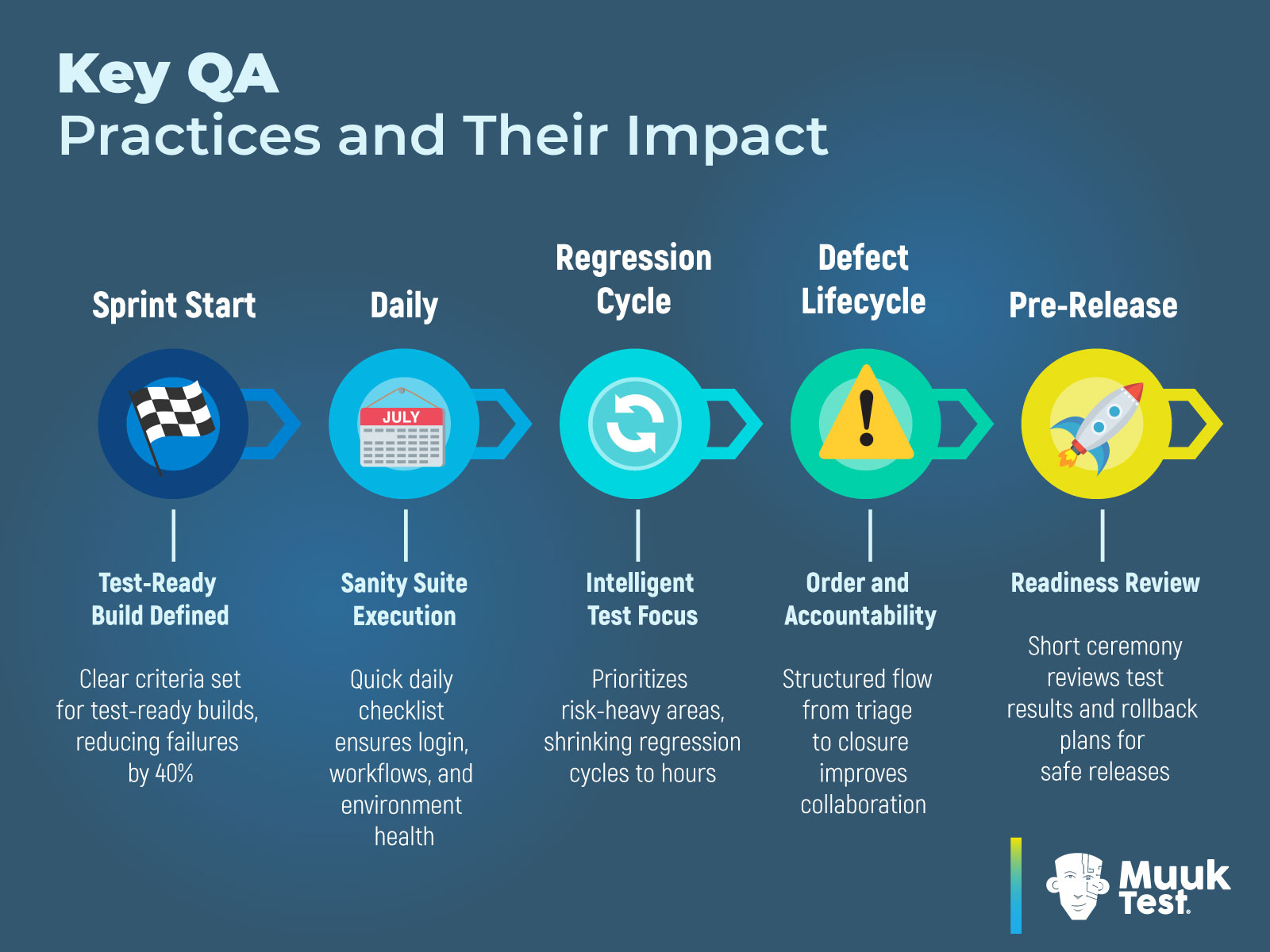
What is a “test-ready” build?
- What is a “release-ready” build?
- What conditions must be met before merging code?
When I introduced basic entry criteria in a mid-size SaaS team, failures dropped by 40% over 3 sprints.
- Daily Sanity Suite
A 10–15 test checklist verifying Login, Critical workflows, Payments/APIs, Configuration flags, and Environment health. This gives developers confidence every morning.
- Regression Cycle Planning
Instead of testing everything always, QA focuses on:
- Risk-based prioritization
- Data-driven hotspots
- Areas touched by recent changes
This is how elite teams reduce test time from weeks to hours.
- Defect Lifecycle
Simple rules:
- Triage → Reproduce → Classify → Prioritize → Fix → Retest → Close
- No hopping tickets
- No back-and-forth blame ping-pong
Suddenly, chaos turns into cadence.
- Release Readiness Reviews
A short pre-release ceremony observing Test results, Automation status, Known issues, Rollback plan, and Observability check. These 15-minute meetings save millions later.
Step 4. Early QA Wins That Change Leadership Perception
Transformation cannot start with genius; it must start with wins. The first QA win usually looks like:
- Catching a critical bug before a big demo
- Stabilizing staging environments
- Creating the first automated smoke test
- Reducing customer complaints
- Bringing predictability to releases
I remember a moment when a QA engineer caught a concurrency bug that a developer missed. The CTO said, “This is the first good sleep I have had in 6 months”. This is where leadership finally stops seeing QA as a cost and starts seeing it as insurance, strategy, and foundation
Step 5. Introducing Automation Stability Before Scaling
A common mistake teams make is jumping into automation without a process in place. You cannot automate chaos; you must stabilize it first. Once the basic QA rhythm is in place, automation begins carefully:
- Phase 1: Smoke Tests
Fast critical checks before every deployment, like Login, user flows, key APIs, and feature flags. This alone catches 30-40% of high-risk issues early.
- Phase 2: Regression
Targeted regression automation on stable areas. Automation grows like a tree.
- Phase 3: Shift-Left Tooling
This is required for static code analysis, contract testing, API schema validation, pre-merge pipelines, or unit test gatekeeping. Shifting-left reduces defect escape dramatically.
- Phase 4: Observability and Monitoring
The QA team collaborates with DevOps to build user journey monitors, synthetic tests, alerting systems, and error budgets. Testing now extends beyond deployment into the customer's reality.
Step 6. Rebuilding Engineering Culture Through QA
The tools fix bugs; the process fixes predictability, but only culture fixes the behavior. QA becomes the mirror in which the organization sees its blind spots.
- Shift from blame to understanding - Instead of asking, who broke this, the high-performing teams ask, how did this slip through, and how do we prevent it?
- QA is a coach, not a cop - The QA sits in grooming sessions saying, “Let's define acceptance criteria together,” or “This scenario needs a negative test too,” or “Can we simplify this flow for testability?” The developers start appreciating QA questions because this makes the product cleaner.
- Shared ownership of quality - One of the most profound changes occurs when developers begin running smoke tests themselves. That's when QA is no longer a gatekeeper; it has become a partner.
- The product managers join the journey - When the PMs see predictable releases, they stop pushing data-driven engineering and shift towards value-driven engineering. This is where quality starts to align with the strategy.
Step 7. When QA Becomes a Strategic Function
By now, the leadership has started asking new questions.
- How do we expand automation?
- Can the QA help us predict risk?
- How do we improve the UX testing?
This is the point where QA transforms from a fire extinguisher into a strategic function. The company now begins to understand:
- Quality is not cost
- Quality is capacity
- Quality is velocity, and
- Quality is trust.
Case Study: How PayZen Moved From Chaos to Control
Remember PayZen, the fintech startup from Parts 1 and 2?
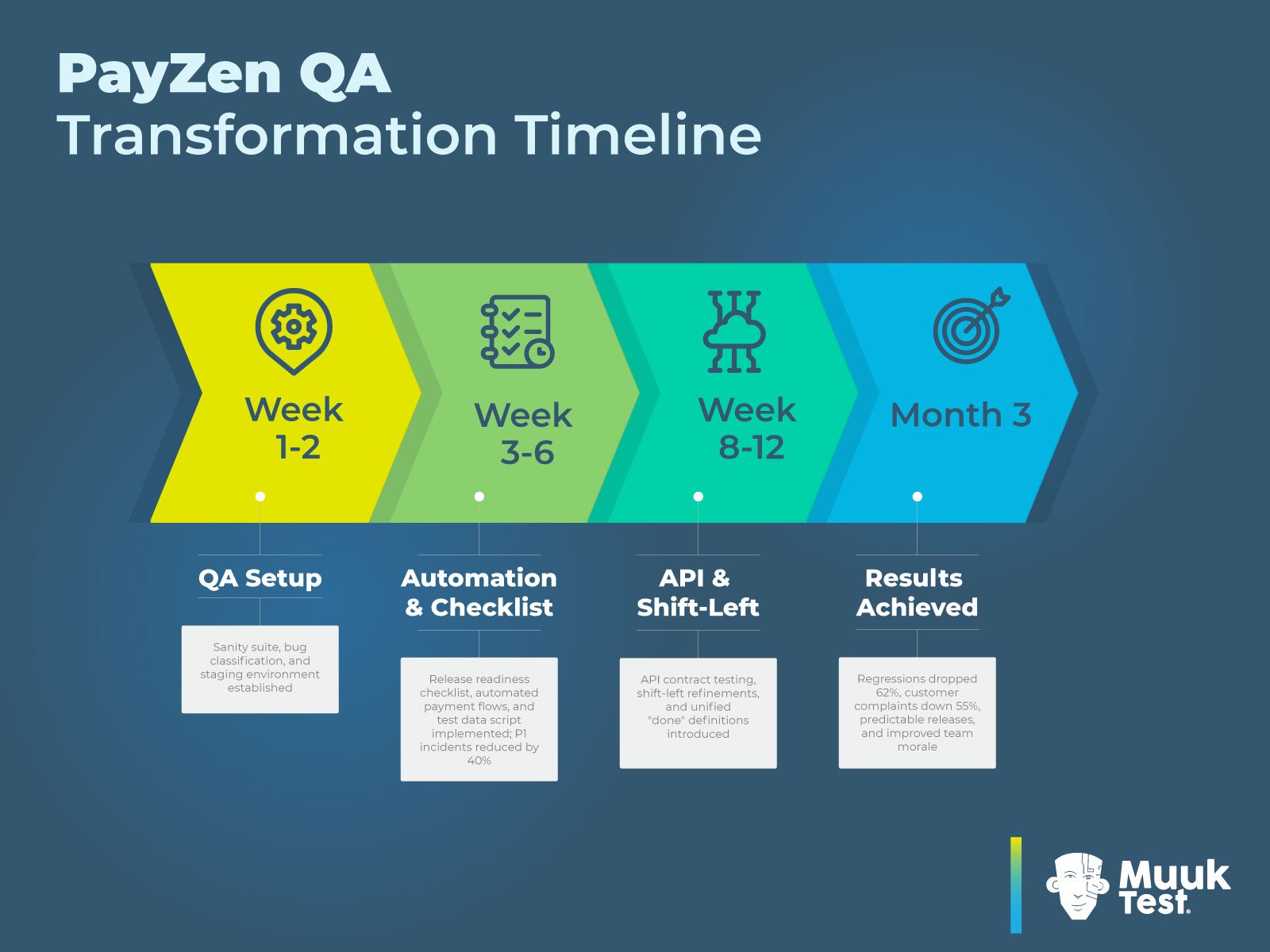
When QA joined, they were drowning in 300+ open bugs, a crashing payment gateway, and a demoralized developer team.
Here’s how QA brought order:
What Comes Next After Stability
When a QA process is finally established and starts working, the team is no longer drowning. Structure replaces chaos. Rhythm replaces firefighting. Confidence returns across the organization. Developers ship without fear and start enjoying releases again. Customers stop complaining. Deployments feel smooth - almost boring, in the best possible way.
But the best teams don’t stop at “stable.” The bigger question is what comes next: Can quality drive growth?
The strongest companies don’t use QA only to prevent failures. They use it to unlock innovation, move faster with confidence, and create lasting competitive advantage. And this is what lies in the heart of the next and final part of this series.
👉 Next: Quality as a Growth Engine - Beyond Bug Prevention

Frequently Asked Questions
When should a software team bring in QA?
Teams typically bring in QA after repeated production issues, unstable releases, or customer trust erosion. The best time to introduce QA is earlier, but the second-best time is when firefighting and uncertainty start slowing development.
What is the first thing QA should focus on in a chaotic environment?
The first priority for QA is visibility. Before fixing bugs, QA must understand where failures occur, which user journeys are most at risk, and how releases currently work. Stability starts with clarity.
How does QA restore confidence in software releases?
QA restores confidence by introducing predictable rhythms such as daily sanity checks, risk-based regression testing, and clear release readiness criteria. These practices reduce surprises and make releases feel routine instead of risky.
Does adding QA slow down development teams?
No. While QA may introduce structure, it ultimately speeds teams up by reducing rework, firefighting, and last-minute rollbacks. Stable teams ship faster because they trust their process.
When should automation be introduced during QA stabilization?
Automation should come after basic stability is achieved. Teams that automate too early often amplify chaos. Successful teams start with manual sanity checks, then layer automation gradually as workflows and environments stabilize.
How does QA impact engineering culture over time?
QA shifts culture from blame to learning. When quality becomes a shared responsibility, developers trust their pipelines, product managers trust timelines, and leadership trusts delivery. This cultural shift is critical to long-term stability.