

Test coverage grows when it's planned as a roadmap milestone, not when it's treated as a side task QA squeezes in between releases. The most reliable way to scale quality alongside product growth is to attach specific, measurable coverage targets to each roadmap phase, from MVP through GA, so that testing capacity expands in step with feature complexity rather than lagging behind it. Teams that do this avoid the common trap where automation becomes an afterthought bolted onto a sprint review, and instead treat a test automation roadmap as a parallel track to the product roadmap itself.
TL;DR
- Coverage milestones should be tied to roadmap phases (MVP, growth, scale, maturity), not tracked as a separate, disconnected QA initiative.
- Industry benchmarks for test coverage vary by sector; reported automation coverage levels differ meaningfully between industries such as finance and insurance versus retail, and most teams treat 80-85% as a strong general target for critical paths.
- A qa automation roadmap needs its own metrics (coverage percentage, flakiness rate, execution time, defect escape rate) reported alongside product KPIs.
- AI-assisted development has sped up code output, with 84% of developers using or planning to use AI coding tools, which makes an unplanned testing gap far more likely unless coverage milestones scale in parallel.
- Services like MuukTest can compress the time it takes to reach meaningful coverage, which matters most at the specific roadmap inflection points where manual test maintenance would otherwise become a bottleneck.
About the Author: This article is informed by MuukTest's work building and maintaining automated test suites for scaleups and engineering teams across SaaS, fintech, and B2B software, where the company has repeatedly mapped coverage milestones to product launch phases as part of its managed QA engagements.
What Does It Mean to Map Test Coverage to a Product Roadmap?
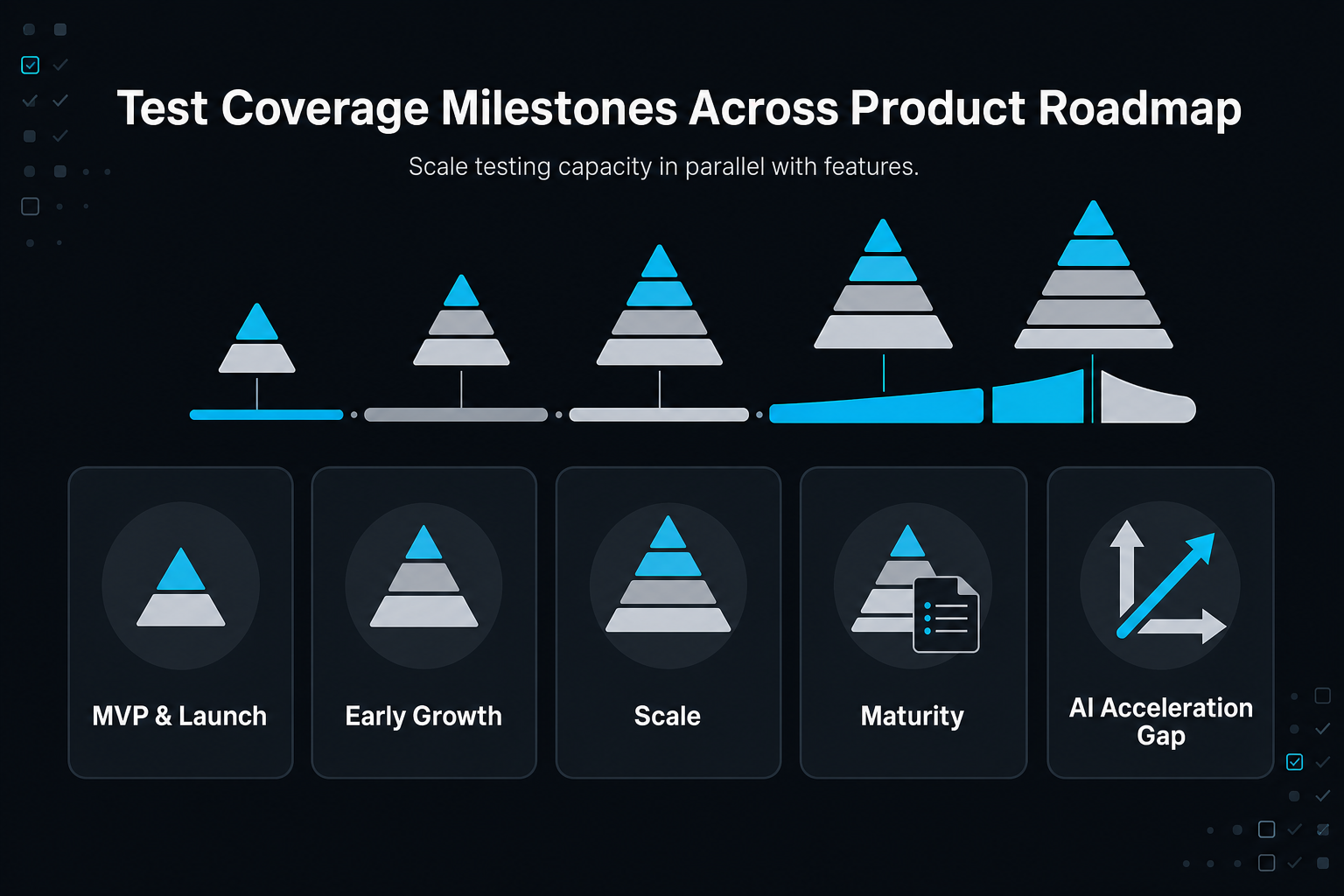
Mapping test coverage to a product roadmap means assigning a specific coverage target and test type to each roadmap phase, instead of setting one static coverage goal for the entire product lifecycle. A roadmap typically moves through stages such as MVP, early growth, scale, and maturity [larksuite.com]; each of those stages carries a different risk profile, and the testing strategy should shift with it.
Think of it like building codes for a house under construction. You don't inspect the electrical wiring the same way at the foundation stage as you do at final occupancy; the inspection criteria tighten as the structure becomes more complex and more people depend on it being safe. The same logic applies to software: a pre-launch MVP needs smoke tests and core-path coverage, while a scaled product serving thousands of users needs deep regression coverage across every critical workflow, running on every change.
This is the core function of a test automation roadmap: it turns an abstract quality goal ("we should have good test coverage") into a sequenced set of milestones tied to what the product actually needs at each stage of growth.
Which Coverage Metrics Actually Belong on a Roadmap?
Coverage metrics belong on a roadmap when they're specific enough to track progress and tied to a business outcome, not just a percentage for its own sake. Product roadmap metrics typically track adoption, velocity, and stakeholder alignment [productplan.com]; test coverage metrics should sit alongside those as a parallel signal of release readiness.
- Coverage percentage: The share of code paths or user flows exercised by automated tests. Industry benchmarks for test coverage vary meaningfully by sector, with industries such as finance and insurance reporting higher rates of increased automation adoption than sectors like retail, and most teams expand coverage of critical functionality over time rather than targeting one fixed percentage.
- Flakiness rate: The percentage of tests that fail intermittently without a real underlying bug. A rising flakiness rate is often the first sign that a test suite is being outpaced by product complexity.
- Execution time: How long the full suite takes to run. This matters directly for release cadence; teams that implement parallel execution and stable infrastructure can cut suite run time from hours to minutes, which keeps testing from gating releases.
- Defect escape rate: How many bugs reach production despite passing tests. This is the clearest downstream measure of whether coverage milestones are actually protecting the roadmap.
These test coverage metrics should appear on the same dashboard engineering leadership uses to review roadmap progress, not buried in a QA-only report that nobody outside the team reads.
How Should Coverage Milestones Change as You Scale?
Coverage milestones should expand in scope and depth at each roadmap phase, because the cost of a missed bug rises as the user base and feature surface grow. An early product with a few hundred users can tolerate a narrower smoke-test suite; a product running business-critical workflows for thousands of customers cannot.
| Roadmap Phase | Primary Coverage Focus | Typical Test Types |
|---|---|---|
| MVP / Pre-launch | Core user flows, critical paths | Smoke, functional, basic API testing |
| Early growth | Regression safety as features ship fast | Regression, end-to-end, integration testing |
| Scale | Regression depth as the feature surface grows | Full end-to-end regression on every PR, cross-browser |
| Maturity | Long-term stability and release confidence | Full regression suites with defect-escape tracking, automated accessibility checks within regression |
A related but distinct question is what happens when the roadmap moves faster than the team can build these milestones out manually. That gap is exactly where a documented qa automation roadmap, planned a phase ahead rather than reactively, prevents the team from scrambling.
Why Does AI-Accelerated Development Make This Roadmap Harder to Keep Up With?
AI-accelerated development makes coverage planning harder because code output has increased faster than most teams' testing capacity has. In the Stack Overflow 2025 Developer Survey [stackoverflow.blog], 84% of developers said they use or plan to use AI coding tools, and 51% of professional developers use them daily. GitHub Copilot has passed 20 million users [techcrunch.com]. Productivity gains from AI coding tools vary widely, from modest cycle time improvements to substantial gains for specific task types, depending on team maturity and application complexity.
Building on the acceleration above, the harder question is what happens to QA when code ships faster but test suites don't scale with it. When development velocity outpaces test automation, bottlenecks in testing capacity can delay releases and compress competitive windows. Manual testing compounds this risk: test cases require ongoing maintenance as the application evolves, and gaps in automation coverage raise the likelihood of bugs reaching production, while comprehensive automated approaches have been shown to improve delivery velocity and reduce field defects.
This is precisely the scenario where a managed approach to test automation earns its keep. Services like MuukTest build and maintain Playwright-based automation frameworks designed to keep coverage moving in step with AI-accelerated commits, rather than letting the test suite become the thing slowing releases down.
What Tooling Choices Affect How Fast You Can Hit Coverage Milestones?
Tooling choice affects milestone velocity because each framework carries a different maintenance cost as test suites grow. Playwright offers advanced web emulation, auto-waiting, and built-in parallel execution, though managing runners and infrastructure can still be a moderate maintenance burden; by comparison, other test orchestration platforms reduce infrastructure maintenance overhead compared to manual Selenium Grid setups. Selenium remains the standard for legacy systems and broad cross-browser coverage, but it carries higher maintenance overhead due to its reliance on explicit waits. Appium remains the practical standard for native mobile automation.
Tooling alone rarely gets a team to its coverage milestones. It generally can't: even a well-chosen framework like Playwright still needs scripts written, maintained, and triaged as the application changes, which is why many scaling teams pair the tooling decision with expert-managed execution rather than treating the framework purchase as the finish line. This is where AI-assisted maintenance matters: at MuukTest, Forward Deployed QAs decide what to cover, while Amikoo, MuukLabs' AI testing tool, generates and repairs tests as the application changes, reducing the maintenance tax that normally slows coverage growth.
For teams mapping out their own roadmap sequencing in more detail, MuukTest's resources on structuring a QA automation roadmap walk through how to sequence these tooling and milestone decisions phase by phase.
How Does Test Coverage Tie Into Compliance as the Roadmap Matures?
Test coverage becomes a compliance requirement, not just a quality preference, once a product reaches the maturity stage of its roadmap. Frameworks like SOC 2 and ISO/IEC 27001 require documented evidence of secure development practices, including test coverage reports, CI pipeline results, and vulnerability management controls. Accessibility standards such as WCAG and ADA, along with FDA regulations in regulated industries, require specific documentation that traces requirements directly to test coverage, proving the software does what it claims to do.
Stepping back from the technical detail, this means a mature-stage coverage milestone isn't just "more tests." It's tests that produce an audit trail, which is a materially different deliverable than a developer's local test run, and one that needs to be planned for well before an audit deadline forces the issue.
Frequently Asked Questions
What's the difference between a product roadmap and a test automation roadmap?
A product roadmap sequences features and business goals over time, while a test automation roadmap sequences coverage milestones, tooling decisions, and QA capacity needed to support those features safely. The two should be built and reviewed together, not in isolation.
What test coverage percentage should a scaling startup aim for?
There's no universal number. Start with full automated coverage of your critical user flows, then expand based on where defects actually escape.
How often should coverage milestones be reviewed?
Coverage milestones should be reviewed at the same cadence as roadmap planning, typically each quarter or at major release boundaries, so testing scope is adjusted before new features ship rather than after a defect surfaces.
Does more AI-generated code mean I need more QA?
It means you need testing capacity that scales as fast as your commit velocity. The code volume problem is real: AI tools have measurably increased developer output, and without a parallel coverage plan, that extra code simply ships with less scrutiny.
Can test automation fully replace manual QA on a growing product?
No single approach covers everything; automation handles repetitive regression and functional checks efficiently, while exploratory and nuanced usability testing still benefit from expert human judgment layered on top of an automated suite.
What happens if coverage milestones fall behind the product roadmap?
Teams typically see rising defect escape rates, slower releases due to manual verification, and, at the compliance stage, documentation gaps that can delay audits or certifications.
How quickly can a team realistically build meaningful coverage?
It depends on application complexity and existing test debt, but managed services focused specifically on rapid framework buildout, such as MuukTest, are designed to compress this timeline to weeks rather than months by combining automation with dedicated QA engineers.
About MuukTest
MuukTest is a managed QA service that builds and maintains automated test suites for lean engineering teams. The company builds frameworks on industry-standard tools like Playwright, Selenium, and Appium, and clients fully own the resulting automation framework. This approach lets teams reach broad test coverage in weeks while avoiding the exit costs that come with proprietary testing platforms. MuukTest works as a managed QA partnership that extends lean engineering teams, covering web, mobile, API, regression, and end-to-end testing without requiring additional hires. Behind the service are expert Forward Deployed QAs, who decide what to cover, which workflows matter, and where the real risk is, working with Amikoo, MuukLabs' AI tool for test generation, repair, maintenance, and defect detection.
If your team is planning the next phase of your roadmap and needs coverage milestones that keep up with it, learn more about how MuukTest builds and maintains test automation at scale.
References
- Master Your Product Management Roadmap: A Strategic Guide (larksuite.com)
- Benefits of Roadmap Metrics | ProductPlan (productplan.com)
