-
Quality doesn’t slow teams down; it enables faster delivery. High-performing software teams ship more frequently because they trust their quality systems, not in spite of them.
-
Mature QA evolves into Quality Engineering. At scale, QA shifts from bug detection to predictability, automation, risk intelligence, and continuous improvement across the delivery lifecycle.
-
Data-driven QA unlocks smarter decisions. Risk heatmaps, release confidence scores, and predictive defect modeling help teams prevent failures before customers ever feel them.
-
DevOps and QA form a closed-loop feedback system. Continuous testing, monitoring, and learning shorten feedback cycles, making every release safer and more reliable.
-
When quality becomes culture, growth follows. Teams that treat quality as identity reduce churn, ship faster, and turn trust into a lasting competitive advantage.
This post is part of a 4-part series, From Speed to Trust: The QA Maturity Journey for Scaling Software Teams.
- The Dev-Only Startup Dream: Why Skipping QA Breaks Software Teams
- When Customers Become Testers: The Real Cost of Missing QA
- From Chaos to Control: How QA Stabilizes Software Teams
- Quality as a Growth Engine: Beyond Bug Prevention ← You're here

From Stability to Acceleration: When QA Stops Being Defensive
By the time most companies stabilize after introducing structured QA, something subtle but profound begins to happen.
- The team breathes easier
- Deployments feel routine instead of risky
- Support queues shrink
- Developers stop fearing merge requests
- Product managers stop whispering silent prayers during releases
But this is not the end of the story. It’s the beginning of a new one: the transformation from quality as defense to quality as acceleration.
QA doesn't just prevent disasters; it becomes the engine that propels the company forward.
From Bug Fixing to Flow Enablement
When we look back, first, the organization believed QA would slow them down.
Then, they realized the cost of not having QA.
After that, they experienced the stabilizing power of a foundational QA system.
Now, QA becomes the force multiplier for innovation.
The surprising truth, as strongly supported by data in the Accelerate research from DORA, is that high-performing teams ship faster because their quality is high, not in spite of it. Quality reduces fear, and that accelerates delivery.
At this stage, the company transitions from tactical QA to Quality Engineering (QE), where the focus is on predictability, automation, intelligence, and continuous improvement.
The New Reality: Speed + Stability = Trust
With automation covering essential flows, regression cycles shrinking, and structured testing in place, teams begin shipping with confidence.
The release cycle looks radically different:
| Before QA Transformation | After QA Transformation |
|
Releases unpredictable |
Releases predictable |
|
Hotfixes every week |
Hotfix rare |
|
Developers stretched thin |
Automation supports developers |
|
High customer complaints |
Customers trust updates |
|
Frequent firefighting |
Engineers focus on innovation |
Case Study: How PayZen Turned Quality Into Growth
Let’s revisit PayZen, our recurring fintech example.
After stabilizing with QA, they began exploring new opportunities:
- Partnerships with banks
- Third-party integrations
- Cross-border payments
- Predictive analytics
All of these required high reliability.
Here’s what QA did for them in the maturation phase:
1. Introduced Predictive Quality Analytics
Using tooling similar to GitPrime/LinearB analytics, they correlated:
- Commit frequency
- Module complexity
- Bug density
- Release outcomes
The system began predicting which modules had the highest risk before they shipped.
This is the promise of Quality Intelligence.
2. Implemented User Journey Monitoring
Instead of waiting for customers to complain, they built:
- Synthetic monitoring scripts
- Continuous API health checks
- Real-user behavior dashboards
- Error budgets for key flows
This made regression detection practically real-time.
3. Automated Partner Certification
Banks have rigid API certification processes. PayZen’s QA built automated certification tests that validated every requirement before external audits. Integration cycles dropped from months to weeks.
4. Expanded End-to-End Automation to Mobile, Browser, API, and Data Layers
Automation became orchestrated, not scattered. Pipeline failures now meant something useful: fix before customers feel it.
Within 6 months of reaching QA maturity, PayZen’s deployment frequency increased 4× while defects dropped 70 %. They didn’t just improve stability. They accelerated growth.
The Cultural Dividend of QA Maturity
One of the hallmarks of a mature QA function is cultural alignment, not just clean dashboards.
When Teams Trust the System, They Move Faster
Developers trust their builds, their pipelines, their tests, and their releases.
Product managers trust the timelines, scope predictions, and risk assessments.
Leadership trusts the system, the data, and the people.
With trust comes speed.
With speed comes innovation.
And with innovation comes market leadership.
QA as a Strategic Business Partner
At this stage, QA leaders are no longer testing specialists. They become strategists.
They speak the language of:
- Risk modeling
- Release economics
- Customer experience
- Operational performance
- Observability
- Predictive engineering
In high-performing organizations, QA sits in product roadmap meetings with equal weight as engineering and product.
A VP of Engineering once told me, “Our QA head is our risk radar. She tells us where the storms are before we feel the wind.” That is the essence of mature QA.
How QA Turns Data Into Decisions
By this point, the company has years of:
- Defect data
- Test results
- User behavior patterns
- Performance metrics
QA converts this into actionable intelligence:
- Risk Heatmaps - Showing which modules require more investment.
- Release Confidence Scores - Automatically generated before deployment.
- Quality OKRs - Aligned with business outcomes.
- Predictive Defect Modeling - Identifying likely break points before they fail.
This is not futuristic. This is what Netflix, Airbnb, Shopify, and Uber already practice.
DevOps + QA: A Seamless Feedback System
In the mature stage, QA and DevOps are inseparable. They collaborate to ensure:
- Continuous testing
- Continuous deployment
- Continuous monitoring
- Continuous feedback
This creates a Closed-Loop Quality System:
Code → Test → Deploy → Observe → Learn → Improve → Code
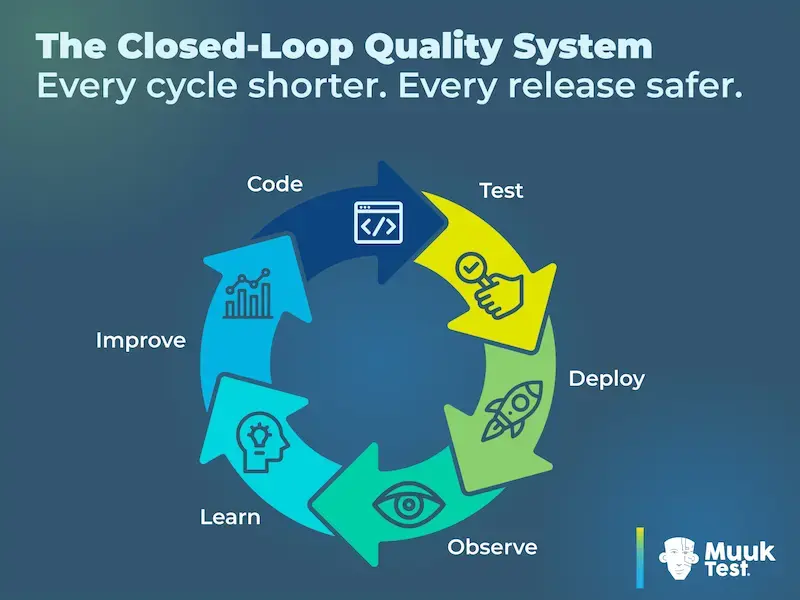
Every cycle gets shorter, release gets safer, and every failure gets rarer.
When Quality Drives Measurable Business Outcomes
At this stage, QA doesn’t just improve software. It improves business metrics.
Examples I’ve measured across organizations:
- Customer churn decreased by 25 %
- Support tickets dropped by 40–60 %
- Release frequency increased by 3×
- On-call escalations reduced by 70 %
- Developer satisfaction increased dramatically
These outcomes matter to CEOs and boards. They directly impact revenue, brand, and market valuation. When QA becomes a growth engine, quality is not just good engineering — it’s good business.
The Final Evolution: Quality as Identity
In the end, the greatest achievement of QA maturity is cultural: Quality becomes who the company is. It becomes the company’s identity.
- Developers write code that is testable.
- PMs write stories that are clear.
- Designers build journeys that are robust.
- Leaders prioritize sustainability over shortcuts.
- Customers trust updates without hesitation.
When teams start saying things like: “We don’t release unless we believe in it.” That’s when quality becomes culture. And culture is the only competitive advantage no one can copy.
Closing Reflection: From Chaos to Market Leadership
Let’s zoom out:
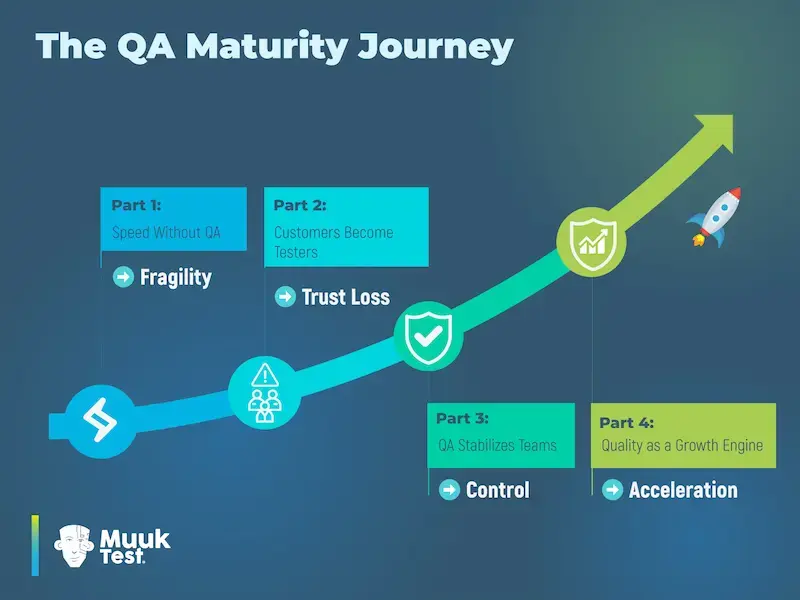
- Part 1: The company chased speed and skipped QA. It looked efficient, but planted seeds of chaos.
- Part 2: Customers became QA. Issues exploded. Trust collapsed.
- Part 3: QA arrived, stabilized processes, rebuilt rhythm, and restored confidence.
- Part 4: Quality transformed into capability. Capability transformed into acceleration. Acceleration transformed into leadership.
This is not a hypothetical journey. It’s a predictable one.
It is repeated across startups, scale-ups, fintechs, IoT companies, and enterprise platforms. Different products, different markets - same inflection points. Teams don’t fail because they move too fast. They struggle because they move fast without feedback.
The lesson is universal:
Quality doesn’t slow you down.
Quality gives you the power to go faster—safely, sustainably, and confidently.
A mature QA function does more than prevent defects. It creates clarity. It turns uncertainty into insight. It gives engineering leaders the confidence to ship, product teams the confidence to plan, and customers the confidence to trust.
That is the real legacy of QA maturity.
Not fewer bugs.
Not more tests.
But the ability to grow without breaking what matters.
If you’re ready to move beyond firefighting and turn quality into a true growth engine, MuukTest helps teams build thoughtful, scalable QA that keeps pace with development.
👉 Book a demo and see how quality engineering works in practice.

Frequently Asked Questions
How does QA become a growth engine instead of a cost center?
QA becomes a growth engine when it moves beyond bug detection and enables predictable delivery, faster innovation, and lower risk. Mature QA focuses on quality engineering, automation, observability, and data-driven decision-making, allowing teams to ship faster with confidence while reducing failures and rework.
What is the difference between QA and QE (Quality Engineering)?
Traditional QA focuses on finding defects after code is written. Quality Engineering (QE) focuses on preventing defects by embedding quality across the entire software lifecycle, including design, development, testing, deployment, and monitoring. QE emphasizes predictability, automation, and continuous improvement.
Can high-quality software teams really move faster?
Yes. Research from Accelerate shows that high-performing teams achieve both speed and stability simultaneously. Strong quality systems reduce fear, firefighting, and rework, enabling teams to deploy more frequently and focus on innovation instead of recovery.
How do DevOps and QA work together in mature organizations?
In mature organizations, DevOps and QA form a closed-loop feedback system. QA contributes continuous testing, monitoring, and quality signals, while DevOps enables fast deployment and observability. Together, they create shorter feedback loops that make releases safer and failures rarer.
What business metrics improve when QA maturity increases?
Organizations with mature QA practices often see measurable improvements such as reduced customer churn, fewer support tickets, higher release frequency, lower on-call incidents, and increased developer satisfaction. These outcomes directly impact revenue, brand trust, and company valuation.
What does it mean when quality becomes part of company culture?
When quality becomes culture, teams design, build, and ship software with trust and sustainability in mind. Developers write testable code, product managers define clear acceptance criteria, leaders prioritize long-term stability, and customers trust updates without hesitation. Quality becomes identity, not a checklist.